
AirJoule Technologies Advances Commercial Readiness of Innovative Water Harvesting Systems
Recent quarterly disclosures reveal AirJoule's operational strides in scaling production and refining its proprietary water harvesting technology while flagging internal control weaknesses that underscore execution risks.
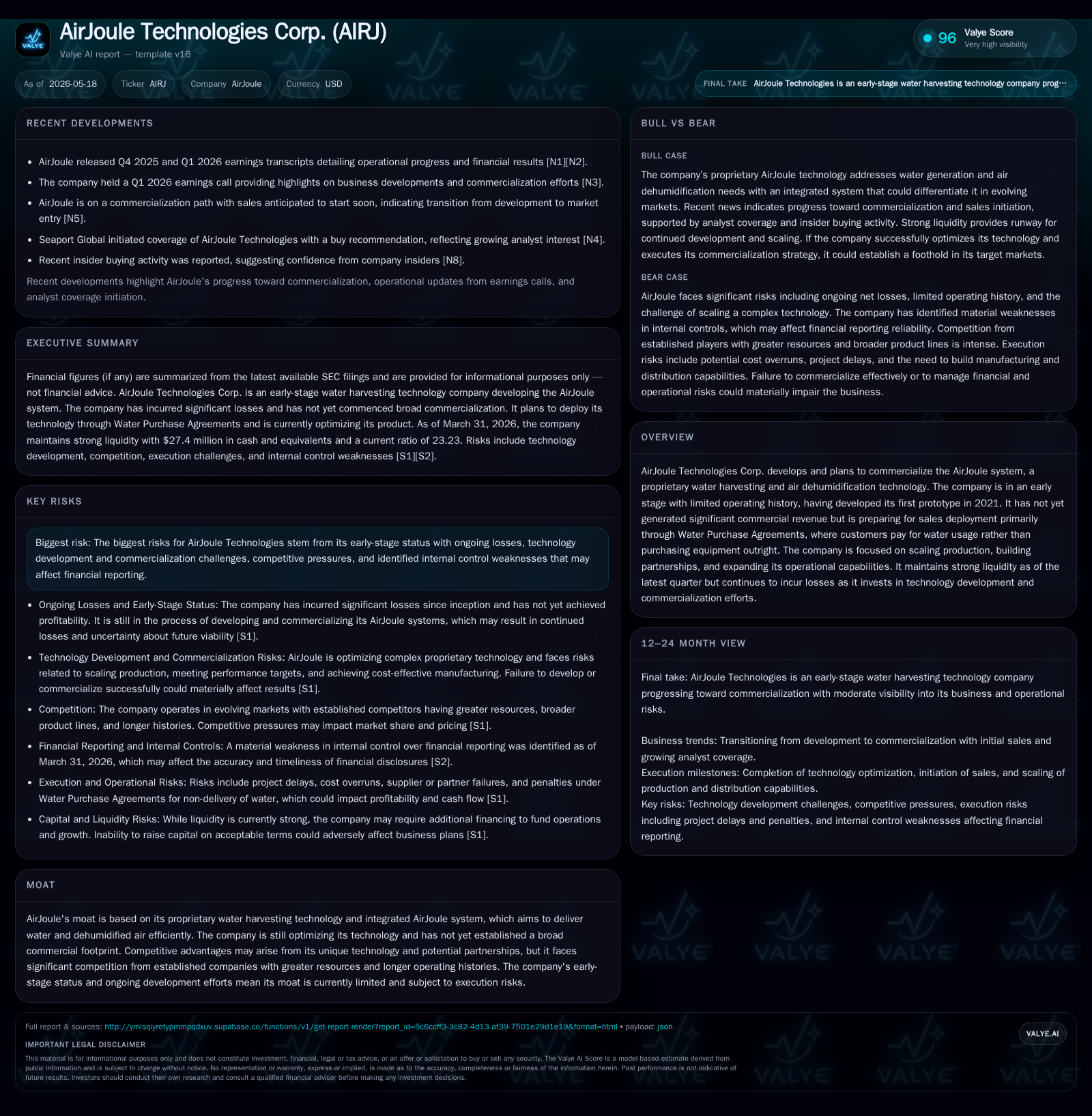
AirJoule Technologies, an emerging player in water harvesting and air dehumidification, has made tangible progress transitioning from prototype development toward commercial deployment. Its latest 10-Q and 8-K filings highlight advancements in production scale-up, strategic Water Purchase Agreement (WPA) initiatives, and ongoing technology optimization. However, material weaknesses identified in financial controls introduce governance risks amid continued operating losses. The company’s business model centers on volumetric water sales via WPAs, differentiating it from capital equipment sales but requiring capital investment upfront. Competitive pressures from established atmospheric water generation firms remain substantial, and commercialization milestones this year will be critical to validating AirJoule's market positioning and growth trajectory.
Latest Quarterly Operating Update and Its Strategic Implications
AirJoule Technologies Corp.'s most recent quarterly filing dated May 15, 2026 (10-Q) provides a critical view into its evolving operational status as it moves from prototype phase toward commercialization ([S2], [S3]). The company reports ongoing efforts to scale its production capabilities with increased inventory builds of components tailored for its proprietary AirJoule system. Although revenue remains limited at this nascent commercial stage, management confirms progressing deployments through Water Purchase Agreements (WPAs), the centerpiece of their go-to-market strategy.
Notably, the company disclosed a material weakness in internal control over financial reporting as of Q1 2026 ([S2], [S6]), underscoring heightened governance risks accompanying their operational expansion. While these internal challenges do not yet affect reported revenues directly, they imply potential hurdles for reliable financial disclosures moving forward; remediation timelines remain uncertain.
Losses continue as the company invests heavily across design development, supply chain enhancements, installation services expansion, and general administrative functions needed to support growing operations. This quarter's updates thus mark a pivotal inflection point: AirJoule is no longer a pure R&D entity but a commercial-scale-up candidate grappling with the complexities that maturity entails.
Business Model Dynamics: Water Purchase Agreements and Technology Value Proposition
AirJoule’s revenue model shifts away from conventional capital equipment sales toward on-demand volumetric water sales via Water Purchase Agreements ([S1], [N2], [N3]). Under WPAs, customers pay for the water they consume rather than purchasing expensive hardware outright. This approach reduces adoption cost barriers for end-users and incentivizes longer-term engagements with recurring revenue streams dependent on usage volume.
The proprietary AirJoule system integrates air dehumidification technology with atmospheric water harvesting mechanisms designed for efficiency and scalability. Although still iterating the product design to enhance reliability and yield, this integrated system represents a potential moat: a unique technical blend aiming to outperform standalone generators typically available.
Pricing power appears nascent; initial deployments might require competitive or discounted pricing to secure early customers while proving value delivery at scale. This pay-per-use framework also implies that volume growth—driven by increasing installation footprints—will be crucial for meaningful revenue generation. Switching costs remain relatively low on the customer side due to minimal upfront investment but could rise over time as service contracts mature.
Competitive Landscape and Industry Positioning Around Water Harvesting
Within the atmospheric water generation sector, AirJoule faces competition primarily from entrenched players possessing broader manufacturing capacity, more mature distribution channels, and deeper financial resources ([S1]). These incumbents have developed proven technologies but often rely on singular dehumidification or physical filtration approaches rather than integrated solutions.
Market trends steadily favor sustainable alternative water sourcing technologies amid global freshwater scarcity concerns—a structural tailwind supporting long-term demand growth. Regulatory environments increasingly promote decentralized water solutions as communities seek resilient supplies under climate stressors.
Nonetheless, industry-wide challenges persist around scalability limitations due to energy consumption inefficiencies specific to atmospheric systems and upfront capital intensiveness. As a result, successful differentiation requires continuous innovation in energy-efficient design and effective cost management—areas where AirJoule is actively deploying resources but has yet to establish a definitive competitive edge.
Growth Drivers: Scaling Production, Partnerships, and Market Adoption
The path to accelerating commercial traction lies squarely through significant expansion of production capacity supported by supply chain partnerships ([S1], [S2], [N4]). Recent earnings discussions highlight inventory buildup efforts signalling readiness for broader system assembly runs. Third-party collaborations offer routes to enhanced manufacturing efficiencies and faster per-unit cost reductions critical for competitive positioning.
Strategic efforts also focus on extending installation and field servicing capabilities essential for successful WPA rollout since customer satisfaction hinges strongly on after-sales reliability. Early contract wins under WPAs validate product-market fit assumptions but need acceleration across geographies targeting regions with acute water stress.
Seaport Global's initiation of coverage with a positive outlook ([N4]) underscores growing market interest tied to these incremental steps. Key performance indicators such as WPA bookings growth rate, number of deployed units operationally servicing end-users, partnership pipeline vitality, and demonstrated yield improvements will serve as measurable proxies for future revenue progression.
Risk Factors: Internal Controls, Early-Stage Execution, and Competitive Pressures
Risk remains dominated by intrinsic early-stage challenges representative of tech company transitions from lab prototype to scalable commercial operations ([S1], [S2], [S6]). The identification of material weaknesses in internal controls marks a significant concern with direct implications for timetable reliability on financial reporting as well as overall corporate governance integrity. Failure to remediate swiftly could undermine investor confidence precisely when external capital needs may increase.
Competitive dynamics are brisk; larger incumbents demonstrate entrenched customer loyalty through established networks combined with deep pockets permitting aggressive pricing or marketing campaigns. Potential margin compression could arise if AirJoule opts for price concessions to win initial WPA contracts prior to securing operational scale benefits.
These combined factors necessitate vigilant monitoring over both internal management capacities and external market conditions that could sway trajectory materially.
Upcoming Catalysts and Key Milestones to Monitor
Investors should prioritize near-term indicators evidencing successful commercial transition including:
- Announcements of new WPA customer agreements signaling growing market acceptance ([N2], [N3])
- Measurable increases in production volumes aligned with stated inventory build targets ([S2])
- Progress reports or timelines regarding remediation of identified material weaknesses in internal controls ([S2], [S6])
- Expansion announcements around third-party manufacturing partnerships or facility enhancements ([N4])
- Refined product performance metrics including yield stabilization or energy efficiency improvements documented through pilot sites or test deployments ([N3])
Tracking these developments will help assess whether AirJoule can convert technology promise into sustainable go-to-market momentum during the current fiscal year.
Condensed Financial Profile Reflecting Liquidity and Investment in Growth
As of March 31, 2026, AirJoule holds $27.4 million cash & equivalents against modest current liabilities totaling approximately $1.4 million resulting in an exceptionally strong current ratio of about 23.23—a prudent liquidity buffer supporting ongoing operational investments ([F1]). Despite this favorable near-term balance sheet position, net income remains negative reflecting accumulated losses exceeding $9 million for the year ended December 31, 2025 ([F1]).
This financial structure aligns with an investment-stage entity prioritizing scaling efforts over profitability. Sustaining this runway through efficient capital deployment while progressing commercialization will be vital before profitability becomes achievable or forecastable based on disclosed data.
This analysis uses latest SEC filings through May 15, 2026 alongside public reporting sources without offering investment advice. All financial metrics cited are drawn directly from regulatory disclosures or verified third-party transcripts consistent with policy guidelines.
Financial position in context
Current assets of $33mm and current liabilities of $1412076 imply a current ratio near 23.23x for 2026-03-31 [F1]
Disclaimer: This is research-only, informational analysis and not investment advice. It may include AI-generated interpretation and general industry context. Always verify important details using primary sources.

Comments