
AirJoule Technologies: Commercialization Inflection, Capital Constraints, and the Stakes of Scaling a Novel Water Platform
AirJoule Technologies stands at a pivotal juncture as it seeks to commercialize its proprietary water harvesting system following the Prime system launch and a high-profile partnership with Kubota.
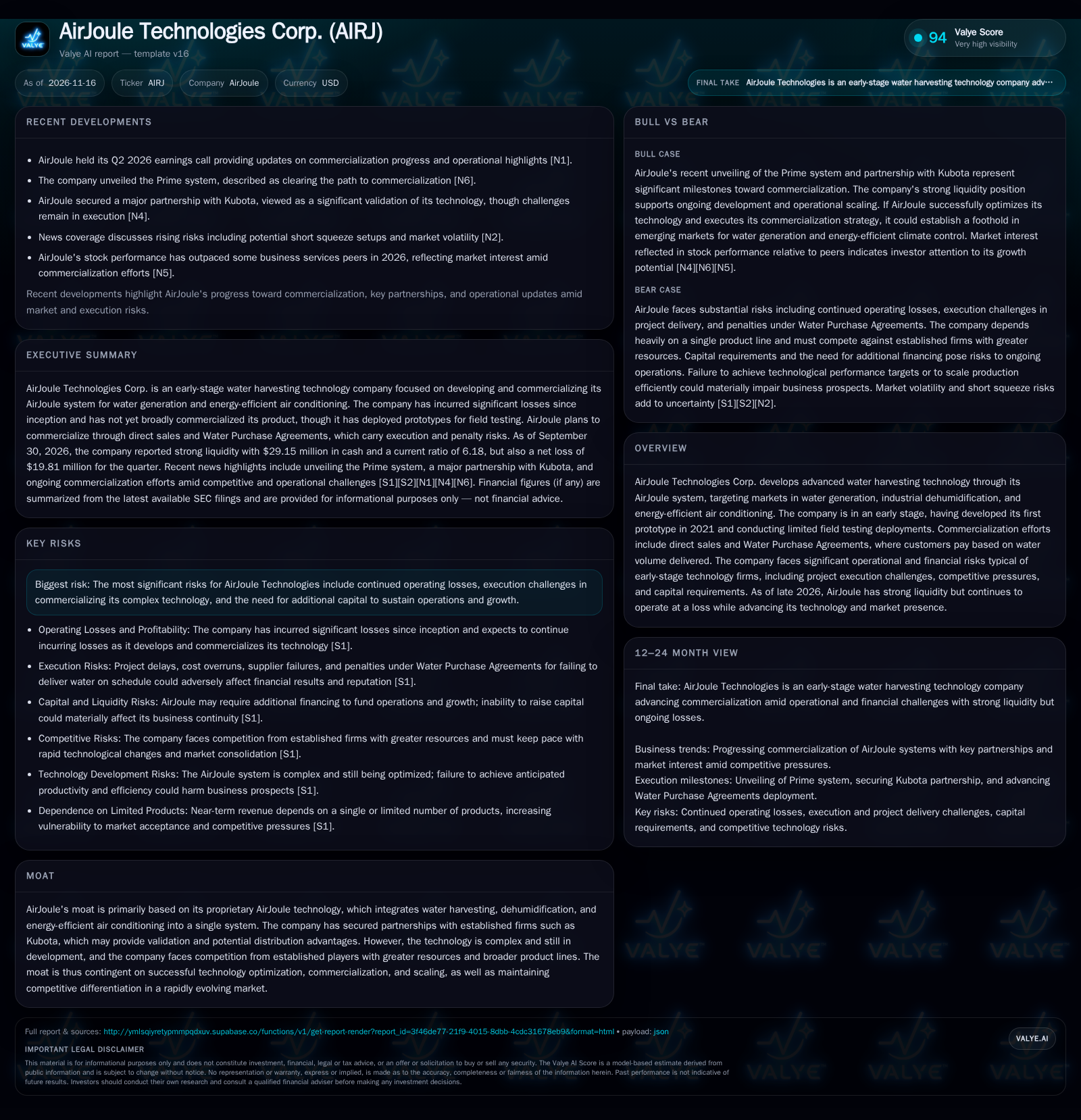
AirJoule Technologies is transitioning from prototype to commercial deployment of its AirJoule water harvesting systems, buoyed by the unveiling of the Prime system and a validation partnership with Kubota. Despite a reported cash position, the company continues to report significant losses and faces execution, capital, and competitive headwinds as it tries to establish a viable business in water generation and efficient climate control. The next 12-24 months will be defined by the company's ability to deliver on Water Purchase Agreements, scale operations, and secure additional financing if needed, amid a rapidly evolving competitive landscape. [S1] [S2] [N4] [N6]
AirJoule Technologies is attempting one of the most challenging transitions in industrial technology: scaling a novel, capital-intensive water harvesting platform from prototype to commercial reality. The 2026 unveiling of the Prime system and a landmark partnership with Kubota signal validation and momentum, but also heighten the stakes around execution, capital sufficiency, and market acceptance.
Prime System Launch and Kubota Partnership Set the Stage for Commercialization
AirJoule Technologies has made two notable advances in 2026: the introduction of the Prime system, which management describes as clearing the path to commercialization, and the formation of a significant partnership with Kubota, a major player in industrial equipment. These developments represent both technological and market validation, suggesting that AirJoule’s core platform is moving beyond the R&D phase and into early commercial adoption. The company reported cash and liquidity metrics for the period; these figures do not by themselves establish operating runway, investment capacity, financial flexibility, or financing capacity. AirJoule’s business model is not yet proven at commercial scale, and the company faces execution risks, especially as it enters Water Purchase Agreements (WPAs) that could trigger penalties if water delivery commitments are missed. [S1] [S2] [N4] [N6]
How AirJoule Could Monetize Atmospheric Water: Pricing, Volume, and Operating Leverage
AirJoule’s economic model is built around two primary channels: direct system sales and Water Purchase Agreements (WPAs), where customers pay based on the volume of water delivered. WPAs are attractive to customers seeking to avoid upfront capital expenditures, but they shift project execution and performance risks to AirJoule, making the company responsible for system uptime, maintenance, and water output. If system reliability is high and cost per liter is competitive, WPAs could deliver recurring revenue and attractive margins over time, but would require significant upfront capital and operational scale to deploy, monitor, and maintain multiple distributed units.
The cost structure is likely to be capital-intensive initially, with high R&D, manufacturing setup, and project management expenses. Fixed costs are substantial, but if AirJoule achieves scale and technological maturity, operating leverage could improve as more units are deployed and serviced on standardized platforms. Variable costs will depend on energy consumption, consumables, and field service, which may be partially offset by the company’s claims of energy-efficient operation. The mix between direct sales (lump-sum, hardware-like margin profile) and WPAs (recurring, but execution-risk weighted) will determine cash flow timing and margin variability. The company’s persistent losses reflect both heavy investment and the absence of scale revenue; achieving break-even will likely require successful execution on multiple, sizable WPA deployments or a robust pipeline of direct sales.
Validation and Vulnerability: AirJoule’s Place in a Crowded, Fast-Evolving Market
AirJoule’s partnership with Kubota provides important external validation, potentially opening doors to industrial, agricultural, or municipal channels. However, the water generation and climate control markets are highly competitive, with incumbents possessing deeper resources, established customer relationships, and proven manufacturing capabilities. AirJoule’s differentiation rests on the technical performance, energy efficiency, and reliability of its proprietary AirJoule system. If these advantages are real and sustainable, the company could carve out a niche, particularly in regions with acute water scarcity or high energy costs.
Counterforces are substantial: established HVAC and water technology firms can leverage scale, distribution, and integration with existing infrastructure; rapid technological change raises the risk of obsolescence or leapfrogging; and customers may be cautious about adopting unproven platforms with limited track records. The company’s dependence on a single product family increases vulnerability to competitive moves, pricing pressure, and technological setbacks. AirJoule’s ability to build a defensible moat will depend on continued technology optimization, execution on WPA contracts, and the cultivation of long-term customer relationships.
From Prototype to Platform: What Would a Breakout Look Like?
The most favorable scenario for AirJoule is one in which the Prime system performs reliably in early deployments, leading to successful fulfillment of WPA contracts and strong references from flagship customers such as Kubota. As the company demonstrates consistent water delivery, cost competitiveness, and operational uptime, it could unlock further WPA agreements and direct sales, creating a flywheel effect of adoption and revenue growth. This would also position AirJoule to negotiate better terms with suppliers, improve manufacturing efficiency, and realize operating leverage as fixed costs are spread over a growing installed base.
Evidence confirming this scenario would include rapid scaling of installed units, disclosure of multi-site WPA contracts with blue-chip customers, positive field performance data, and margin improvement in quarterly filings. Additional non-dilutive partnerships, supply agreements, or early profit milestones would further validate the model. Conversely, delays in WPA fulfillment, negative customer feedback, or persistent cost overruns would falsify the bullish scenario.
Commercialization Proceeds, but at a Measured Pace with Continuing Losses
The most probable outcome is that AirJoule gradually ramps up commercial activity, but faces intermittent execution challenges and slower-than-hoped revenue conversion. Early WPA deployments may encounter teething issues—such as reliability, maintenance, or water output variability—that require further engineering and customer support. Direct sales may be limited to pilot programs or niche applications while the company builds credibility. Cash burn continues, but is partially offset by milestone payments or modest recurring WPA revenue. The company may need to seek additional financing, either through equity, debt, or strategic partnerships, to bridge the gap to sustainable cash flow.
Confirmation of this scenario would come from incremental increases in deployed systems, steady (but not exponential) revenue growth, and continued but narrowing quarterly losses. Evidence against it would include either a sudden inflection in WPA signings and profitability (bullish) or repeated contract failures, customer attrition, and inability to secure new funding (bearish).
Execution Stumbles and Funding Gaps Threaten Business Continuity
In a negative scenario, AirJoule’s early deployments fall short of contractual obligations, triggering penalties under WPA agreements and damaging its reputation with key partners such as Kubota. Technical setbacks or supplier failures could delay installations, escalate costs, and erode customer confidence. As losses mount and cash reserves dwindle, the company may face difficulty raising additional capital—especially in a risk-off equity market or if operational milestones are missed. Competitive encroachment could further squeeze pricing or limit market access.
This scenario would be confirmed by missed WPA delivery deadlines, rising warranty or penalty expenses, material customer complaints, and disclosure of going-concern risks or financing shortfalls. A lack of new customer wins, layoffs, or asset sales would also indicate that AirJoule is struggling to sustain its business.
Milestones and Metrics That Will Test AirJoule’s Commercialization Thesis
The number and scale of WPA contracts signed, and the volume of water delivered versus commitments, if disclosed, will directly reveal commercial traction and operational reliability.
Gross margin trends as reported in quarterly filings would help assess progress on unit economics and operating leverage as deployments scale.
Customer concentration and retention statistics, if disclosed, would indicate whether AirJoule is diversifying its revenue base or remains vulnerable to a handful of anchor customers.
Rate of cash burn and timing of additional financing events will determine whether current liquidity is sufficient to bridge to sustained revenue.
Disclosure of system uptime, maintenance costs, and field performance data would provide insight into the real-world reliability and cost structure of the AirJoule platform.
Any updates on supplier contracts, manufacturing capacity, or cost reductions would signal progress toward scalable and cost-competitive production.
Evidence of competitive pricing, customer adoption by major industry players (beyond Kubota), or market share gains would validate claims of differentiation.
Material changes in the regulatory or subsidy environment for water or climate technology could either accelerate or impede adoption, depending on direction.
Disclaimer: This is research-only, informational analysis and not investment advice. It may include AI-generated interpretation and general industry context. Always verify important details using primary sources.

Comments