
Aerkomm Inc.: Information Gaps Cloud Strategic Outlook
The absence of public disclosure on its business model or sector leaves investors without visibility into core operations, potential revenue drivers, or paths to stabilization.
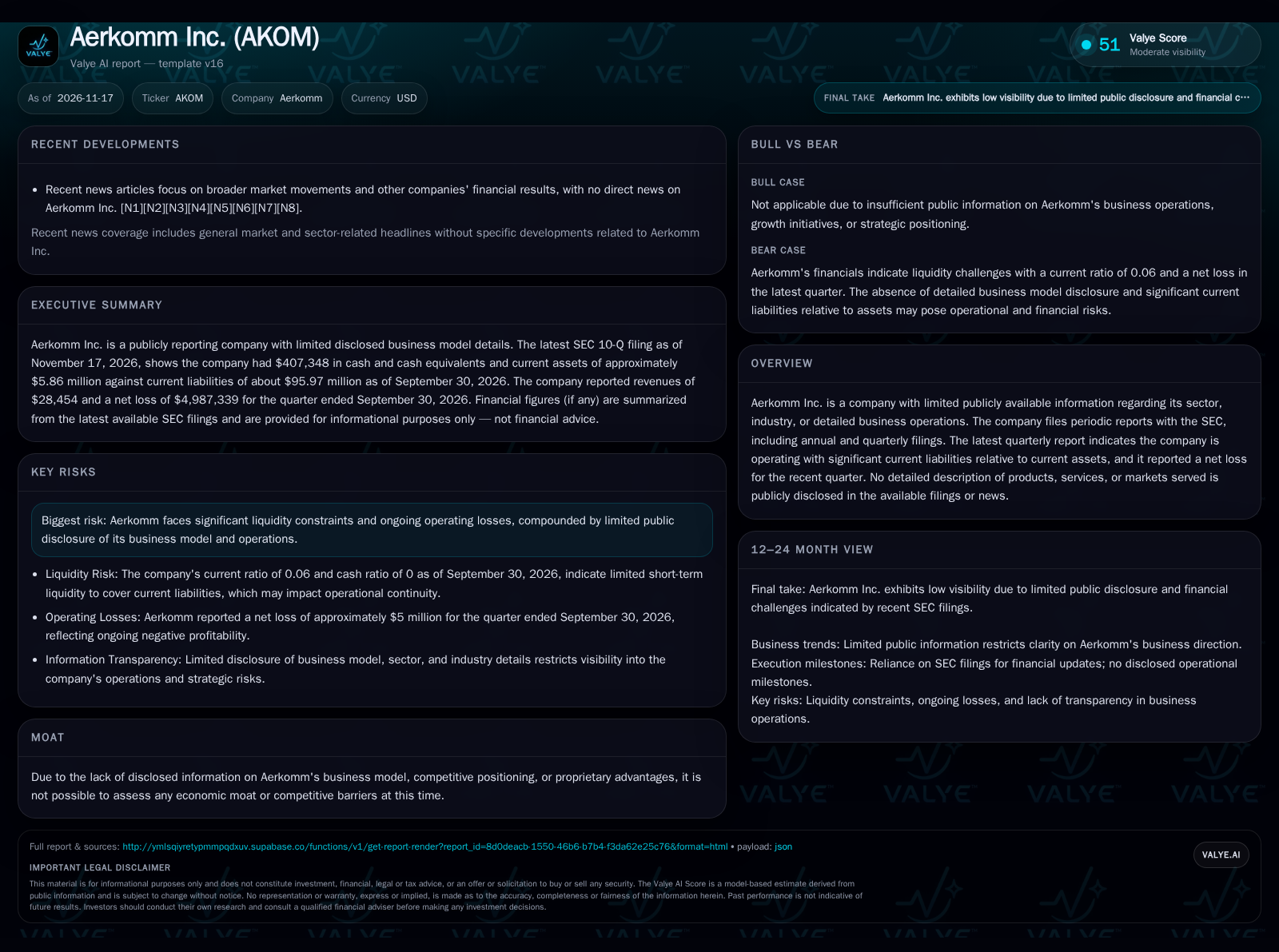
Aerkomm Inc. reports a negligible cash balance and an overwhelming current liability load, with only $28,454 in quarterly revenue against a $5 million net loss. The company’s operations, industry, and commercial strategy are undisclosed, creating profound uncertainty about its future viability and economic model. Immediate liquidity concerns and a lack of transparency dominate the investment thesis.
Aerkomm Inc. stands out not for its business prospects, but for the stark opacity and acute financial distress signaled in its latest SEC filings. With nearly $96 million in current liabilities and less than half a million dollars in cash, Aerkomm’s short-term liquidity is essentially exhausted. The company’s quarterly revenue covers only a tiny fraction of its operating losses, and with no public disclosure of its industry, products, or customer base, stakeholders are left with little basis for assessing its underlying economics or strategic options. In this environment, the central questions revolve around immediate solvency and whether any path to operational viability exists.
Liquidity Strains and Limited Transparency Shape Current Conditions
Aerkomm Inc.’s most recent quarterly report reveals a cash balance of $407,348 and current assets totaling approximately $5.86 million, dwarfed by current liabilities of about $95.97 million, yielding a current ratio of just 0.06 and a cash ratio of 0 [S2]. This financial posture signals a severe liquidity crunch, with obligations vastly exceeding liquid resources. Revenue for the quarter ended September 30, 2026 was only $28,454, while the net loss approached $5 million [S2]. Compounding these challenges, the company has not publicly disclosed its sector, business model, or operational details, leaving critical gaps in stakeholder understanding and precluding any standard assessment of business mechanics or market context [S1] [S2].
Revenue Uncertainty and Persistent Losses Raise Economic Viability Concerns
With only $28,454 in quarterly revenue against nearly $5 million in net losses, Aerkomm’s commercial engine appears either non-existent or extremely underdeveloped [S2]. The absence of any public description of its products, services, customers, or end markets means the company’s revenue model—whether transactional, subscription-based, hardware-centric, or otherwise—remains entirely speculative. Fixed costs are presumably high relative to negligible revenue, driving persistent negative operating leverage. The magnitude of current liabilities relative to assets suggests the company may rely on deferred payments, short-term borrowing, or accrued expenses to fund ongoing operations, but with no evidence of meaningful incoming cash flows or asset monetization. Without disclosure of capital expenditure needs, working capital requirements, or funding sources, it is not possible to assess how, or if, Aerkomm could bridge its liquidity gap or achieve scale economies.
Without clarity on Aerkomm’s revenue streams, it is difficult to assess the scalability or sustainability of its business model. If the revenue is transactional and tied to irregular contracts, volatility and unpredictability could exacerbate cash flow challenges. Conversely, if revenues are subscription-based or recurring, the low reported figures might suggest early-stage customer acquisition difficulties or high churn rates. Additionally, the lack of information on gross margins obscures whether the company’s cost structure is inherently unprofitable or if losses stem primarily from fixed overheads. Understanding the contribution margin would help determine the potential for operational leverage and the degree to which cost reductions could translate into profitability.
Competitive Position Remains Unclear Without Business Model Transparency
Aerkomm’s lack of disclosure on its sector, product portfolio, or target market makes any assessment of competitive positioning, differentiation, or industry structure infeasible. Without knowing whether the company operates in telecommunications, technology, industrials, or another space, it is not possible to benchmark against relevant peers, identify potential substitutes, or evaluate switching costs, barriers to entry, or customer stickiness. If Aerkomm is engaged in a capital-intensive or regulated industry, the combination of high fixed costs and liquidity pressure would typically confer disadvantage relative to better-capitalized incumbents, but this remains hypothetical in the absence of concrete information. Any potential advantages—such as proprietary technology, regulatory licenses, or established customer relationships—are unsubstantiated by current disclosures.
The competitive landscape Aerkomm faces is also indeterminate without knowledge of its industry or market positioning. If the company operates in a fragmented market with low entry barriers, it might struggle to establish defensible market share or pricing power, especially under financial duress. Alternatively, if it occupies a niche with high switching costs or proprietary technology, the liquidity challenges could be a temporary hurdle rather than a terminal weakness. Furthermore, the presence or absence of strategic partnerships, distribution channels, or intellectual property rights would materially influence Aerkomm’s ability to fend off competitors and attract investment, yet these remain undisclosed.
Turnaround Hinges on Enhanced Visibility, Funding, and Platform Monetization
For Aerkomm to engineer a turnaround, several conditions would need to materialize. First, the company would need to disclose its business model, value proposition, and market opportunity, allowing stakeholders to evaluate commercial viability. Second, a substantial capital infusion—through debt restructuring, equity issuance, asset sale, or strategic investment—would be required to address immediate liquidity needs. Third, evidence of a scalable and monetizable product, service, or contract pipeline would need to emerge, with revenue growth outpacing cost structure. Confirmation would come from public announcements of new funding, detailed product launches, customer wins, or strategic partnerships, accompanied by a reversal of negative cash flow and reduction in current liabilities. Falsification would occur if no such disclosures materialize and losses persist at current levels.
Without Fresh Data, Losses and Cash Drain Are Expected to Continue
Given the lack of operational disclosure and the scale of liquidity shortfall, the most plausible scenario is continued erosion of Aerkomm’s financial position. Without new funding or a sudden change in revenue trajectory, the company will likely face mounting pressure from creditors and could be forced to pursue restructuring or asset sales under duress. The persistence of minimal revenue and large net losses, coupled with zero cash coverage of liabilities, suggests that default risk may rise rapidly unless external capital is secured. This scenario would be confirmed by ongoing negative cash flow, lack of new operational milestones, and continued absence of business model clarity. Evidence to the contrary would require disclosure of new funding, a credible plan for cost reduction, or revenue growth.
Funding Shortfalls and Disclosure Gaps May Lead to Insolvency or Market Exit
If Aerkomm is unable to secure additional capital or monetize assets, the current balance sheet suggests a high probability of technical insolvency. The gap between liabilities and liquid assets leaves little margin for error, and without operational transparency, stakeholders may lose confidence, accelerating counterparty risk and potentially triggering default covenants or legal proceedings. In the most severe scenario, the company could face delisting from public markets, forced liquidation, or bankruptcy proceedings. Confirmation would be visible in further deterioration of balance sheet metrics, missed payments, or regulatory filings indicating going-concern risk; falsification would require evidence of a successful recapitalization or a strategic transaction that resets the company’s financial footing.
Developments That May Shed Light on Aerkomm’s Financial Health and Risks
Any public disclosure of Aerkomm’s business model, sector, or primary revenue streams would materially improve visibility and enable more rigorous analysis.
Announcements of capital raises, debt restructuring, or new credit facilities would indicate efforts to address liquidity shortfalls.
Evidence of significant cost reductions, asset sales, or operational restructuring would help test whether management is proactively addressing financial distress.
If disclosed, new customer contracts, product launches, or commercial partnerships would suggest traction and potential for revenue growth.
Updates on regulatory filings, going-concern warnings, or auditor commentary would provide early signals of escalating financial risk.
Trends in accounts payable, accrued expenses, or changes in current liability composition (if disclosed) could reveal creditor patience or pressure.
A useful metric would be the company’s cash burn rate and runway estimate, if management provides such guidance.
Disclaimer: This is research-only, informational analysis and not investment advice. It may include AI-generated interpretation and general industry context. Always verify important details using primary sources.

Comments