
Akari Therapeutics Advances Novel RNA-Targeting ADC Pipeline Toward Clinical Trials
Latest quarterly filing highlights progress on lead ADC candidate AKTX-101 toward first-in-human studies, underscoring near-term clinical development momentum.
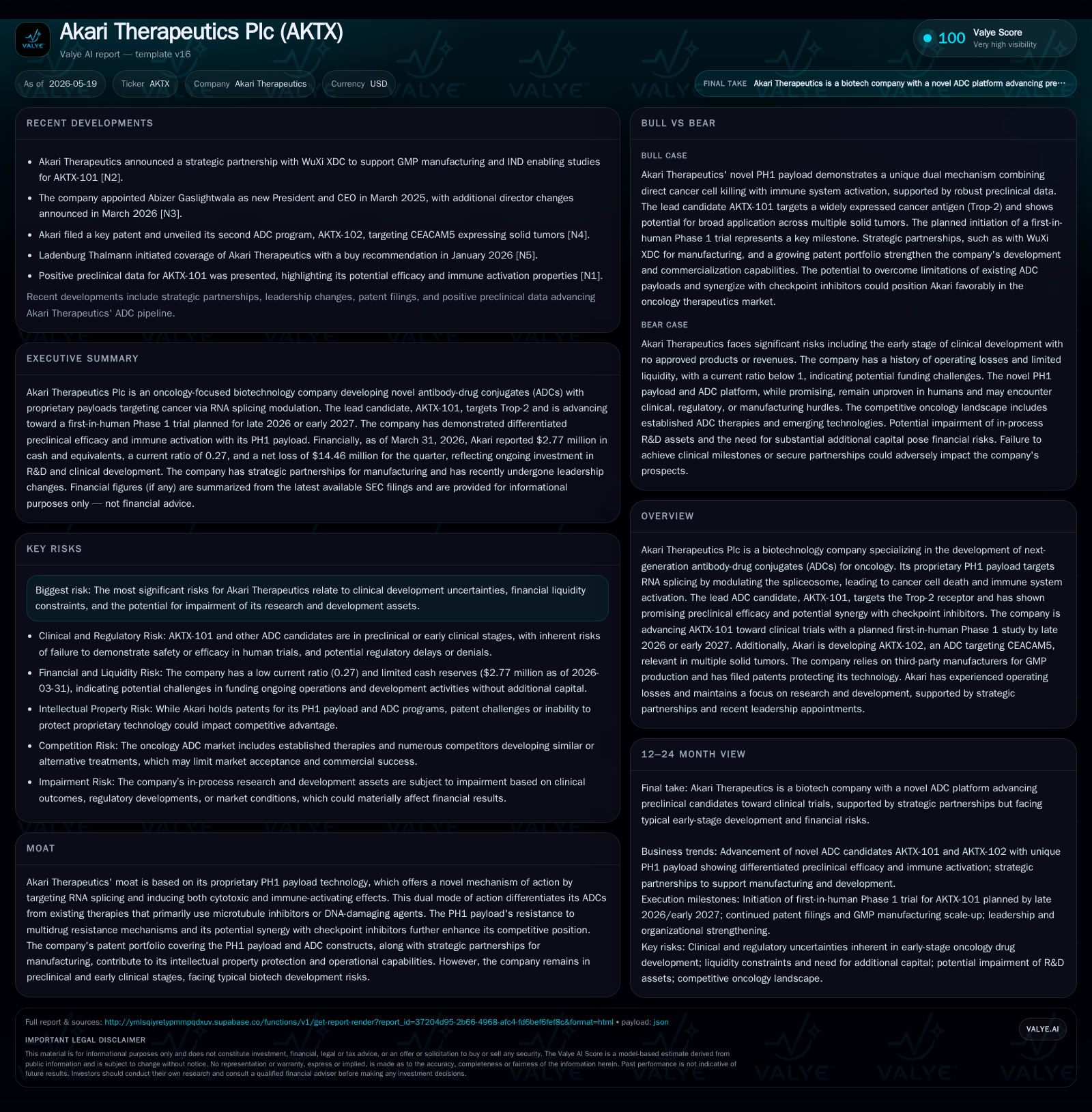
Akari Therapeutics is progressing its proprietary antibody-drug conjugates featuring the novel PH1 payload targeting RNA splicing in cancer cells. The company has advanced IND enabling studies for AKTX-101 with plans to initiate a Phase 1 clinical trial by late 2026 or early 2027. Strategic partnerships for GMP manufacturing and a growing patent portfolio support its biopharmaceutical platform. However, Akari faces typical early-stage biotech challenges including limited liquidity and ongoing operating losses, making successful capital raising critical for future operations.
Recent Quarterly Operating Developments: Progress Toward Clinical Stage
Akari Therapeutics’ latest quarterly filing (10-Q dated May 19, 2026) underscores meaningful advancement toward clinical validation of its lead ADC candidate AKTX-101. Specifically, the company has initiated IND enabling studies necessary for regulatory submission to commence first-in-human Phase 1 trials by late 2026 or early 2027 [S2]. This represents a pivotal inflection point from predominantly preclinical activity toward entering the clinic. Complementing this progression is the establishment of GMP manufacturing activities initiated in late 2025 with WuXi Biologics’ WuXi XDC unit as their contract manufacturing partner [N1], ensuring production capabilities for clinical trial material are secured [S11]. This operational update reflects an acceleration in translational efforts since prior disclosures.
Business Model Overview: Specialized RNA Splicing Modulator ADCs
Akari’s business model is anchored in developing next-generation antibody-drug conjugates (ADCs) that deliver a proprietary PH1 payload directly into tumor cells via target-specific antibodies. Unlike conventional ADC approaches that utilize known cytotoxic agents such as microtubule inhibitors or DNA-damaging drugs, Akari’s PH1 payload uniquely modulates RNA splicing by targeting the spliceosome machinery critical to cancer cell survival and protein synthesis [S1]. This disrupts cancer cell growth through direct cytotoxicity while simultaneously generating neoantigens that can activate both innate and adaptive immunity against tumors.
Revenue generation remains aspirational at this stage as Akari has no approved products nor commercial sales; revenues will ultimately depend on successful clinical development followed by either direct commercialization or licensing/partnering deals leveraging PH1 technology or individual ADC candidates like AKTX-101 [S1]. The company outsources manufacturing to third-party CDMOs such as WuXi XDC to optimize cost efficiency and ensure capacity scalability without investing heavily in in-house production infrastructure.
Product and Technology Quality: The PH1 Payload Differentiator
Akari’s core technological edge lies in its novel PH1 payload platform which interferes with RNA splicing machinery to exert two synergistic modes of action: killing cancer cells directly while concurrently provoking an immune response via neoantigen presentation [S1]. This mechanism offers potential advantages over standard payloads used in approved ADCs that primarily rely on cytotoxins with no immune engagement.
PH1 also appears less susceptible to multidrug resistance pathways common in oncology treatment failures. Preclinical data presented highlight superior efficacy signals for AKTX-101 compared to ADCs using traditional topoisomerase inhibitors, including activity against various cancer genetic subtypes such as FGFR3 fusions and SMARCA4 deletions [N2]. Importantly, combining AKTX-101 with checkpoint inhibitors shows greater-than-additive effects indicating promising combination therapy potential.
Such attributes bolster Akari's intellectual property moat supported by a robust patent portfolio covering composition of matter claims extending through September 2038 across multiple jurisdictions including the U.S., China, and Europe [S25]. This IP coverage secures exclusivity on key chemical entities such as Thailanstatin-based payloads and proprietary linkers vital for targeted delivery.
Competitive and Industry Context: Innovation Amidst Payload Homogeneity
The antibody-drug conjugate market is characterized by limited diversity in payload chemistries despite numerous ADC approvals targeting different tumor antigens. Most competitors use microtubule-disrupting agents or DNA damaging compounds as cytotoxic components. Akari aims to differentiate via its spliceosome-targeting PH1 payload representing an emerging subclass within immuno-oncology ADCs.
Competition includes established Trop-2-targeting ADCs like Trodelvy® and Datopotamab Deruxtecan (Datroway®), both with large clinical footprints; hence Akari must demonstrate clear efficacy or safety improvements to capture share once AKTX-101 advances clinically [S11]. Regulatory complexity remains high due to stringent requirements for biologics combined with challenges around demonstrating additive benefit over existing standards of care.
Pricing pressure and reimbursement uncertainties typical for specialty oncology drugs could also constrain initial commercial uptake without compelling differentiation or favorable outcomes data post-launch. Nevertheless, Akari’s novel mechanism providing both cytotoxicity plus immune activation aligns well with ongoing oncology trends favoring combination therapies leveraging checkpoint blockade synergy.
Growth Catalysts: Clinical Trial Initiation and Partnering Opportunities
Key near-term growth drivers center on successfully executing IND enabling studies enabling initiation of Phase 1 trials for AKTX-101 within the next several quarters [S2]. Positive clinical data demonstrating safety and preliminary efficacy could substantively advance valuation inflection points.
Parallel development of AKTX-102 targeting CEACAM5 broadens pipeline breadth across cancers like pancreatic, colon, stomach, esophageal, and lung tumors thereby diversifying indications under exploration [S1]. Partnership agreements such as the one announced with WuXi XDC assure manufacturing scalability capable of supporting later-stage trials or commercialization needs [N1].
Licensing potential for the PH1 payload technology offers additional upside by enabling biopharma collaborators to develop their own bespoke immuno-oncology ADC candidates using this novel mechanism—potentially accelerating monetization without full commercialization burdens borne by Akari itself.
Risk Factors and Operational Constraints: Development and Funding Challenges
Significant risks stem from typical early-stage biopharma uncertainties: successful transition from preclinical proof-of-concept to human safety/efficacy proof remains untested. As of March 31, 2026, Akari carries approximately $30.3 million in in-process research & development (IPR&D) assets primarily related to AKTX-101 and its platform technology—intangible assets subject to impairment if expected future benefits do not materialize due to adverse trial outcomes or regulatory setbacks [S2]
Liquidity constraints are acute given limited cash resources of roughly $2.8 million as of quarter-end March 31, 2026 against current liabilities exceeding $13 million yielding a concerning current ratio around 0.27 signaling short-term solvency pressures absent fresh capital infusions [F1]. The company reported operating losses totaling $17.3 million during fiscal year 2025 reflecting heavy investment in R&D with no offsetting revenues yet realized [F1]. Sustained access to funding through public/private equity offerings or strategic partnerships will be essential to maintain development momentum.
Additional risk domains include complex regulatory landscapes across US/EU markets potentially prolonging approval timelines; competitive dynamics that may erode future market share; intellectual property challenges; plus operational execution risks tied to manufacturing reliability even when outsourced externally.
Key Watchpoints: Upcoming Regulatory and Clinical Milestones
Investors should closely monitor Akari’s progress toward filing IND applications for AKTX-101 which enables official regulatory green-lighting to commence human trials. Timely initiation followed by enrollment pace and safety/efficacy readouts from Phase 1 study represent critical value catalysts expected within the upcoming year horizon [S2]
Partnership announcements expanding manufacturing or co-development collaborations would validate confidence in technical viability and commercial strategy [N1]. Capital raising events will be necessary milestones given demonstrated liquidity constraints impacting operational continuity absent replenishment.
Monitoring preclinical data releases particularly any combinatorial regimen results with checkpoint inhibitors could provide important validation signals supportive of differentiated positioning within the crowded ADC marketplace [N2].
Financial Snapshot: Liquidity, Capital Needs, and Cost Structure
As detailed per companyfacts as of March 31, 2026,[F1] Akari held approximately $2.8 million cash equivalents alongside minimal debt estimated at $200 thousand (latest available). Nonetheless balance sheet structure reveals short-term liabilities significantly exceeding current assets ($13.4 million vs $3.6 million), translating into a low current ratio around 0.27 reflecting elevated liquidity stress.[F1]
Operating expenses remain dominated by research & development outlays pushing net losses above $17 million annually most recently.[F1] The absence of revenue generation combined with tightening cash reserves mandates financing measures soon to support ongoing clinical programs.[S2]
Capital management will be critical both to fund expensive IND-enabling studies ahead of costly human trials and preserve corporate viability amid typical biotech sector funding volatility.
This analysis is based solely on publicly disclosed information including SEC filings up to May 19, 2026, Nasdaq news releases through April 2026, and aggregate company facts datasets current as of March 31, 2026. It intends to provide an informed operational overview without offering investment advice or forecasts.
Disclaimer: This is research-only, informational analysis and not investment advice. It may include AI-generated interpretation and general industry context. Always verify important details using primary sources.

Comments