
Alchemy Investments Acquisition Corp 1 Faces Liquidity and Governance Challenges Ahead of Cartiga Merger
ALCY’s latest quarterly filing highlights significant liquidity constraints and internal control weaknesses amid its merger process with litigation finance platform Cartiga.
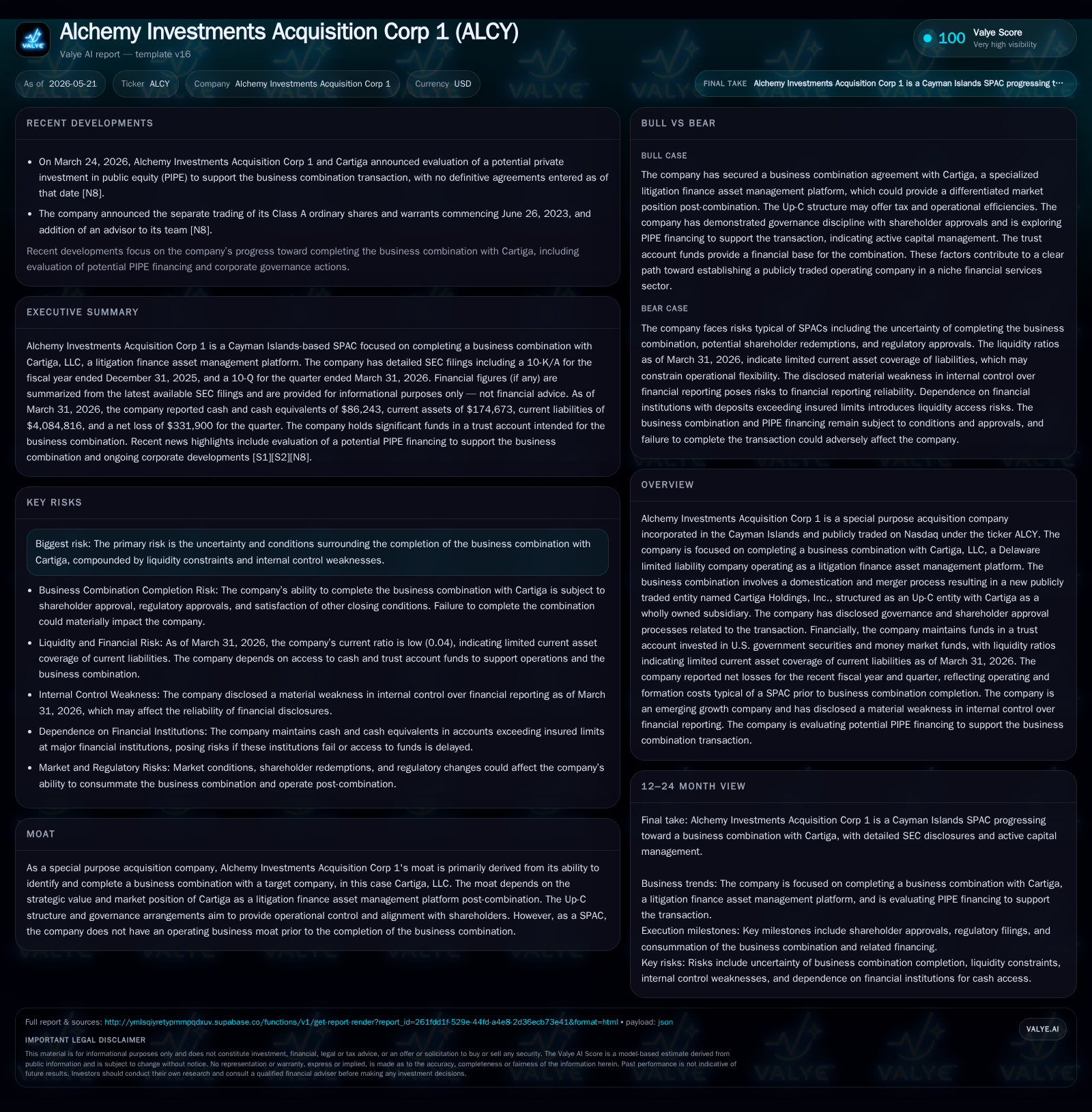
Alchemy Investments Acquisition Corp 1 (ALCY) is navigating a critical transitional phase from SPAC to operating entity through its pending business combination with Cartiga, LLC. The May 2026 quarterly report reveals severe liquidity shortages, a Nasdaq delisting event, and material weaknesses in disclosure controls, underscoring operational risks prior to closing. Post-merger success depends on Cartiga’s positioning within the litigation finance niche and effective execution of PIPE financing alongside an Up-C governance structure designed to align shareholder and management interests. Key risks include financing adequacy, regulatory approvals, and remediation of control deficiencies necessary for resuming public trading and scaling operations.
Latest Quarterly Operating Update: Delisting and Disclosure Controls Under Pressure
Alchemy Investments Acquisition Corp 1's latest quarterly filing dated May 21, 2026 ([S2]) reveals critical operational challenges as it approaches completion of its business combination with Cartiga. The company confirmed that its securities were delisted from Nasdaq effective May 14, 2026 following a decision not to appeal the determination ([S3]). This transition places ALCY’s shares on the less liquid OTC market immediately after suspension from Nasdaq trading — potentially constraining investor access and trading volumes.
Liquidity metrics at quarter-end underscore financial strain: current assets stood at approximately $174,673 against current liabilities exceeding $4 million as of March 31, 2026 ([F1]), yielding a current ratio near 0.04. This indicates an acute shortage of liquid resources relative to short-term obligations. Additionally, certifying officers disclosed a material weakness in internal controls over financial reporting as of the quarter end ([S2]), raising concerns about governance quality during this pivotal phase.
These developments highlight the imperative for swift merger closure to attain operational scale and enhanced capital access through Cartiga’s platform.
Business Model Overview: SPAC Transitioning to Litigation Finance Asset Manager
ALCY is currently structured as a Cayman Islands-incorporated special purpose acquisition company with no active operations beyond IPO proceeds held primarily in trust ([S1], [F1]). Its value proposition depends entirely on consummating a business combination.
The target entity, Cartiga, LLC, specializes in litigation finance asset management—providing capital solutions for legal claims portfolios within alternative asset management—a niche requiring specialized underwriting capabilities and regulatory compliance ([S1]). Upon closing, ALCY plans domestication into Delaware as Cartiga Holdings, Inc., adopting an Up-C structure that optimizes tax efficiency while maintaining Cartiga as a wholly owned operating subsidiary ([S1]). This strategic pivot moves ALCY from an IPO shell toward an operating asset manager positioned to capitalize on growth opportunities in litigation finance.
Prior to closing the transaction, ALCY holds no competitive advantages independently; all future value depends on Cartiga’s assets under management (AUM), client relationships, deal flow networks, and execution expertise.
Industry Context: Litigation Finance Asset Management Landscape
Litigation finance has emerged as an alternative investment class attracting institutional investors seeking non-correlated returns. Managers compete based on proprietary deal sourcing networks, rigorous legal case underwriting expertise, regulatory adherence, and customized investment vehicle structuring.
The market remains fragmented with variable risk profiles across managers—ranging from single-case funding to diversified portfolios—with performance linked closely to legal system dynamics. Regulatory considerations around transparency and fiduciary duties remain key compliance factors. Switching costs are moderate but strong track records combined with sponsor relationships can secure recurring capital commitments.
Cartiga’s focus situates the combined entity well within this expanding niche aligned with institutional demand for alternative yield sources amid low traditional interest rates ([S1]).
Growth Drivers: PIPE Financing Support, Up-C Structure Advantages, Market Expansion
In March 2026 disclosures ([S6]), Alchemy and Cartiga announced plans to pursue private investment in public equity (PIPE) financing concurrent with their business combination. PIPE funding is critical for meeting minimum cash thresholds ($40 million per agreement) required at closing and providing operating capital post-merger ([S4], [S17]).
The Up-C corporate structure enhances value creation by combining favorable tax treatment with managerial equity incentives aligned with post-merger performance ([S1]). This alignment is also attractive to PIPE investors seeking governance stability.
Growth beyond capital infusion will depend on expanding Cartiga’s portfolio through new partnerships or geographic expansion into adjacent markets where demand for litigation finance is rising due to increased legal complexity across sectors.
Key Risks: Liquidity Constraints, Delisting Impact on Trading Liquidity, Control Weaknesses
ALCY faces layered risks including reported liquidity shortfalls (current ratio ~0.04), impacts from its May 14 Nasdaq delisting transitioning shares to OTC trading ([S3]), and acknowledged material weaknesses in internal controls over financial reporting ([S2]).
These factors limit flexibility for interim financings pre-close and may depress share price or trading volume ahead of definitive proxy filings needed for merger approval ([S4], [S15]). Failure or delay in closing exposes shareholders to downside without clear exit alternatives.
Internal control deficiencies raise concerns about financial disclosure accuracy that could attract regulatory scrutiny or require costly remediation efforts at a critical early stage post-merger.
Governance Structure Post-Merger: Shareholder Alignment and Lock-Ups
Transaction documents include governance mechanisms such as lock-up agreements restricting early sale of shares issued from merger consideration ([S12]) intended to stabilize ownership post-transaction.
Shareholder approval via proxy voting constitutes a central closing condition along with regulatory clearances ([S17]). The Up-C structure introduces distinct share classes aligning founder/sponsor stakes closely with operating results—encouraging long-term value creation beyond typical SPAC sponsor economics ([S1]). These measures aim to mitigate dilution concerns common in de-SPAC transactions.
Milestones Ahead: Proxy Filings, Shareholder Votes, PIPE Finalization,
and Market Trading Resumption
Key upcoming catalysts include SEC acceptance of proxy filings related to the business combination agreement alongside shareholder votes required for closing approval ([S4], [S15]). Completion also depends on meeting cash thresholds inclusive of PIPE proceeds subject to investor commitments yet to be finalized ([S6]).
Investors should closely monitor announcements regarding potential Nasdaq relisting or improvements in OTC market liquidity that would support volume recovery. Delays here could extend illiquidity periods adversely impacting investor confidence post-merger.
Financial Snapshot: Liquidity Position Highlights Pre-Close
As of March 31, 2026 per company facts data ([F1]), ALCY held approximately $86k in cash equivalents against total debt near $2 million resulting in net debt around $1.9 million. This balance sheet profile reflects typical pre-merger SPAC shells reliant on pending capital inflows for continuity.
This snapshot corroborates qualitative assessments emphasizing liquidity management as a critical watchpoint alongside operational readiness transitioning into an active litigation finance asset manager upon business combination closure.
This analysis is based solely on publicly available SEC filings and company disclosures without any investment research view.
Financial position in context
As of 2026-03-31, companyfacts shows $86,243 in cash and equivalents and $2 million of total debt [F1]. The same snapshot implies net debt of roughly $1,913,757, keeping balance-sheet context relevant but secondary to the operating story [F1]. Current assets of $174,673 and current liabilities of over $4 million imply a current ratio near 0.04x for 2026-03-31 [F1].
Disclaimer: This is research-only, informational analysis and not investment advice. It may include AI-generated interpretation and general industry context. Always verify important details using primary sources.

Comments