
Allegro MicroSystems Advances Sensor Innovation While Managing Supply Constraints
Allegro’s latest quarterly report highlights operational resilience amid supply chain pressures and evolving competitive dynamics in automotive sensor ICs.
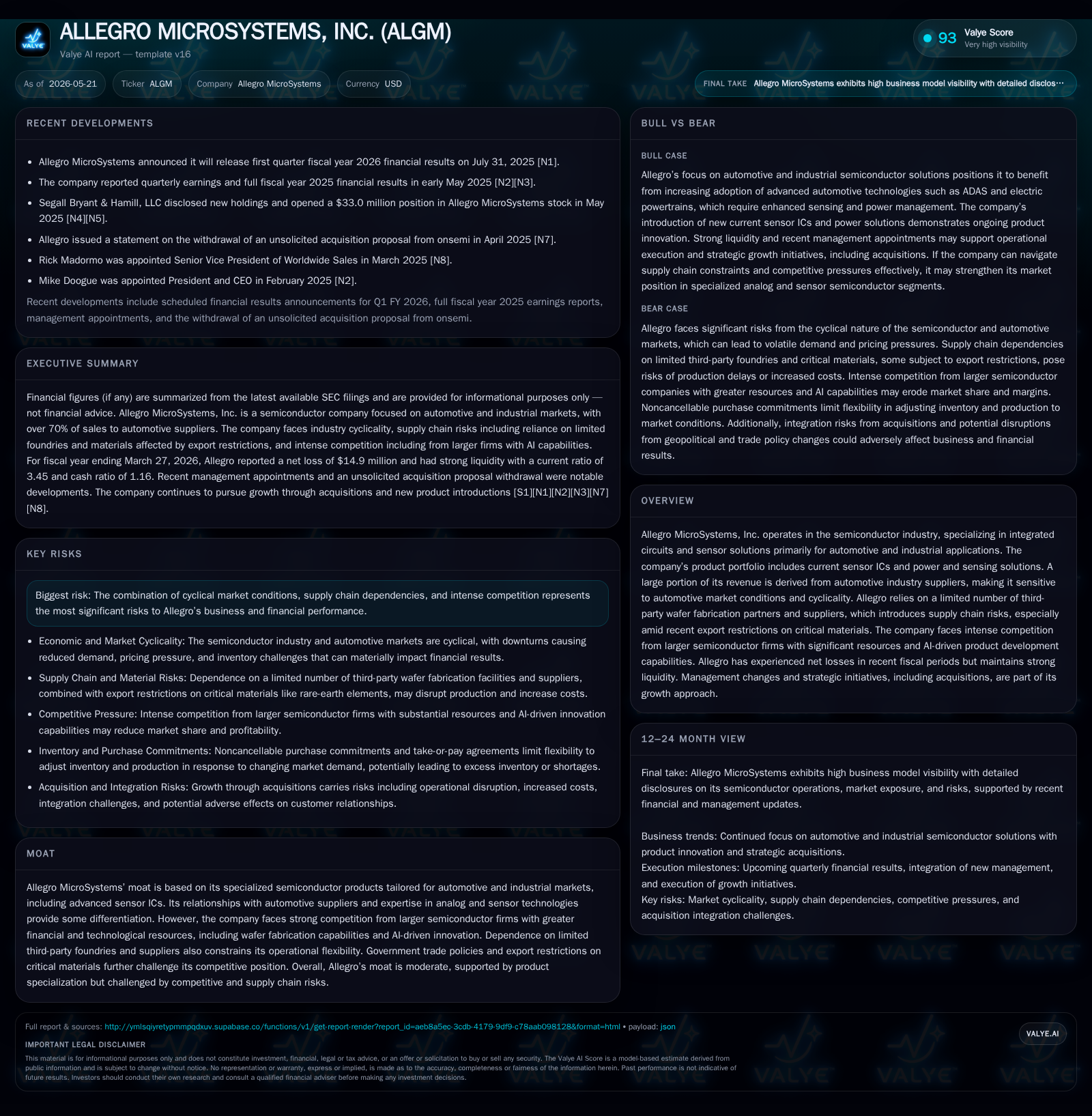
In its most recent quarterly filing, Allegro MicroSystems reported steady operational progress despite ongoing supply chain challenges affecting semiconductor fabrication and component sourcing. Its specialized automotive and industrial sensor integrated circuits remain core revenue drivers, though demand volatility tied to the automotive sector persists. The company’s competitive position benefits from strong product specialization but faces constraints from wafer fab dependence and intensifying rivalry from larger semiconductor peers. Key growth initiatives center on new product introductions targeting electrification and ADAS markets, while risks include cyclicality, supply limitations, and regulatory complexity around AI technologies. Financially, Allegro maintains a solid liquidity buffer with notable net leverage, underscoring the need for disciplined capital management as it pursues strategic growth.
Latest Quarterly Operating Update: Key Changes and Implications
Allegro MicroSystems’ January 2026 10-Q filing outlines a near-term operating landscape characterized by ongoing supply chain constraints particularly stemming from its dependence on a limited number of third-party wafer fabrication partners. Despite these limitations, shipment volumes have remained stable indicating resilient underlying demand for its sensor ICs in automotive and industrial applications [S2]. The company notes that while order intake remains healthy, fulfillment is occasionally delayed due to wafer fab capacity bottlenecks and materials shortages exacerbated by geopolitical export restrictions. This tight supply environment constrains Allegro’s ability to scale quickly in response to demand surges but also preserves pricing power by limiting channel oversupply. Inventory management remains a focus to prevent excess stock amid potential end-market cyclicality.
Business Model Overview: Sensor ICs for Automotive and Industrial Markets
Allegro’s business centers on designing and selling analog and mixed-signal integrated circuits tailored primarily for automotive original equipment manufacturers (OEMs) and their tier-one suppliers. The product suite includes current sensor ICs essential for vehicle safety systems (e.g., motor control for brakes and steering), power management chips critical for electric drivetrains, and various sensing solutions used in industrial automation. Revenue streams are largely contract-driven via design wins embedded into OEM platforms, which creates sticky customer relationships driven by high switching costs due to qualification cycles and safety certifications [S1][F1]. The company monetizes through volume shipments where ASPs can fluctuate based on product mix shifts toward higher-value sensing solutions aligned with emerging vehicle electrification and ADAS trends.
Competitive Positioning in Semiconductor Sensor Solutions
Within the crowded semiconductor space focused on sensor solutions, Allegro maintains a moderate moat grounded in its specialized analog expertise and deep integration within automotive supply chains. However, substantial competitive pressure arises from larger semiconductor companies possessing end-to-end manufacturing capabilities including proprietary wafer fabs enabling greater cost control and faster iterative innovation cycles powered by AI-driven R&D [S1]. Allegro’s reliance on third-party foundries inherently limits certain operational flexibilities against these integrated device manufacturers (IDMs). Moreover, industry incumbents increasingly leverage sophisticated AI modeling to accelerate product development timelines – an area where Allegro faces resource contrast. This competitive tension underscores the necessity for Allegro's continued investment in differentiated sensor designs that align tightly with evolving vehicle system requirements.
Sector-Specific Dynamics: Supply Chains, Pricing, and Customer Behaviors
Geopolitical factors exert notable influence over Allegro’s sector dynamics. The company confronts risk concentration due to dependence on a few key wafer fabs whose capacity is affected by U.S.-China export restrictions on critical semiconductor materials [S1][S2]. These constraints induce longer lead times impacting customer order fulfillment cadence. Pricing pressure remains an industry norm due to incremental ASP declines over multi-year horizons; however, innovations in sensor complexity enable partial offsetting through premium product adoption. Customer behaviors show cyclical sensitivity tied closely to global automotive production cycles complicated by inventory adjustments downstream at tier-one suppliers acting as distributors [S1][S2]. In this environment, the company's distributor-heavy channel strategy introduces both forecasting risk and inventory balance challenges.
Drivers of Growth: Innovation, Market Demand, and Strategic Initiatives
Growth prospects hinge on leveraging several structural tailwinds: the accelerating penetration of electrification technologies demands high-accuracy current sensors for battery management; advanced driver assistance systems (ADAS) require sophisticated sensing with stringent reliability profiles; meanwhile industrial automation grows steadily as manufacturing digitization advances [S1][S3]. Management highlights ongoing R&D investments aimed at expanding next-generation sensor portfolios that incorporate enhanced precision measurement capabilities integrating seamlessly with in-vehicle networks. Efforts have also been made toward supplier diversification to mitigate wafer fab dependency risk. Recent board changes announced in May 2026 signal potential governance shifts geared toward reinforcing strategic focus on technology leadership and operational execution excellence [S3].
Risks and Challenges: Market Cyclicality, Supply Chain Constraints, and Competition
Allegro faces material challenges inherent to its market structure including pronounced cyclicality originating from fluctuations in automotive production volumes influenced by macroeconomic conditions or consumer preference shifts [S1][S2]. Continued dependence on limited foundry partners subjects the company to supply interruptions or cost inflation linked to tariffs or export controls. Competitive pressure manifests not only from scale advantages held by IDMs but also through rapid innovation cycles powered by AI-centric design processes employed by rival firms [S1]. Regulatory uncertainty around AI usage impacts internal compliance costs while heightening legal risk exposures as evolving frameworks impose stringent standards globally [S8]. Additionally, turnover among executive ranks recently observed introduces potential discontinuities impacting strategic consistency [S3][S7]. Restructuring initiatives aimed at cost optimization carry execution risk that could affect operating margins if revenue forecasts underperform expectations [S24].
Upcoming Catalysts and What to Watch Closely
Critical near-term milestones include monitoring quarterly order book health as a leading indicator of demand sustainability amid macro volatility. Progression of new product launches geared toward enhanced sensing functions for EV platforms represents another crucial growth vector. The impact of recent governance changes following director departures warrants attention regarding strategic direction continuity [S3]. Furthermore, watch for developments around supply chain improvements including alternative foundry engagements or expanded supplier networks that could alleviate capacity restraints. Finally, any updates related to trade policy shifts or AI regulatory clarifications will influence operational planning given their potential cost or compliance implications.
Brief Financial Snapshot and Capital Structure Overview
As of the most recent fiscal quarter ending March 27, 2026, Allegro holds cash and equivalents totaling approximately $169 million against total debt obligations near $281 million resulting in net debt around $112 million [F1]. The company maintains a strong current ratio of about 3.45 signaling sufficient short-term liquidity to cover immediate liabilities comfortably [F1]. Operating income stood positive at roughly $18.5 million despite a net loss of about $15 million reflecting costs related to restructuring or other one-time charges impacting bottom-line results [F1]. Interest coverage considerations are important given existing credit facility covenants restricting total net leverage ratios below defined thresholds near 4x EBITDA levels [S4][S5][S7]. Cash flow generation from operations will thus be critical to preserving financial flexibility necessary for R&D investment and potential strategic acquisitions going forward.
This analysis synthesizes all information drawn directly from SEC filings as referenced without speculative extrapolation or forward-looking estimates beyond explicit statements made by Allegro MicroSystems. It provides an objective view grounded in disclosed operating developments to aid understanding of the company's positioning within the semiconductor sensor landscape.
Disclaimer: This is research-only, informational analysis and not investment advice. It may include AI-generated interpretation and general industry context. Always verify important details using primary sources.

Comments