
ALX Oncology: Clinical Ambitions, Capital Dynamics, and the Stakes of Early-Stage Biotech Execution
ALX Oncology sits at the pivotal intersection of early clinical progress and sustained capital requirements, with lead assets in development but no commercial revenue.
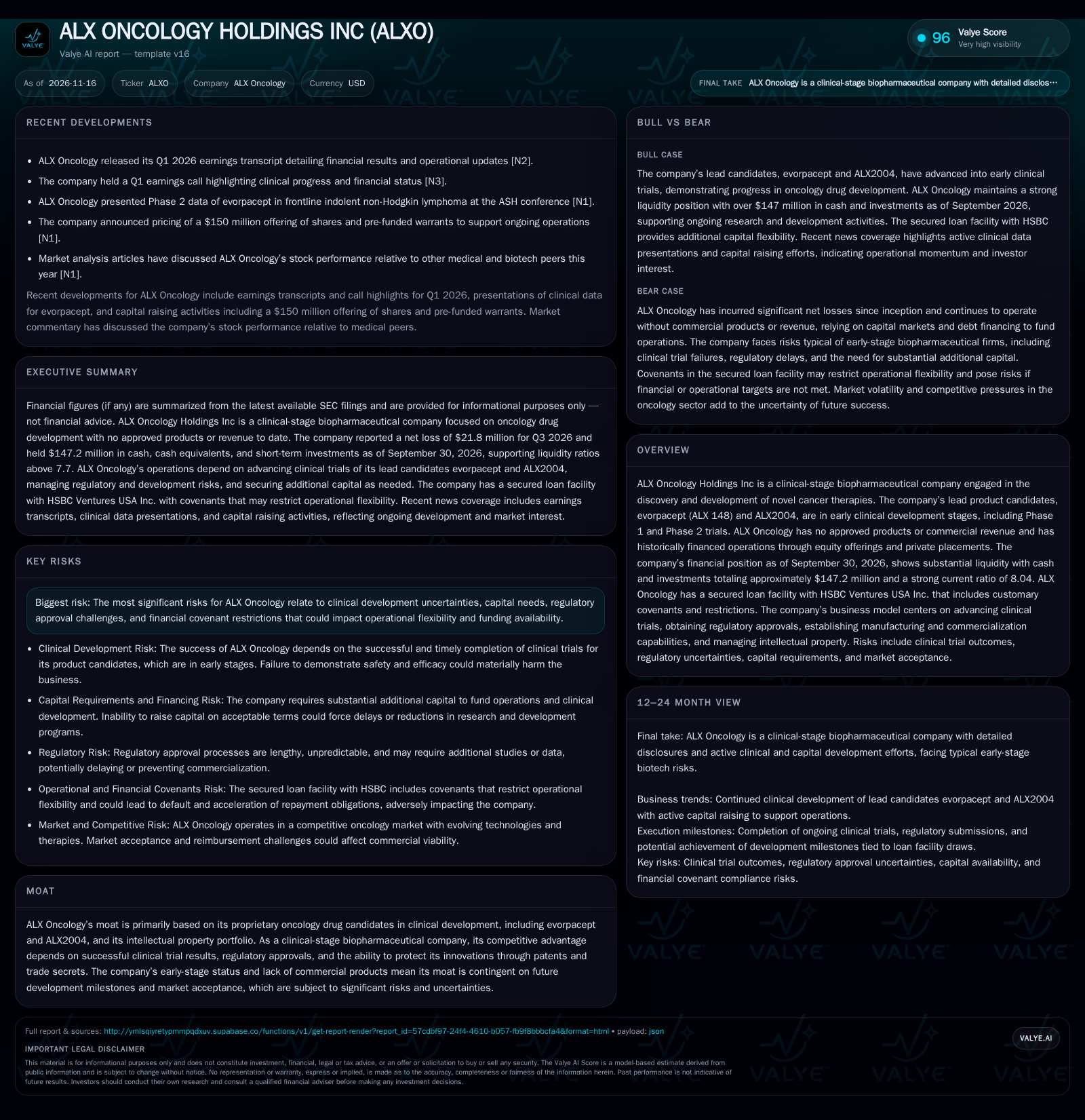
ALX Oncology remains a pre-commercial oncology developer with lead candidates in early clinical trials, significant ongoing net losses, and a cash balance of $147.2 million as of September 2026. Success depends on clinical trial outcomes, regulatory progress, and the ability to convert R&D investment into future partnerships or approvals, while competitive and capital risks remain acute. [S2] [N1]
ALX Oncology Holdings Inc exemplifies the high-stakes, high-uncertainty profile of clinical-stage biopharmaceuticals: it holds a promising pipeline of novel oncology candidates, but no approved products or commercial revenue. With its future tied to the success of evorpacept and ALX2004, ALX Oncology must not only deliver positive clinical data but also navigate the operational constraints of a new loan facility and the competitive, fast-evolving cancer therapy landscape. [S2]
ALX Oncology’s Position: Early-Stage Pipeline, Capital, and Losses
The company reported cash and liquidity metrics for the period; these figures do not by themselves establish operating runway, investment capacity, financial flexibility, or financing capacity. However, the company reported a net loss of $21.8 million for Q3 and $57.7 million for the first nine months of 2026, reflecting the ongoing cost of clinical-stage research and development. No commercial revenue has been generated, and the company remains entirely dependent on external funding. Recent developments include the establishment of a $50 million multi-tranche secured loan facility with HSBC Ventures USA Inc., of which $10 million had been drawn by June 2026, and a $150 million equity and pre-funded warrant offering to support continuing operations. These facts underscore ALX Oncology’s status as a pre-commercial biotech with active capital management and an urgent need to demonstrate clinical and regulatory progress. [S2] [N1] [N3]
How ALX Oncology’s Model Could Create Value—If Clinical Bets Pay Off
The business model for ALX Oncology is typical of early-stage biopharma: invest heavily in R&D to advance proprietary drug candidates through clinical trials, with the aim of achieving regulatory approval and, ultimately, commercialization or partnership. The company’s lead candidates, evorpacept and ALX2004, are in early clinical stages, which means that all current expenditures are aimed at generating future value rather than realizing present revenue. Expenses are dominated by clinical development, regulatory filings, and the buildout of intellectual property. Fixed costs are high relative to variable costs until a product is approved and commercial infrastructure must be built or scaled.
ALX Oncology’s economics are therefore defined by negative operating leverage in the near term—costs rise with trial complexity and advancement, while revenue remains zero. Capital needs are persistent and likely to increase as lead candidates progress into later-stage trials that require larger patient cohorts and more sites. If a candidate reaches regulatory approval, the economics could shift dramatically: high-margin revenue from oncology drugs is possible due to premium pricing and unmet need, though the costs of commercialization (manufacturing scale-up, sales force, reimbursement negotiations) are substantial. Alternatively, a partnership or licensing deal with a larger pharmaceutical company could generate milestone payments and royalties, potentially reducing the company’s need to build out a full commercial infrastructure. The key economic inflection points are positive clinical data (enabling partnerships or fundraising on better terms) and regulatory milestones.
Navigating a Crowded Oncology Landscape: Differentiation and Threats
ALX Oncology competes in one of the most dynamic and congested sectors of biopharma: oncology. The company’s potential competitive advantages stem from the novelty and clinical promise of its lead candidates, along with its intellectual property portfolio. However, the oncology market is characterized by rapid innovation, frequent emergence of new modalities (such as immunotherapies and targeted agents), and intense competition from both large pharmaceutical firms and other biotech startups.
Switching costs for providers and payers are modest until a therapy is established as standard of care, so any future product from ALX Oncology would need to demonstrate clear clinical benefit—superior efficacy, safety, or convenience—relative to both existing therapies and those in late-stage development. Barriers to entry are primarily scientific and regulatory rather than commercial at this stage. The durability of any future moat will depend on successful clinical outcomes, robust patent protection, and the ability to secure reimbursement and adoption in a crowded treatment paradigm. Without commercialized products, ALX Oncology’s competitive position is speculative and contingent on future data.
Positive Clinical Readouts Catalyze Partnerships or Accelerated Funding
The most favorable scenario for ALX Oncology is one where its lead programs, particularly evorpacept, generate compelling safety and efficacy data in ongoing or upcoming clinical trials. Such results could trigger several value-creating events: increased investor confidence enabling further capital raises at attractive terms, the potential for partnership or licensing agreements with larger pharmaceutical companies, and the ability to access additional tranches of the HSBC loan facility. Regulatory progress—such as the granting of breakthrough therapy designation or fast-track status—could add further momentum.
Confirmation of this scenario would require the release of positive interim or top-line clinical data, announcements of new collaborations with major pharma partners, and public disclosure of milestone payments or non-dilutive funding. The company’s ability to attract attention at major oncology conferences or in peer-reviewed publications would also help validate its scientific platform.
Clinical Progress Amid Capital Consumption and Regulatory Uncertainty
The most plausible near-term scenario is that ALX Oncology continues to advance its lead programs through early- and mid-stage clinical trials, incurring ongoing losses as it spends down its cash reserves. The company may secure additional funding through follow-on offerings or milestone-based draws from its loan facility, but will remain dependent on external capital until it achieves a major clinical or regulatory milestone. Operational flexibility could be constrained by the covenants in its secured loan agreement, especially if trial timelines slip or results are equivocal.
This scenario would be confirmed by regular clinical trial updates, continued capital-raising activity, and the absence of major clinical setbacks or partnership announcements. If disclosed, metrics such as cash burn rate, patient enrollment progress, and trial readout timelines would help test the base case.
Clinical Setbacks, Delayed Milestones, and Funding Pressures Compound Risk
In a negative scenario, one or more of ALX Oncology’s lead programs could experience clinical setbacks—such as safety concerns, lack of efficacy, or slow enrollment—leading to delays or outright trial failures. These outcomes would erode investor confidence, potentially close off access to additional loan tranches, and force the company to raise capital under highly dilutive terms or scale back operations. The covenants in the HSBC loan facility could become binding constraints, especially if financial or operational targets are missed, potentially accelerating repayment obligations or triggering a default.
This scenario would be confirmed by announcements of negative clinical data, trial discontinuations, missed milestones, or urgent capital-raising at depressed valuations. Watch for management disclosures around operational flexibility, debt covenant compliance, and changes to R&D priorities as early warning signs.
Milestones That Will Shape ALX Oncology’s Value Proposition
The timing and substance of upcoming clinical trial data releases for evorpacept and ALX2004; positive safety and efficacy signals would be the most direct drivers of value.
Updates on the ability to draw additional tranches from the HSBC loan facility and any changes to the terms or covenants attached.
Announcements of new partnership agreements, licensing deals, or non-dilutive funding that would validate the technology and provide additional resources.
Enrollment rates and protocol amendments in ongoing clinical trials, as slow progress or changes could signal underlying challenges.
Regulatory feedback or designations (e.g., fast track, breakthrough) that could accelerate timelines or improve funding prospects.
Any changes in competitive landscape, such as new data from peer companies targeting similar oncology indications, which could affect perceived differentiation.
Disclosures around compliance with operational or financial covenants in the HSBC loan agreement, especially if development timelines slip.
Disclaimer: This is research-only, informational analysis and not investment advice. It may include AI-generated interpretation and general industry context. Always verify important details using primary sources.

Comments