
AMC's Premium Format Expansion Boosts Revenue Amid Ongoing Liquidity and Attendance Challenges
AMC reported strong Q2 2026 attendance gains and promotional success while navigating significant leverage and equity dilution.
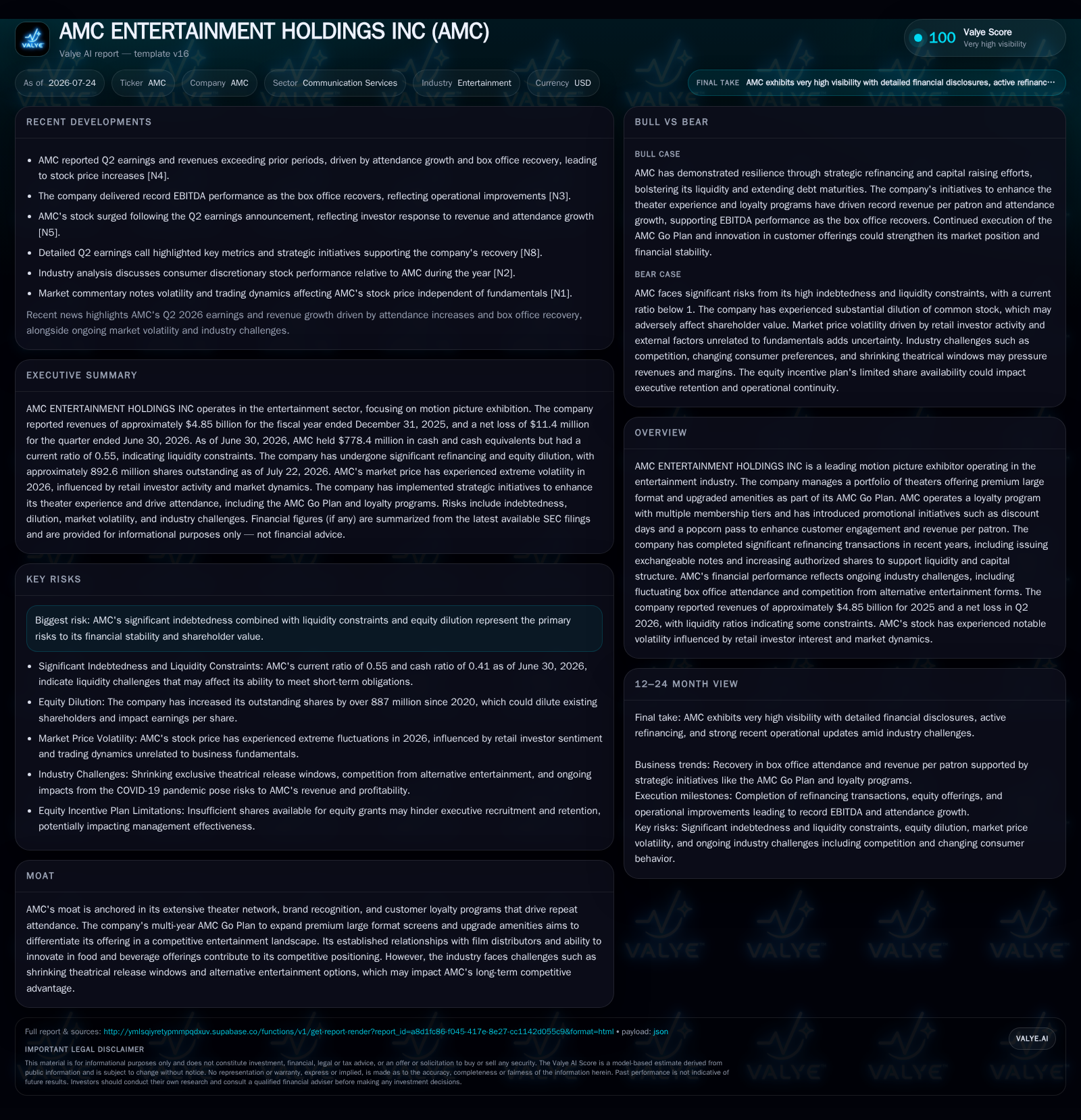
AMC Entertainment’s latest quarterly results reveal a partial recovery in box office attendance supported by premium large format screens, loyalty plan growth, and promotional initiatives. However, the company’s capital structure remains strained with significant debt and continued equity issuance diluting shareholder value. AMC’s business model leverages its extensive theater network and AMC Go Plan membership tiers to drive incremental revenue per patron amid competitive pressures from streaming and shrinking theatrical windows. Continued execution on premium amenities and balancing liquidity constraints will determine sustainability in a challenging exhibition environment.
Recent Operating Update Anchored on Q2 2026 Filing
AMC Entertainment Holdings Inc. reported its second-quarter results for the period ended June 30, 2026, highlighting a partial recovery in box office attendance that surpassed analyst expectations [S2][N2]. This attendance growth was driven notably by AMC’s strategic expansion of premium large format (PLF) screens, which offer enhanced audiovisual experiences commanding higher average ticket prices (ATP), and the continued growth of its AMC Go Plan loyalty program. The multi-tiered membership structure incentivizes repeat visits by providing benefits such as discounted tickets, concession offers, and priority access, thereby increasing customer lifetime value and stabilizing revenue streams beyond traditional ticket sales.
Promotional initiatives, including discount days and the popular popcorn pass subscription, have effectively boosted concession sales per patron, a critical revenue lever given the higher gross margins on food and beverage sales compared to ticketing [S1][N3]. These efforts contributed to same-store sales growth, reflecting improved per-customer monetization amid competitive pressures.
Despite these operational improvements, AMC continues to navigate significant industry headwinds. The theatrical release window has contracted as studios increasingly prioritize streaming platforms, compressing the period of exclusivity that historically drove sustained box office attendance. This shift, combined with intensified competition from digital entertainment alternatives, challenges AMC’s ability to maintain high occupancy rates and screen utilization [S2][S4]. Seasonal variability remains pronounced, with revenues sensitive to blockbuster film availability and broader consumer discretionary spending trends.
Business Model Specificity: Revenue Mechanics and Strategic Position
AMC operates as a downstream exhibitor in the motion picture value chain, licensing films from distributors and delivering the theatrical experience to consumers through its extensive network of theaters. The company’s revenue model is primarily driven by ticket sales, supplemented by concessions and premium offerings such as PLF screens and luxury amenities including recliner seating and enhanced sound systems.
Key operating metrics include total attendance, average ticket price, concession sales per patron, and premium format penetration. The AMC Go Plan loyalty program introduces a subscription-like revenue stream, generating recurring fees that enhance revenue predictability and customer retention. Membership tiers offer escalating benefits, encouraging upgrades and increased frequency of visits.
Promotional passes, such as the popcorn subscription, create incremental revenue by increasing concession spend and fostering habitual patronage. AMC’s monetization strategy leverages its geographic footprint and screen count to optimize local market penetration, while premium formats allow for price premiums that improve revenue per screen and gross margin.
Relationships with movie distributors influence film availability and scheduling, with evolving contractual terms reflecting the industry’s shift toward shorter theatrical windows and hybrid release models. AMC’s ability to negotiate favorable terms and secure high-profile releases remains critical to sustaining attendance and revenue growth.
Industry Structure and Competitive Positioning
The U.S. motion picture exhibition industry is capital intensive, requiring continuous investment in real estate, technology upgrades, and amenities to attract audiences amid competition from streaming and home entertainment. AMC is among the largest national chains, competing with Cinemark Holdings and Regal Cinemas. While scale provides negotiating leverage with distributors, differentiation is achieved through premium large format offerings, loyalty program innovation, concession product development, and geographic diversification.
AMC’s extensive footprint supports economies of scale but also entails substantial fixed operating costs, making profitability sensitive to attendance fluctuations and screen utilization rates. The company’s emphasis on experiential enhancements such as PLF screens aligns with industry trends prioritizing differentiated customer experiences to justify higher ATPs and concession spend.
Shrinking theatrical release windows and the rise of streaming platforms compress the revenue tail of new releases, increasing the importance of rapid monetization during initial box office runs. AMC’s competitive positioning depends on its ability to balance scale advantages with innovation in amenities and customer engagement.
Growth Drivers: Leveraging Format Innovation and Membership Engagement
Blockbuster film releases remain a primary driver of attendance and screen utilization. Popular franchises and tentpole movies stimulate elevated box office demand, which AMC capitalizes on through its premium large format expansion. PLF screens offer superior sound and image quality, attracting customers willing to pay price premiums, thereby increasing revenue per patron.
The AMC Go Plan loyalty program has demonstrated year-over-year subscriber growth, reflecting successful conversion of casual moviegoers into engaged members with recurring revenue contributions [S1][N3]. The program’s tiered benefits and promotional passes, such as discount days and popcorn subscriptions, lower price barriers and increase concession margins.
Geographic diversification across urban and suburban markets helps smooth seasonal revenue volatility, with key metropolitan areas offsetting weaker periods in other regions. International market development, while not a primary focus currently, presents potential for long-term growth if regulatory and competitive conditions permit.
Risks and Watchpoints: Capital Structure Constraints amid Industry Cyclicality
AMC’s capital structure remains highly leveraged, with total debt of approximately $3.91 billion against cash and equivalents of $778 million as of June 30, 2026, resulting in net debt near $3.14 billion [F1]. The company’s current ratio stands at a constrained 0.55, reflecting liquidity pressures given current liabilities nearly double current assets [F1]. This leverage level exposes AMC to risks from cyclical revenue swings inherent in the exhibition industry.
Since 2020, AMC has issued nearly 900 million new shares (adjusted for reverse stock splits) through various equity offerings, note conversions, and preferred stock exchanges, leading to significant shareholder dilution [S2]. While these transactions have supported liquidity and refinancing efforts, ongoing dilution remains a critical risk factor affecting investor sentiment and market valuation.
Additional risks include the continued contraction of theatrical release windows, which reduces the exclusivity period that drives box office attendance. Labor disruptions in film production and distribution could delay content pipelines, while inflationary pressures increase operating costs, particularly for concessions [S4]. Consumer preferences may shift away from out-of-home entertainment during economic downturns, and emerging technologies such as AI in filmmaking could alter audience acceptance and content dynamics
What To Watch Next: Execution Milestones and Demand Indicators
Near-term milestones include the upcoming shareholder meeting where approval for additional authorized shares to support equity incentive plans is sought [S23]. Approval is important for talent retention and competitive compensation in a capital-intensive industry
Monitoring box office trends around major summer blockbuster releases will provide insight into whether attendance gains are sustainable or primarily cyclical. Key operational indicators include same-store sales growth, premium large format screen expansion progress, average ticket price trends, and concession sales per patron. These metrics will help assess AMC’s pricing power and customer willingness to spend relative to peers such as Cinemark and Regal.
Liquidity management remains a focus, with potential refinancing transactions or asset optimization initiatives critical to managing interest costs and debt maturities. The company’s ability to balance investment in premium amenities with capital structure constraints will be central to its medium-term financial health.
Financial Profile Discussion
As of June 30, 2026, AMC held $778 million in cash and equivalents against $3.91 billion in total debt, resulting in net debt of approximately $3.14 billion [F1]. Current assets of $1.04 billion contrasted with current liabilities of $1.90 billion yield a current ratio of 0.55, indicating liquidity pressures typical of capital-intensive exhibitors but warranting close monitoring [F1].
The company has actively engaged in refinancing transactions through 2024 and 2025, including at-the-market equity offerings and note exchanges, to extend maturities and improve liquidity [S2][S3]. These efforts support ongoing investments in premium large format screen expansion and loyalty program enhancements, which are critical to driving revenue per patron and improving operating margins.
While AMC’s operating income remained negative for the full year 2025, reflecting ongoing industry challenges, the company’s strategic focus on experiential differentiation and membership growth aims to stabilize and grow revenues amid a shifting competitive landscape [F1][S1]
Disclaimer: This analysis is for informational purposes only and does not constitute investment advice. Readers should consult primary sources and consider their own circumstances.
Disclaimer: This is research-only, informational analysis and not investment advice. It may include AI-generated interpretation and general industry context. Always verify important details using primary sources.

Comments