
AMC Robotics Leverages E-Commerce and AI to Expand Security Market Presence
AMC Robotics enhances its competitive positioning through e-commerce distribution and AI-enabled product innovation while scaling manufacturing capabilities in Vietnam.
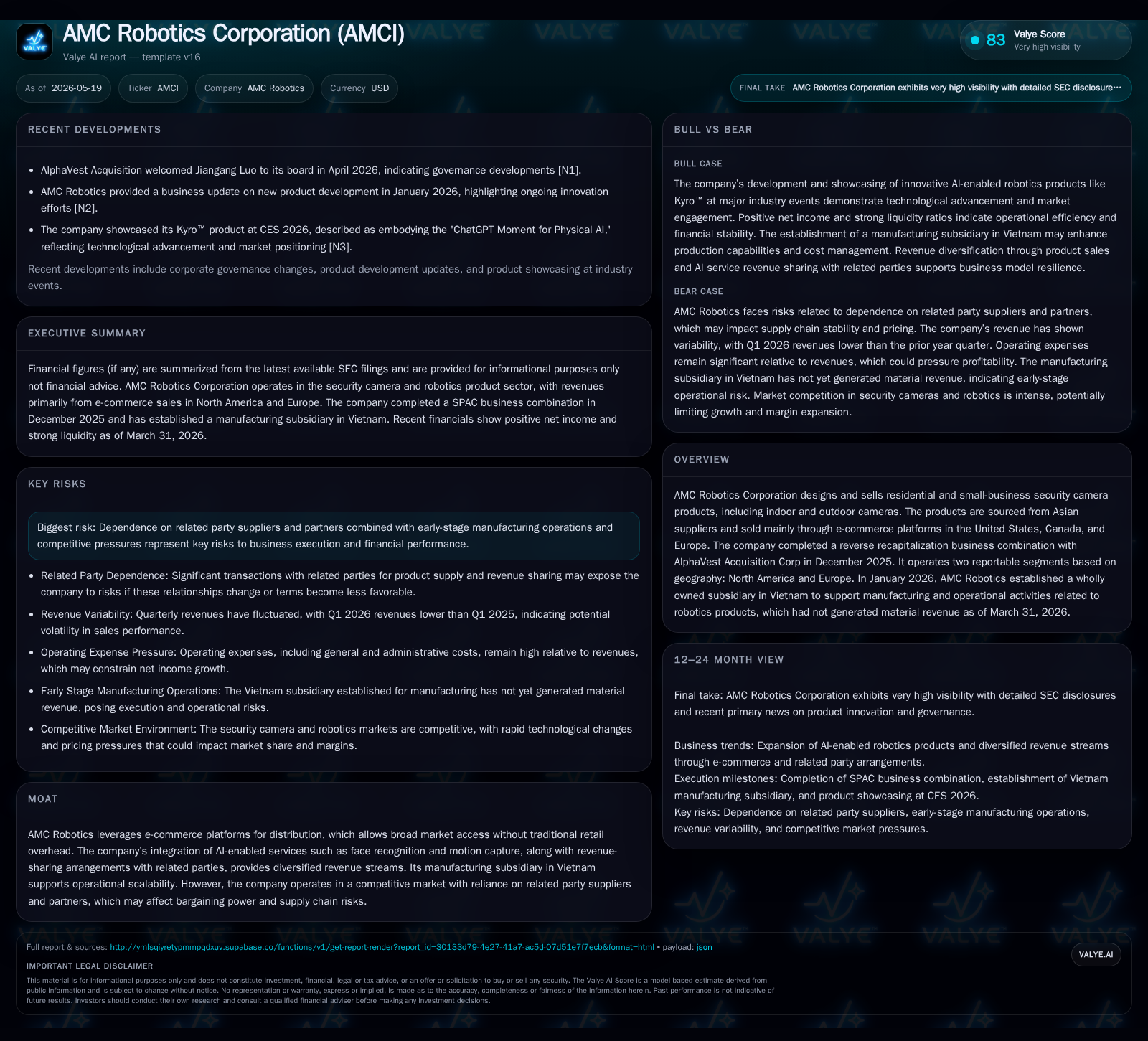
AMC Robotics reported substantial improvement in cost of revenues in its latest quarter, reflecting operational leverage following its reverse recapitalization. The company’s business model centers on AI-integrated residential and small-business security cameras distributed primarily via e-commerce across North America and Europe. Its recent launch of a Vietnam-based manufacturing subsidiary aims to bolster operational scalability. Supply chain reliance on related parties and early-stage manufacturing represent meaningful execution risks. Key growth drivers include vertical integration opportunities from Asian manufacturing and expanding AI service revenues.
Latest Quarterly Operating Highlights: Cost Efficiency and Revenue Recognition Dynamics
In its latest Q1 2026 Form 10-Q filing [S2], AMC Robotics disclosed significant improvements in cost of revenues compared to the prior year quarter. The company recognized product sales revenue on a gross basis acting as principal across e-commerce platforms — maintaining control over pricing, product inventory risk, and customer fulfillment. Cost of revenues encompasses product costs sourced primarily from related-party suppliers in Asia, alongside e-commerce platform fees, delivery, freight expenses, and inventory impairment losses.
Notably, cost of revenues plunged from approximately $1.3 million in Q1 2025 to $163,960 in Q1 2026 [S2]. This sharp reduction points to enhanced supply chain management or operational leverage after the company's reverse recapitalization completed in December 2025 [S1]. Although total revenue figures for Q1 are not explicitly cited beyond annual data [F1], the improved margin dynamic is underscored by an increase in gross profit to over $1 million compared to $488K in prior year quarter [S12].
Inventory impairment losses also declined markedly quarter-over-quarter ($309 vs. $25,425), suggesting better demand forecasting or tighter inventory controls.
Business Model Overview: Security Cameras with AI-Enhanced Features via E-Commerce Platforms
AMC Robotics designs and sells residential and small-business security camera products featuring both indoor and outdoor models integrated with artificial intelligence capabilities such as face recognition and motion capture [S1]. These advanced features serve as key differentiators within a market often characterized by commoditized hardware devices.
The company distributes primarily through major e-commerce platforms across North America and Europe—its two key reportable segments [S15]. This distribution approach reduces traditional retail overhead costs but requires effective digital marketing strategies to drive customer acquisition amid crowded online marketplaces.
Revenue streams vary between direct product sales managed as principal transactions on e-commerce platforms—where AMC controls pricing and assumes inventory risk—and diversified income through revenue-sharing arrangements with related parties offering AI services tied to its hardware products [S2]. This revenue mix expands AMC’s monetization beyond one-time device sales into recurring service-based streams.
However, reliance on related-party suppliers remains substantial for both components procurement and AI service collaborations, creating material implications for bargaining power and supply continuity.
Industry Context: Competitive Pressures, Supplier Relationships, and Distribution Models
The security camera industry is intensely competitive with multiple global players offering general-purpose solutions at varying price points. Pricing pressure inherent in this commoditized sector weighs on gross margins broadly.
Against this backdrop, AMC’s strategy leverages AI integration to enhance product relevance—features like face recognition improve user value beyond basic surveillance functionalities—and sell through scalable e-commerce channels enabling broad consumer reach without brick-and-mortar limitations.
Nonetheless, supplier dependence on Asian contract manufacturers associated with related parties specific to AMC limits AMC's negotiating leverage over component costs [S1], potentially constraining margin expansion under competitive pressure.
E-commerce distribution offers extensive market access but also subjects AMC to digital marketplace competition requiring continuous capitalization on marketing spend efficiency. Customer switching costs remain low given device substitutability but are somewhat mitigated by integrated software ecosystems tied to AMC’s AI services.
Additionally, early-stage Vietnam manufacturing support operations set up in January 2026 have yet to generate material revenue or capacity scale but represent a strategic attempt at vertical integration potentially mitigating supplier risks long-term [S10]
Growth Catalysts: Asia Manufacturing Expansion and AI Service Integration
AMC’s wholly owned Vietnam subsidiary focuses on ramping manufacturing capacity for robotics-related products that include their security camera lines or associated smart home robotics items [S10]. While no significant revenue has emerged yet as of March 2026, this move aligns with aims to vertically integrate production capabilities outside third-party related suppliers—potentially reducing input costs or enabling faster innovation cycles.
Concurrently, AMC’s AI embedded service offerings—including facial recognition algorithms and motion capture technology—extend product differentiation horizontally into value-added services that can generate incremental recurring revenues via subscription or licensing models linked directly or indirectly with camera hardware installed bases [S2].
This dual approach addresses both cost structure improvement through operational scaling as well as top-line enhancement via software ecosystem stickiness—characteristics sought after by industry participants targeting sustainable competitive advantage.
Risks and Constraints: Related-Party Supplier Dependence and Early Stage Manufacturing Challenges
Dependence on affiliated suppliers poses key risks for AMC Robotics. Related-party transactions may limit bargaining flexibility resulting in compressed margins or supply volatility if counterparties alter terms unexpectedly [S1]. Such bottlenecks appear critical considering the company's thin pricing power amid product commoditization.
The newly established Vietnam manufacturing arm has minimal operating history and no reported revenues while incurring administrative buildup costs [S10]. Transitioning from assembly setup to efficient volume production could introduce execution challenges including quality control issues or capital expenditure demands that stress liquidity profiles.
Furthermore, despite sharper inventory management progress seen recently (lower impairment losses), residual demand forecasting inaccuracies or underutilized capacity could persist as demand scales unevenly across geographies.
Competitive intensity continues escalating with larger incumbents leveraging scale advantages difficult for AMC to replicate immediately; price competition may restrict profitable growth absent successful niche differentiation through AI features.
Upcoming Developments: Monitoring Manufacturing Scale-up, AI Service Adoption, and Sales Milestones
Key near-term milestones include monitoring how quickly the Vietnam manufacturing subsidiary moves from initial operational setup towards meaningful production volumes impacting gross margins positively [S10]. Metrics such as inventory turnover improvements or fulfillment cycle reductions would provide tangible signs of progress.
Tracking customer adoption rates of AMC’s AI-enhanced security features will be critical in assessing the scalability of recurring revenue streams. Repeat purchase rates or subscription growth could be monitored indirectly through segment revenue disclosures or earnings commentary in upcoming filings.
Sales growth trends across North American and European segments via e-commerce platforms remain essential indicators of market acceptance; quarterly updates may reveal whether distribution scale is improving profitability alongside top-line growth.
A recent board refreshment mentioned in external news sources introducing Jiangang Luo suggests governance evolution aimed at strengthening strategic oversight during this transformative phase [N1].
Financial Snapshot: Liquidity Strength amid Operational Scaling Efforts
As of March 31, 2026, AMC Robotics held cash and cash equivalents totaling approximately $6.63 million against current liabilities under $773K—translating into a strong current ratio of about 14.5 evidencing excellent short-term liquidity headroom amidst ongoing investments [F1], [S2]. Total debt remains minimal near $820K last measured end-2024 with net debt structurally negative given cash holdings [F1].
Cost efficiencies realized in recent quarters paired with reduced impairment losses provide encouraging financial momentum though prudent cash burn monitoring remains warranted given early-stage manufacturing costs overheads detailed above.
This analysis is based solely on publicly available information including SEC filings through May 19, 2026. It does not constitute investment advice or research views concerning AMC Robotics Corporation securities.
Disclaimer: This is research-only, informational analysis and not investment advice. It may include AI-generated interpretation and general industry context. Always verify important details using primary sources.

Comments