
American Fusion Advances Kepler Integration Despite Substantial Liquidity Challenges
Following its reverse merger with Kepler Fusion Technologies, American Fusion is pivoting towards advanced fusion technology development while navigating significant financial constraints.
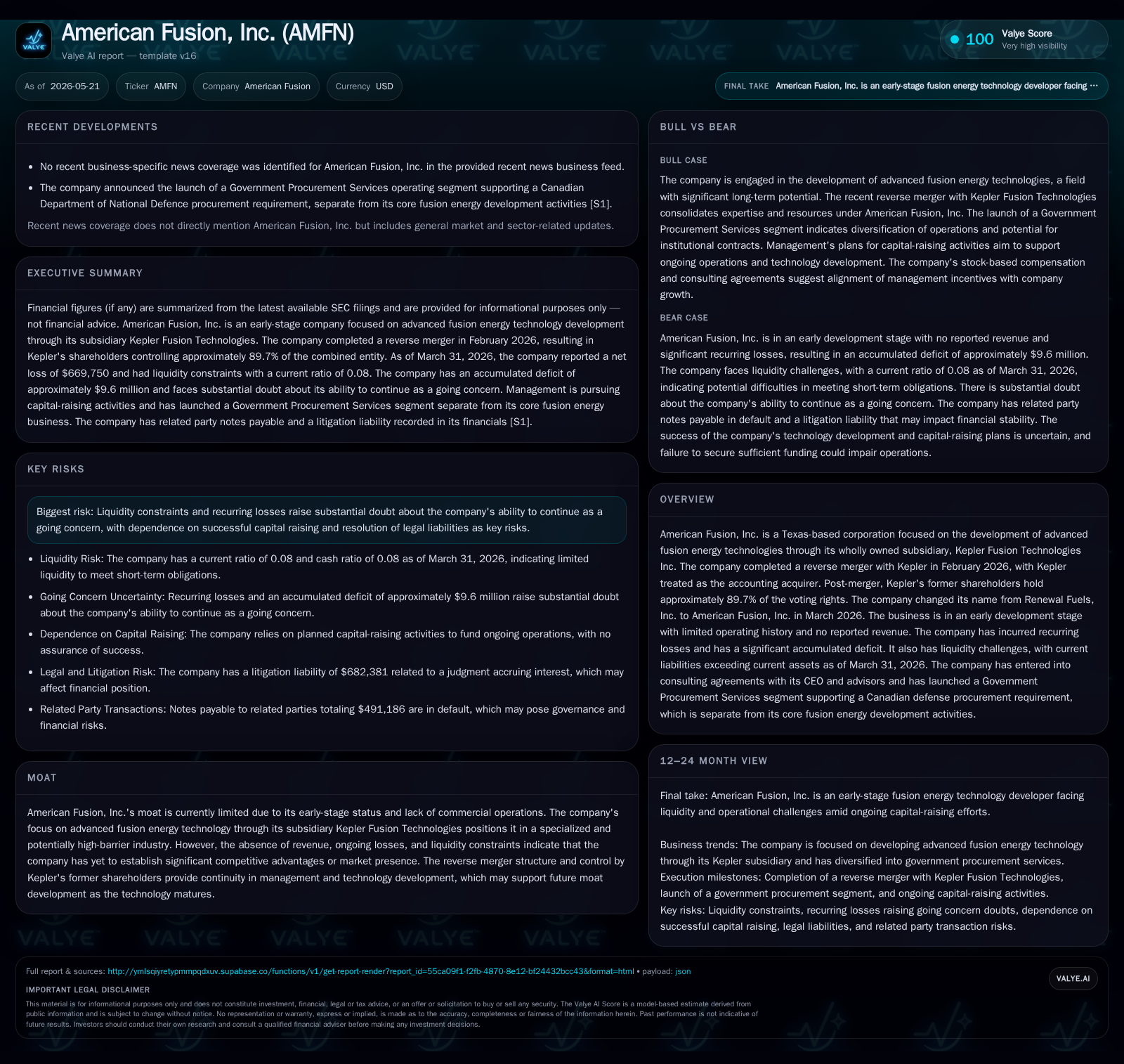
American Fusion, Inc. completed a reverse merger with Kepler Fusion Technologies in early 2026, repositioning itself as a development-stage advanced fusion energy company under Kepler’s operational control. Despite this strategic consolidation, the entity remains pre-revenue with a substantial accumulated deficit and glaring liquidity challenges, highlighted by a current ratio of 0.08 as of Q1 2026. The firm’s growth prospects hinge on technological advances within its Kepler subsidiary and expanding government procurement activities, yet continued reliance on capital raises and resolution of legacy legal liabilities poses near-term risks.
Recent Operating Update: The Impact of the Kepler Reverse Merger
American Fusion, Inc.'s May 2026 quarterly filing clearly signals a pivotal strategic reset following its February 2026 reverse merger with Kepler Fusion Technologies Inc. [S2], [S5], [S6]. Although American Fusion remains the legal acquirer, consistent with ASC 805-40 guidance, Kepler is treated as the accounting acquirer due to it obtaining approximately 89.7% voting rights post-merger, controlling board seats, and holding management leadership positions. This structure reflects that the consolidated financials essentially continue Kepler's operations while folding American Fusion’s non-operating shell into the combined public entity.
This move consolidates control and technological assets under Kepler's stewardship but leaves American Fusion without standalone operating history or revenue generation. The Q1 2026 balance sheet reveals extremely tight liquidity: cash and equivalents totaled just $99,594 against current liabilities exceeding $1.2 million—a current ratio of roughly 0.08 [F1]. These figures underline substantial near-term funding dependency despite recent capital raises through prepaid warrants [S3], [S12].
Business Model: Early-Stage Fusion Technology and Non-Revenue Operations
American Fusion functions primarily as a holding company for Kepler Fusion Technologies—a subsidiary focused on developing advanced fusion energy technologies using the Texatron™ platform [S2], [S4]. The business model currently centers on research and development activities aimed at advancing fusion system prototypes rather than commercial sales.
No revenue has been reported to date, reflecting both the nascent stage of fusion energy commercialization industry-wide and the company's own developmental timeline [S2]. Alongside technology development efforts, American Fusion launched a Government Procurement Services operating segment in early 2026 that targets ancillary contracts such as institutional procurement for defense agencies—evidenced by a transaction supporting Canada's Department of National Defence [S4]. This diversification aims to leverage government relationships for incremental contract wins alongside core R&D.
Revenue mechanics in this model will eventually depend on licensing or selling technology rights to utilities or energy providers who pay for fusion-generated power solutions after suitable performance validation. Currently, customer adoption is prospective rather than realized.
The company also maintains consulting agreements with key executives and directors (notably CEO Brent Nelson) that provide advisory continuity during this formative phase [S16].
Industry Context: Positioning Within the Advanced Energy Innovation Sector
American Fusion operates within an industry marked by high technology barriers—fusion energy development requires sustained significant capital investment in experimental reactors and infrastructure amid complex federal regulatory regimes governing nuclear technologies. As an early-stage fusion developer without commercial output, AMFN typifies specialized innovation ventures characterized by long timelines to market entry and uncertain regulatory pathways.
Fusion energy firms face steep customer adoption hurdles chiefly because of extended R&D cycles before achieving economically viable energy generation. Capital intensity also constrains scaling; consequently, many players remain pre-revenue for years. AMFN's niche position within this value chain aligns it closer to research institutions than utility operators at present.
Competitive Dynamics: Challenges in Building a Sustainable Moat
Despite promising advanced technology through its wholly owned subsidiary, AMFN’s current competitive moat is minimal due to (i) lack of commercial operations or product revenues, (ii) absence of substantial intellectual property monetization at scale, and (iii) negligible pricing power or customer switching costs given no end-user deployments yet [S2]
The firm’s differentiation hinges on evolving proprietary fusion technology platforms which are unproven commercially but could present high technical barriers if successfully developed. Nonetheless, ongoing liquidity pressures limit resource availability to fully exploit these potential advantages.
The strategic consolidation with Kepler centralizes technical expertise but does not remove fundamental uncertainties endemic to early-stage clean energy innovation businesses competing against alternative renewable technologies.
Growth Drivers: Technology Development and Government Procurement Initiatives
AMFN's primary levers for future growth are tied directly to milestone-driven maturation of its Texatron™ fusion platform under Kepler’s technical leadership supplemented by government procurement wins that lend non-dilutive cash inflows [S4]. Incremental validation benchmarks in reactor design efficacy will underpin eventual licensing or commercialization opportunities.
Government procurement initiatives diversify revenue beyond research funding alone—a pragmatic step given lengthy commercial fusion timelines. These institutional contracts may provide intermittent volume boosts anchored by defense or energy sectors seeking next-generation capabilities.
Execution progress can be monitored through disclosed contractual wins within government segments as well as noted increases in stock-based compensation indicative of talent retention amidst development ramp-up [S27]
Risks and Constraints: Liquidity, Legal Liabilities, and Commercialization Hurdles
Liquidity stands out as the dominant risk factor; as of March 31, 2026, current liabilities ($1.21 million) exceed current assets ($99k) by more than twelvefold yielding a razor-thin current ratio of ~0.08 [F1]. Such imbalance creates considerable doubt about going concern status without imminent successful capital injections [S8], [S9], [S25].
Alongside liquidity pressures are accrued litigation liabilities totaling approximately $682k arising from legacy disputes dating back prior to merger activity [S14], [S19]. The firm continues active legal efforts to overturn related judgments but carries financial burden meanwhile.
Notes payable held by related parties remain in default with principal around $491k bearing interest rates from 8% up to punitive default levels near 15% annually further compounding financial stress [S9],[S28]. Governance complexity is elevated due to share structures granting super-voting rights via preferred shares controlled by CEO-affiliated entities post-merger [S7],[S16].
Commercialization risks persist given uncertain regulatory approval paths inherent in nuclear fusion projects along with required scale-up from prototype validation to market-ready systems.
Outlook and Key Milestones: Capital Raising, Technology Advances, and Regulatory Touchpoints
Looking forward, key operational milestones will center on executing planned prepaid warrant financing facilities providing up to $3 million additional liquidity from accredited investors throughout 2026 [S3], [S12]. Monitoring drawing pace from these facilities offers insight into near-term runway preservation.
Progression toward definitive technical validations of fusion platforms will be critical inflection points influencing broader market credibility and partnership interest.
Regulatory interactions remain nascent but represent pivotal future catalysts as government policies continue evolving regarding emerging nuclear technologies.
Resolution of outstanding litigation matters will also help clarify contingent liability exposures affecting investor confidence.
Financial Summary: Quarterly Liquidity and Profitability Snapshot
During Q1 2026 American Fusion recorded a net loss nearing $670k driven by operating expenses totaling approximately $632k stemming largely from professional fees, consulting compensation including CEO remuneration at $15k monthly, marketing expenditures related to government procurement segment initiation, accrued interest expenses associated with notes payable defaults plus legal liabilities accruals [F1], [S27], [S29].
Cash positions improved substantially sequentially—from roughly $2.5k at year-end 2025 to nearly $100k by March-end—primarily due to equity issuance proceeds via prepaid warrant financings totaling over half a million dollars last quarter [F1], [S7], reflecting external support albeit insufficient relative to short-term obligations exceeding $1.2 million which underscore acute working capital strain.
This financial posture necessitates continued focus on capital raising execution alongside disciplined cost management during technology build-out phases.
DISCLAIMER: This analysis is provided solely for informational purposes based on SEC filings and does not constitute investment advice or research views. Readers should perform their own due diligence before making any financial decisions regarding American Fusion Inc.
Disclaimer: This is research-only, informational analysis and not investment advice. It may include AI-generated interpretation and general industry context. Always verify important details using primary sources.

Comments