
AMERISAFE's Q1 2026 Pressure from Underwriting Costs Contrasts with Niche Strengths
AMERISAFE’s latest quarter reveals margin pressures despite its specialized workers’ compensation focus.
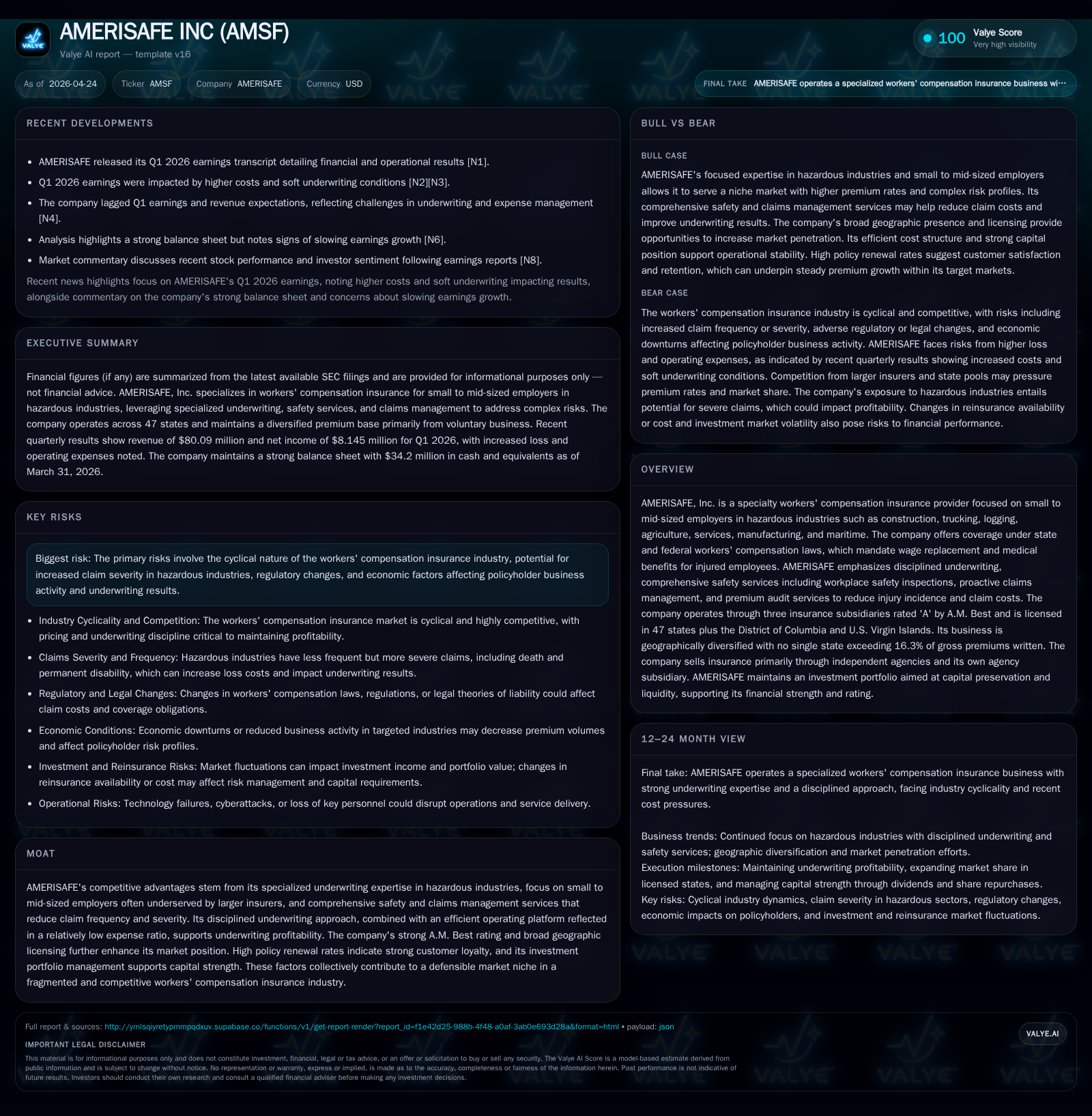
In Q1 2026, AMERISAFE reported immaterial net realized losses and a reduction in net unrealized losses on equity securities compared to last year but faced softness in underwriting profits due to rising claims costs. The company’s focused business model in hazardous industries supports pricing power and safety services that underpin strong customer retention, yet recent cost pressures indicate tougher market dynamics. Geographic diversification and licensing in 47 states provide expansion optionality, although growth is constrained by regulation and cyclical claim cost fluctuations. Monitoring upcoming premium rate adjustments and claims severity will be critical indicators for the company’s return to consistent profitability.
Recent Operating Update
AMERISAFE’s Q1 2026 results delivered a nuanced picture: while net realized investment losses were immaterial compared to last year’s similar levels, net unrealized losses on equities were halved ($1.7 million vs. $3.2 million in Q1 2025) indicating relatively stable investment performance amid volatile markets [S2]. However, the company flagged softness in underwriting profitability driven primarily by increased claim severity and frequency consistent with their exposure to hazardous industries such as construction and trucking — sectors where injury claims tend to be less frequent but more severe [S3; N2]. These dynamics contributed to a first-quarter earnings miss relative to estimates according to multiple market reports [N2], signaling underlying cost pressures outweighing incremental premium growth.
Business Model Overview
AMERISAFE is a specialty workers’ compensation insurer serving predominantly small-to-mid-size employers engaged in hazardous industry segments including construction, trucking, logging/lumber, agriculture, services (such as telecom infrastructure maintenance), manufacturing, and maritime operations [S1]. Workers' compensation coverage is mandated under state and federal laws ensuring wage replacement and medical benefits for on-the-job injuries. In these hazardous sectors, injury severity drives higher-than-average premiums per payroll dollar — a structural underpinning for pricing power.
The company's revenue is generated principally through policy premiums collected from employers who seek coverage compliance and financial protection against workplace injury liabilities. Key differentiators are their disciplined underwriting expertise—critical for selecting risks within complex hazardous operations—and comprehensive service offerings beyond pure insurance: proactive workplace safety inspections aim to reduce injury incidence; dedicated field claims managers engage promptly with injured employees and providers to control claim costs; premium audits ensure appropriate charges aligned with actual payroll exposure; all contribute to lowering total claim expense burdens [S1].
Three main insurance subsidiaries — American Interstate Insurance Company (AIIC), Silver Oak Casualty Inc., and American Interstate Insurance Company of Texas (AIICTX) — operate under an 'A' A.M. Best rating signifying robust capital adequacy and operational strength. This endorsement enhances trustworthiness especially given the employer size focus where larger insurers may not emphasize clientele of this scale [S1]. The policy renewal rates around 93% highlight strong customer loyalty attributed to the integrated service model.
Industry Structure & Competitive Position
Workers’ compensation insurance is inherently fragmented geographically due to varying state regulations and legal frameworks governing coverage terms. AMERISAFE counters fragmentation with broad licensing across 47 states plus DC and U.S. Virgin Islands but ensures no single state concentration exceeds roughly 16.3% of gross premiums written ensuring geographic risk diversification [S10]. This wide licensing also functions as a strategic asset facilitating opportunistic expansion without needing new filings.
Competition is intense among insurers servicing hazardous industries marked by diverse employer sizes. Larger carriers often prioritize volume over tailored risk management for smaller or mid-market accounts; AMERISAFE fills this gap by combining specialized underwriting analytics with enhanced safety programs that mitigate claim frequency/severity — a meaningful moat against commoditized offerings . Their relatively lean expense ratio (~30.4% in FY2025) further improves profitability potential versus peers who may have heavier operating cost structures [S14].
Regulatory oversight imposes residual market mechanisms such as mandatory pooling arrangements affecting underwriting results but also protect premium adequacy through rate approval processes at the state level. AMERISAFE participates selectively in these pools primarily for compliance purposes rather than volume expansion emphasizing voluntary underwriting discipline [S10].
Growth Drivers & Constraints
Growth potential emerges from multiple vectors:
- Market Penetration: Estimated sub-5% market share per state suggests room for share gains within existing jurisdictions using data-driven underwriting analytics coupled with value-added services such as safety consultations.
- Pricing Discipline: Hazardous industry employers typically pay elevated rates reflecting inherent risk; AMERISAFE strives to maintain premiums commensurate with evolving loss costs rather than chase market share imprudently.
- Geographic Expansion: Existing licenses offer optionality for expansion pending favorable regulatory environments or local market conditions.
- Customer Retention: High renewal rates stabilize earned premium bases providing predictability.
However, sustainability depends on mitigating growth constraints:
- Claims Severity Volatility: The cyclical nature of work injuries (including catastrophic events) can cause sudden spikes in loss ratios impacting earnings volatility.
- Regulatory Risks: Changes in workers’ compensation statutes or residual market reforms may alter underwriting economics.
- Economic Activity: Fluctuations in the underlying hazardous industry activity directly affect payroll exposure volumes.
What To Watch Next
Key near-term milestones include:
- Monitoring upcoming premium rate filings or revisions signaling management confidence in underwriting loss trend outlooks.
- Claims development patterns in hazardous segments for visibility into severity/frequency normalization following recent cost upticks.
- Investment portfolio trends especially unrealized equity valuation impacts or credit allowance modifications given low but non-zero exposures as of Q1 ’26 [$0.1M credit loss allowance on held-to-maturity fixed income] [S2].
- Policy renewal rates updates beyond the historical ~93% level reflecting client satisfaction amid economic uncertainty.
- Regulatory updates at major states contributing >5% gross premiums (e.g., Florida at ~16%) which can disproportionately affect profitability if adverse changes occur.
Financial Profile
Historical performance (annual)
| FY | Rev ($mm) | Net ($mm) | CFO ($mm) | Capex ($mm) | Rev YoY | Net YoY |
|---|---|---|---|---|---|---|
| 2025 | 317 | 47 | 11 | 2 | +2.7% | -15.0% |
| 2024 | 309 | 55 | 24 | 1 | +0.7% | -10.7% |
| 2023 | 307 | 62 | 30 | 1 | +4.1% | +11.7% |
| 2022 | 295 | 56 | 28 | 2 |
Source: SEC companyfacts cache [F1].
Capital returns and efficiency (annual)
| FY | Div ($mm) | FCF ($mm) | ROE% |
|---|---|---|---|
| 2025 | 63 | 9 | 18.7 |
| 2024 | 71 | 23 | 21.5 |
| 2023 | 56 | 29 | 21.2 |
| 2022 | 78 | 26 | 17.5 |
Source: SEC companyfacts cache [F1].
As of March 31, 2026, AMERISAFE held $34.2 million in cash & equivalents supporting liquidity needs comfortably [F1]. Their investment portfolio remains conservative, dominated by municipal bonds issued by states/political subdivisions ($313.5M amortized cost) alongside corporate bonds (~$16M) and Treasury obligations totaling several million dollars [S2]. Credit losses remain minimal ($0.1M allowance), suggesting sound portfolio quality.
Annual revenues reached $317 million in FY2025 representing a modest ~2.7% increase over FY2024 indicating steady top-line progression amid challenging market conditions [F1]. However, net income declined about 15% year-over-year to $47 million driven by widening underwriting losses partially offset by investment income erosion [$47M vs $55M prior] [F1]. Operating cash flow decreased substantially (-54%), influenced likely by timing differences or elevated claim payments while capex increased notably though still modest relative to overall operations ($2.15M FY2025) [F1]. Return on equity stands near 18.7%, reflecting respectable profitability despite recent earnings headwinds [F1].
Overall balance sheet strength remains intact supporting ongoing operational flexibility and shareholder returns via dividends ($62.7 million distributed in FY2025) albeit buybacks have been minimal recently [F1]. No material new indebtedness is evident from quarterly disclosures reinforcing capital solidity [S5][F1].
Conclusion
AMERISAFE continues leveraging its niche specialization within hazardous industries offering tailored workers’ compensation coverage supplemented by safety and claims management support that engenders customer loyalty and pricing leverage. The latest quarter tempered optimism as elevated claim costs pressured margins revealing the cyclical challenges inherent in this segment’s risk profile. Broad geographic licensure plus diligent underwriting discipline afford strategic optionality though growth will hinge on navigating regulatory complexities alongside maintaining tight claims controls. Investors should track ongoing claims trends closely alongside regulatory backdrop changes while noting financial stability underscored by solid capital reserves and conservative investment posture.
Disclaimer: This is research-only, informational analysis and not investment advice. It may include AI-generated interpretation and general industry context. Always verify important details using primary sources.

Comments