
AMERISAFE Inc. Strengthens Premium Growth While Managing Rising Claims Costs in Q2 2026
AMERISAFE’s Q2 results reflect robust premium growth supported by its hazardous industries niche, tempered by elevated claims costs that pressure underwriting margins.
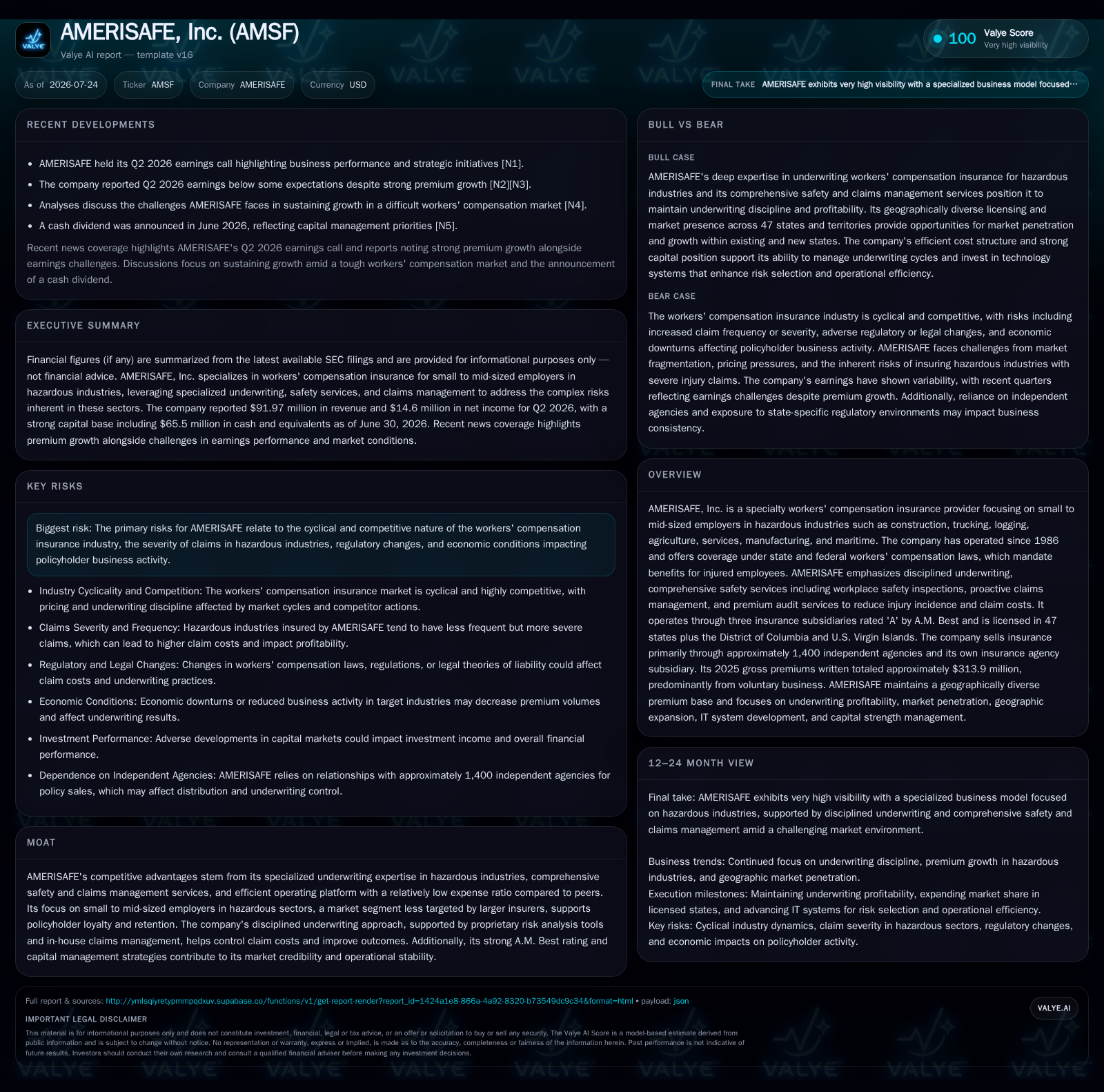
AMERISAFE, a specialty workers' compensation insurer focused on hazardous small to mid-sized employers, reported strong written premium growth in Q2 2026. However, rising claims severity amid challenging market conditions pressured underwriting profitability, highlighting the importance of its disciplined risk selection and comprehensive safety and claims management services. The company’s continued expansion in premium volumes and stable policy retention underscore its durable competitive position, while loss cost volatility and regulatory risks remain key headwinds. Monitoring combined ratio trends and claim frequency will be critical to assessing margin sustainability in upcoming quarters.
Q2 Operating Snapshot: Premium Growth Meets Claims Cost Headwinds
AMERISAFE reported a meaningful increase in written premiums for the second quarter ended June 30, 2026, continuing a trend of leveraging its specialized focus on high-rate hazardous industries such as construction, trucking, logging, manufacturing, agriculture, and maritime operations [S2], [S3]. This segment’s inherent risk profile commands higher-than-average premium rates per payroll dollar due to lower-frequency but high-severity injury exposures. However, alongside this premium growth came an escalation in loss costs attributed to more severe claim incidences typical of these lines of business. The heightened claims severity pushed the loss ratio upwards for the quarter, impairing overall underwriting profit margins despite higher top-line volumes [S2]. The tension between premium growth and rising claims cost is a critical near-term dynamic that tests AMERISAFE's risk selection discipline.
The results emphasize that while AMERISAFE can sustain pricing power owing to its niche expertise and higher-risk customer base willing to pay elevated rates reflecting exposure severity, controlling loss costs remains the pivotal factor for profitability. Confirmation of margin recovery or further deterioration will depend notably on subsequent quarters’ combined ratio trends, particularly whether claims management practices effectively mitigate escalating severities.
Specialized Underwriting Focus in Hazardous Industries Supports Pricing Power
AMERISAFE’s business model centers on underwriting workers’ compensation insurance policies for small to mid-sized employers engaged in hazardous sectors often underserved by larger insurers due to complexity and volatile claims environment [S1]. This specialization enables AMSF to maintain stronger pricing leverage since these industries face legislated requirements mandating workers’ compensation coverage at rates that reflect their elevated workplace dangers.
By focusing exclusively on this niche market, AMERISAFE benefits from higher average premiums per policy unit relative to generalist insurers offering broader workers’ compensation products across less risky sectors. Moreover, the tailored underwriting approach deploys proprietary risk assessment tools permitting selective acceptance of policyholders with acceptable risk characteristics despite inherent industry volatility. Thus, AMSF preserves policy quality over sheer volume growth – an important economic distinction underpinning durable underwriting margins when claims costs remain controlled.
Furthermore, AMSF's licensing across 47 states plus D.C. and the U.S. Virgin Islands expands addressable markets while maintaining regulatory compliance challenges confined within manageable geographies. The company's “A” rating from A.M. Best further bolsters pricing credibility among brokers and clients sensitive to carrier financial strength.
Safety and Claims Management as Differentiators in Loss Control
A cornerstone of AMERISAFE’s value proposition lies in delivering comprehensive safety services directly at client workplaces alongside vigorous claims management protocols [S1], [S2]. These offerings include detailed workplace safety inspections aimed at identifying hazards preemptively and advising corrective actions intended to reduce injury incidence. Effective implementation can moderate claim frequency trends – a critical lever when facing potential increases in severity.
In parallel, AMERISAFE deploys proactive Field Case Managers (FCMs) who engage early with injured employees, employers, and treating physicians to facilitate proper medical treatment paths while guiding claim development towards resolution efficiently. This direct intervention capability influences outcomes positively by preventing claim inflation through inappropriate care or delays.
The synergy between these safety inspections and hands-on claims administration not only supports underwriting discipline but represents operating leverage; incremental investment in these services can reduce overall claims expense significantly over time if managed effectively. Key performance indicators such as frequency and average severity of workplace injuries represent metrics where AMSF must demonstrate sustained improvement to offset natural industry volatility.
Competitive Dynamics Within Specialty Workers’ Compensation Insurance
Within the broader property and casualty landscape specializing in workers’ compensation for high-risk sectors, AMERISAFE occupies a distinct niche by targeting smaller-scale employers often overlooked by national carriers favoring larger commercial accounts. Peers such as AmTrust Financial or The Hartford’s specialized workers’ comp segments operate similarly but with different scale or geographic emphases.
AMERISAFE’s expense ratio remains relatively low compared with regional competitors primarily due to operational efficiencies achieved through centralized underwriting models coupled with disciplined agency commission structures via approximately 1,400 independent agencies [S1]. Expense management is crucial since heavy commission payments or overhead could erode benefits gained from premium rate adequacy.
The company also maintains robust policy retention rates illustrating stable relationships with its broker network and client base even amid industry competitiveness over price points or coverage terms. Retention reflects trust developed through safety engagement initiatives and consistent claims handling responsiveness – intangible advantages difficult for new entrants or large generalist insurers to replicate seamlessly.
Growth Prospects Tied to Industry Payrolls and Regulatory Environment
Growth drivers for AMERISAFE predominantly link to expansion in employment levels across hazardous industries it serves since workers’ compensation premiums are largely payroll-based [S1]. As construction activity cycles upward or trucking fleets expand logistics reach post-pandemic recovery phases, associated wage bases rise supporting premium volume increases organically.
Additionally, regulatory developments mandating enhanced workers’ compensation coverage or adjustments in prescribed benefits can drive higher average premium rates per policy dollar. Such changes tend not only to increase revenue but also intensify operational demands requiring careful cost controls.
Technological improvements—particularly digital tools enhancing underwriting precision or accelerating premium audits—also offer incremental growth pathways by tightening risk selection accuracy and reducing fraud/misclassification risks embedded within payroll reporting processes.
Strategic partnerships with independent agencies extend market penetration capacity beyond internal sales teams alone while geographic licensing expansions provide future optionality should targeted states adjust workers’ compensation frameworks favorably towards insured market share gains from self-insured status shifts.
Risks From Claim Severity, Regulatory Shifts, and Economic Cycles
AMERISAFE operates inherently exposed to cyclical risks stemming from unpredictable fluctuations in workplace injury severity including catastrophic events manifesting as paralysis or death common within target industries [S1]. Even sporadic spike occurrences can significantly shift loss ratios adversely impacting periodic underwriting results.
Regulatory changes pose ongoing uncertainty; modifications either tightening benefit requirements or altering pricing flexibility could penalize carriers under fixed-cost structures limiting prompt rate pass-through abilities. Moreover, heightened competition from larger insurers leveraging broader product portfolios could compress AMSF’s achievable margin ceilings if pricing differs materially without compensatory service differentiation.
Economic downturn scenarios contracting insured payroll bases reduce total premium volumes even if unit risk persists unchanged - adversely affecting scale economics critical for fixed-cost absorption within operating expense structures.
Other risks include inaccuracies during premium audits potentially causing adverse selection scenarios if client payrolls are underestimated leading to subsequent reserve inadequacies or delayed claims recognition complicating reserving assumptions.
Key Metrics to Watch: Policy Retention, Combined Ratio, Premium Trends
Investor focus should concentrate on forthcoming quarterly milestones including:
- Policy retention rate stability signaling resilience of broker-client relationships despite competitive pressure;
- Movement in combined ratio reflecting aggregate effectiveness balancing loss ratios against operational expense efficiencies;
- Premium rate progression confirming continued pricing power amidst evolving market conditions;
- Claims frequency/severity trajectory changes indicating success levels of implemented safety programs;
- Reserve adequacy monitoring emerging through actuarial assumptions revisions impacting loss reserves carried on balance sheet. These indicators function collectively as real-time barometers validating management’s strategy execution amid external uncertainties.
Financial Profile Discussion: Capital Position and Reserve Adequacy
As of June 30, 2026, AMERISAFE reported $65.5 million in cash and equivalents providing healthy liquidity support suitable for statutory surplus requirements attendant with insurance operations [F1], [S2]. The company maintains a conservatively structured investment portfolio primarily comprising fixed maturity securities classified as available-for-sale with amortized costs reflecting unrecognized losses largely attributable to interest rate environments rather than credit concerns [S2].
The trio of operating insurance subsidiaries retaining “A” ratings from A.M. Best signal both capital adequacy strength and operational soundness supportive of sustainable underwriting activity levels [S1]. Maintaining favorable credit ratings contributes positively towards distribution channel confidence particularly among independent agencies where carrier financial strength influences placement decisions.
Reserve adequacy remains fundamental given the long-tail nature of workers’ compensation liabilities; careful actuarial calibration ensuring carried reserves appropriately reflect ultimate incurred losses affects both earnings volatility potential and capital utilization efficiency.
Working capital availability coupled with prudent balance sheet positioning enables AMSF to meet future claim obligations while investing strategically into expanded safety services infrastructure designed ultimately to curb future loss cost escalation creating positive feedback loops into operating margins over time.
This analysis synthesizes publicly filed quarterly updates alongside annual disclosures emphasizing AMERISAFE Inc.'s specialty focus within the workers' compensation insurance niche servicing hazardous industries. It outlines recent operational developments highlighting growth opportunities juxtaposed against challenges from escalating loss costs inherent in high-risk employer segments. Readers should interpret evolving combined ratio dynamics closely as indicative signals regarding durability of the company's disciplined underwriting approach under changing market conditions. No forward-looking research views are provided herein.
Disclaimer: This is research-only, informational analysis and not investment advice. It may include AI-generated interpretation and general industry context. Always verify important details using primary sources.

Comments