
Hartford Insurance Group Advances Premium Growth and Underwriting Gains Amid P&C Segment Dynamics
The Hartford reports moderate earned premium growth and underwriting improvements in Q2 2026 driven by Business Insurance gains, offset by challenges in Personal Insurance and Employee Benefits expense pressures.
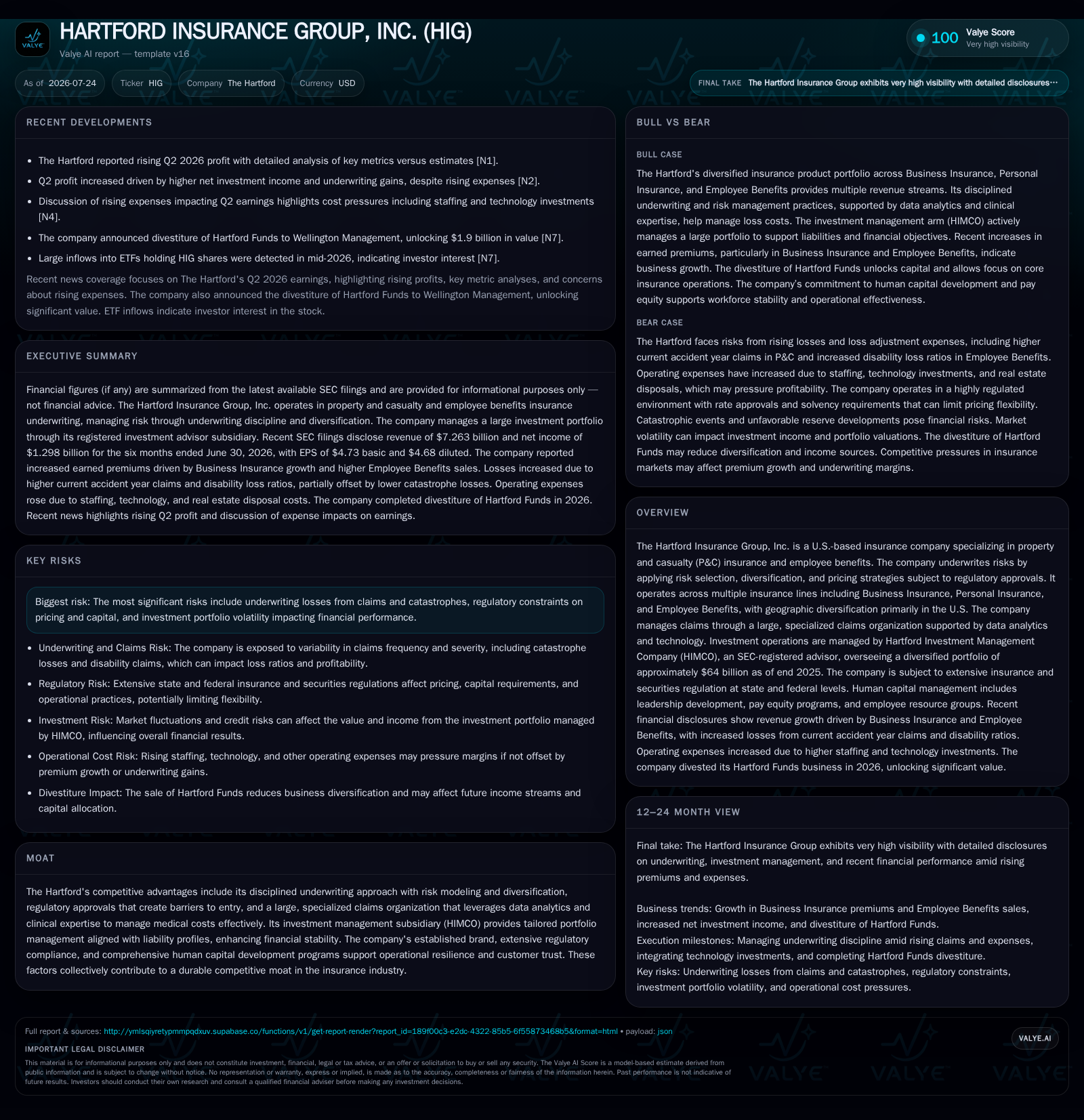
In its latest quarterly report ending June 30, 2026, Hartford Insurance Group posted a 5% increase in earned premiums primarily led by business insurance rate hikes and new business growth. The company’s property and casualty underwriting saw improvement with lower catastrophe losses and favorable loss ratios in Personal Insurance, although Business Insurance faced a higher loss ratio. Employee Benefits earnings were pressured by rising disability claims and expenses. Investment income strengthened due to higher asset levels and realized gains. Regulatory approval for pricing remains critical alongside tight expense management to sustain profitability in a competitive and highly regulated U.S. insurance market.
Recent Operating Update
The Hartford Insurance Group’s Q2 2026 results reveal a nuanced operational landscape shaped by solid premium growth yet mixed underwriting outcomes across its segments [S2], [S3]. Total earned premiums rose by $628 million or 5%, mainly fueled by a 7% increase in Business Insurance reflecting broad pricing increases approved across multiple lines of business alongside stronger new business volume. Conversely, Personal Insurance experienced a modest contraction of about 1% due primarily to reduced automobile policy counts, partially balanced by rate hikes and homeowner insurance pricing advancement [S2]. Employee Benefits also contributed positively with earned premium growth driven by more new sales across their product suite and greater exposure on existing accounts coupled with high persistency exceeding 90%.
From an underwriting perspective within Property & Casualty (P&C), the company reported a higher underwriting gain versus the prior year quarter—attributable chiefly to decreased current accident year catastrophes compared to the prior period's higher storm activity concentrated geographically in the southern and midwestern U.S., as well as better loss ratios in Personal lines [S2]. However, this gain was partially eroded by a less favorable underlying loss ratio in Business Insurance lines along with diminished favorable reserve development relative to the comparative quarter. In Employee Benefits, margin compression emerged through elevated loss ratios on short- and long-term disability products alongside increased infrastructure costs including staffing levels and technology investments, although group life insurance results showed improvement due to lower mortality trends [S2].
On the investment front, net investment income improved substantially reflecting an expanded invested asset base managed by their SEC-registered subsidiary Hartford Investment Management Company (HIMCO), reinvestment at approximately 5.4% rates exceeding average yields on maturing securities, and a swing from net realized losses last year to net realized gains coinciding with equity market recoveries and IPO-related gains [S2]. Separately, the recent agreement finalizing the sale of Hartford Funds has had financial implications: the recognition of a $251 million deferred tax asset pertaining to the difference between tax basis versus GAAP carrying value contributed materially to income from discontinued operations this quarter [S15]. This divestiture is expected to streamline Hartford’s operational focus while providing stable deferred payment streams over time.
Business Model Overview
Hartford operates principally as an insurer specializing in property & casualty insurance—encompassing both Business Insurance offered to corporate clients across commercial property, liability, workers' compensation; Personal Insurance such as auto and homeowners policies—and Employee Benefits including disability coverages managed largely on a fully insured or self-funded basis [S1]. Revenue streams arise primarily through earned premiums—the charges levied for policy coverage during stated periods supplemented by fees related to specific product lines such as Hartford Funds historically before divestiture—and investment income derived from deploying collected premiums into fixed maturities, mortgage loans, equities, alternative investments, and cash equivalents [S1], [S2].
Underwriting discipline governs risk acceptance using quantitative risk modeling tools that constrain aggregate exposures both per line of business and geographically; for example, limitations are placed on exposures tied to catastrophe-prone areas segmented by peril type (wind/hail/tornado/flood). Pricing functions are intricately linked with regulatory oversight where state insurance departments approve rate filings for most personal lines while workers' compensation products adjust pricing based on historical loss data. Excess & surplus lines within specialty sectors provide some flexibility absent stringent regulations [S1]. Claims management represents a substantial cost center supported by approximately 6,700 specialized claim personnel leveraging data analytics alongside clinical expertise to reduce loss severity particularly in medical-related benefit claims [S1].
Investment activities executed through HIMCO focus on achieving returns aligned with liability profiles emphasizing credit quality amid rising interest rate environments; recent reinvestment yields near 5.4% reflect an improvement over the average yields on assets sold or matured driving incremental net investment income [S2]. The decision to exit Hartford Funds marks a strategic pivot away from asset management fee income toward core insurance operations.
Industry Structure and Competitive Position
Operating within the broad U.S. P&C marketplace supplemented by employee benefits lines situates Hartford among nationally recognized insurers like Travelers Companies Inc., Chubb Corporation (specializing more heavily on global specialty lines), Progressive Corporation (noted for personal auto), Aflac Incorporated (focused on supplemental employee benefits), and diversified groups under Berkshire Hathaway’s umbrella. Regulatory frameworks impose considerable compliance costs but also erect entry barriers protecting incumbents equipped with scale advantages necessary for claims management infrastructure.
Hartford’s geographic footprint shows meaningful exposure across large commercial insurance markets: California accounts for roughly 12% of total earned premiums combining all segments followed by New York (9%) and Texas (9%), reflecting diversified concentration that balances regional catastrophe risk sensitivity [S1]. Its Lloyd’s Syndicate operation further extends specialty risks under unique capacity controls.
Competitively, Hartford leverages its mature actuarial models for underwriting precision supported by comprehensive claims assessment capabilities that help contain loss adjustment expenses—a differentiator when compared against peers whose expense ratios suffer from less developed infrastructures or narrower product breadths. Its systematic reinvestment approach under HIMCO helps smooth earnings volatility relative to peers more exposed to equity swings or real estate markets directly.
Growth Drivers
Key growth vectors include ongoing rate adequacy supported through state regulator approvals enabling premium rate increases particularly beneficial amid inflationary claim cost pressures. In Business Insurance segments where new business additions accelerate combined with rate hikes across most lines primarily drive earned premium expansion evident this quarter’s reported 7% gain [S2]. Improving technology adoption underpins tighter underwriting cycles allowing enhanced risk selection accuracy advancing margins over time.
Employee Benefits revenue growth relies upon rising participation based on favorable persistency metrics (>90%) coupled with expanding fully insured sales albeit modest recently; pressures on disability claims suggest opportunities exist for refined clinical case management approaches which could improve loss trends eventually [S2]. Additionally, capital redeployment following Hartford Funds’ sale may enable targeted acquisitions or innovation investments enhancing product offerings.
Favorable developments in reserve adequacy manifesting through positive prior accident year reserve release contribute directly to net income stability though these remain volatile depending on external market factors including claims climate shifts or natural disaster occurrences [S2]. Net investment income enhancements propelled by reinvesting maturing fixed maturities at mid-5% yields amid generally higher interest rates demonstrate durable earnings support unrelated to underwriting swings.
Risks and Watchpoints
Underwriting risk remains paramount given inherent uncertainty around claim frequency/severity patterns especially amid evolving labor markets affecting workers' compensation or broader economic shifts influencing commercial exposures. The observed increase in Employee Benefits disability loss ratios flagged this quarter signals trending risk requiring monitoring [S2]. Catastrophe losses remain volatile; while Q2 benefited from reduced event impact relative to last year’s concentrated storms across Southern/Midwest regions including California wildfire exposure previously reported, future quarters can abruptly reverse trends.
Regulatory risks persist as state insurance commissions control rate approval processes constraining price-setting flexibility vital for maintaining adequate margins—protracted approval timelines or restrictions could compress underwriting returns structurally over time [S1]. Emerging regulatory themes around climate-related disclosures introduce compliance costs plus potential underwriting impacts if legislative bodies impose stricter sustainability mandates.
Reserve adequacy judgment involves significant actuarial assumptions influenced by historical loss patterns combined with projections adapting for changing trends such as legal environment shifts or medical inflation that could result in material adverse reserve strengthening impacting earnings unpredictably [S7]. Investment portfolio volatility—particularly credit spread widening causing mark-to-market impairments—or rising default risks represent additional layers of financial uncertainty despite diversified portfolio management practices.
Finally, operational execution challenges tied to rising personnel costs amidst wage inflation particularly affecting claims staff or IT infrastructure spending may pressure expense ratios absent commensurate top-line growth or productivity efficiencies detailed this quarter [S2]. The post-close performance of the divested Hartford Funds business will also bear watching given earn-out payment structures influencing medium-term cash flow profiles.
What To Watch Next
Upcoming milestones include regulatory feedback on filed rate changes especially within Business Insurance where price elasticity interacts dynamically with competitive responses influencing policy count expansions observed recently [S2]. Monitoring Q3 earnings will reveal whether favorable catastrophe trends persist or reverse as hurricane season advances.
Claims frequency/severity indicators alongside Employee Benefits disability claim trend data will be key early warning flags for margin trajectory adjustments required through pricing or provisioning actions. Observing reserve development patterns—prior accident year reserves releases versus strengthening—will serve as indicators of underlying portfolio health beyond standard reported combined ratios.
On investment fronts, sustaining reinvestment yields amid volatile interest rate environments remains crucial alongside close surveillance of credit quality metrics within fixed maturities portfolios handled by HIMCO. As well anticipated are disclosures regarding integration of technology-enhanced underwriting tools improving risk segmentation accuracy aiming at improving mix/product profitability over horizon.
Lastly, following Hartford Funds’ transaction close effects on liquidity deployment strategy along with quarterly cash flows generated via contractual payments underpinning shareholder distributions form critical financial facets influencing capital allocation choices ahead.
Financial Profile Discussion
At June 30, 2026, The Hartford maintained strong capital resources supported by $1.5 billion held at the holding company level inclusive of fixed maturities and cash equivalents positioning it well for operational liquidity needs alongside disciplined leverage practices reported historically around $500 million total debt levels unchanged since earlier public disclosures reflecting conservative balance sheet management without recent material debt issuance or refinancing activities documented explicitly this quarter [S1], [F1], [S2].
The combined effect resulted in enhanced operating earnings reflective of balanced growth strategies emphasizing prudent risk selection allied with active capital deployment post-asset sale adjusting portfolio exposures dynamically responding to changing macroeconomic conditions notably interest rate movements fueling incremental yield pickup yet preserving credit quality conservatively managed through HIMCO expertise consistent with sector best practice benchmarks.
Overall financial positioning remains resilient amid evolving industry headwinds typical for property & casualty insurers confronted with cyclical claim volatility yet supported through effective diversification strategies spanning multiple insurance segments complemented by steady investment contribution robust capital buffers enabling sustainment of strategic initiatives including continued commitment towards technology enhancements facilitating operational scalability imperative for competitive differentiation moving forward.
This analysis is based exclusively on publicly filed financial statements and company disclosures without research view or investment advice. All specific financial measures have been cited directly from quarterly filings unless otherwise noted.
Disclaimer: This is research-only, informational analysis and not investment advice. It may include AI-generated interpretation and general industry context. Always verify important details using primary sources.

Comments