
Synchrony Financial Strengthens Retail Partnerships and Navigates Credit Volatility in Q2 2026
Synchrony’s Q2 2026 update reflects resilient loan origination via expanded retail channels and disciplined credit risk amid shifting consumer credit trends.
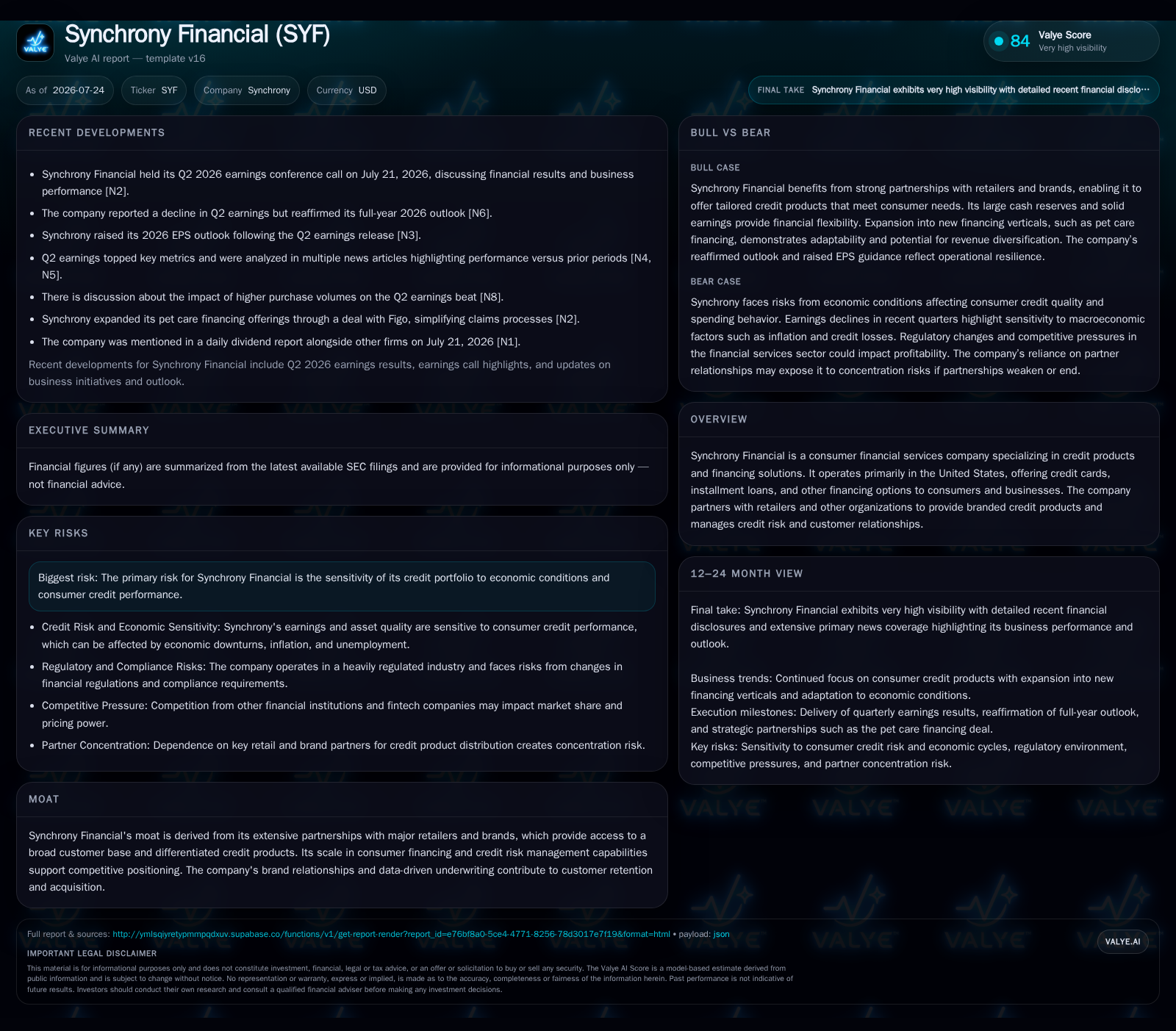
In Q2 2026, Synchrony Financial reported steady growth driven by durable retail partnerships enabling sustained loan origination volumes despite cautious consumer credit behavior. The company’s net interest margin remained stable while fee income provided incremental diversification. Credit risk management continues to be a focal point, with charge-off rates showing sensitivity to macroeconomic variables but underpinned by effective underwriting and provisioning. Synchrony’s competitive position benefits from its scale in co-branded credit products, though ongoing risks from economic cycles and regulatory shifts necessitate close monitoring.
Q2 2026 Performance Highlights: Retail Partnerships Drive Loan Origination Amid Credit Volatility
Synchrony Financial’s second quarter 2026 results demonstrate resilience anchored in its extensive retail partnerships, which continue to underpin robust loan origination volumes despite cautious consumer credit behavior amid macroeconomic headwinds [S2][N1]. These partnerships enable Synchrony to access a broad consumer base through co-branded and private-label credit products, effectively lowering customer acquisition costs by leveraging retailer traffic rather than relying on broad-market direct marketing. This channel strategy supports sustained purchase volume growth, contributing to stable earning assets on the balance sheet. The company’s net interest margin (NIM) remained relatively stable in Q2 2026, balancing portfolio yield against incremental funding cost pressures, reflecting effective mix management and disciplined pricing strategies [S2]. This operational dynamic highlights the strategic importance of retail collaborations as a critical distribution conduit that differentiates Synchrony’s credit offerings and strengthens customer engagement.
Revenue Composition: Balancing Interest Income and Fee Income
Synchrony’s revenue primarily derives from interest income generated on revolving credit card balances and installment loans originated through its retail partnerships [S1][S2]. In Q2 2026, net interest income remained the dominant revenue driver, supported by portfolio yield management that balances loan pricing with funding costs. Fee income, primarily from program management fees embedded in private-label financing arrangements, contributed a steady and meaningful portion of total revenue. This non-interest income stream provides incremental diversification and margin stability, buffering the company against potential fluctuations in loan demand or net interest spread compression [S1]. The interplay between interest and fee income reflects Synchrony’s ability to leverage its scale and retail relationships to diversify earnings beyond pure lending spreads.
Credit Risk Management Amid Macroeconomic Pressures
Credit portfolio performance remains a critical determinant of Synchrony’s financial results given the cyclical nature of consumer credit risk [S2][S1]. During Q2 2026, charge-off rates increased modestly in line with rising delinquency metrics, a trend consistent with inflationary pressures that have constrained consumer disposable income and slowed wage growth [N14]. Despite these headwinds, Synchrony’s disciplined underwriting standards and conservative provisioning policies enabled measured increases in the provision for credit losses without causing significant earnings volatility. The company’s monthly disclosure of charge-off data enhances transparency around portfolio quality trends [S21]. This measured credit risk management approach aligns with sector peers such as Capital One and Discover Financial Services, which have reported similar macroeconomic sensitivities but have also emphasized effective loss mitigation strategies. Synchrony’s ability to dynamically adjust provisioning and maintain underwriting discipline supports portfolio resilience during economic cycles.
Competitive Positioning Within the Consumer Finance Sector
Synchrony operates in a competitive landscape alongside large consumer finance firms including Capital One and Discover Financial Services. Its competitive advantage lies in deep retail partnerships that facilitate unique co-branded credit card offerings, embedding brand affinity directly into financial products—a model comparable to American Express’s retail collaboration strategy. These partnerships reduce customer acquisition costs by capitalizing on retailer foot traffic and brand loyalty rather than broad direct marketing campaigns. Additionally, Synchrony’s efficiency in managing credit losses amid rising delinquencies distinguishes it from peers facing similar economic conditions. The company’s diversified revenue mix, combining net interest income with fee income, provides margin resilience uncommon among peers more reliant on interest income alone. Regulatory frameworks affecting fee structures and product terms apply broadly across the sector, requiring Synchrony and its peers to navigate evolving compliance landscapes carefully.
Growth Drivers: Retail Expansion and Technological Innovation
Looking forward, Synchrony’s growth prospects depend heavily on expanding its retail partnerships and enhancing underwriting capabilities through technological investments [S3][N7]. The adoption of advanced data analytics and automated underwriting platforms aims to improve risk-adjusted loan origination volumes while controlling customer acquisition costs. Demographic trends, including increased credit adoption among younger consumers, support expansion in installment lending and revolving credit products. Management highlighted during the Q2 earnings call a strategic focus on cross-selling financial products within existing customer bases, a tactic designed to deepen wallet share without proportionally increasing acquisition expenses [N1]. Regulatory environments that maintain consumer credit access while ensuring compliance provide a foundation for sustainable portfolio growth.
Risks and Challenges: Economic Sensitivity and Competitive Pressures
Key risks facing Synchrony include heightened sensitivity of its credit portfolio to economic downturns, which could lead to increased defaults and charge-offs if inflationary pressures persist or worsen [S1][N14]. Regulatory changes targeting fee disclosures, interest rate caps, or penalty fee structures could compress non-interest income, impacting overall profitability. Competition from fintech lenders and alternative credit providers intensifies pressure, particularly in digitally native consumer segments. Portfolio concentration risk also exists due to reliance on specific retail partners for a significant portion of originations and revenue; adverse developments affecting these retailers could disproportionately impact Synchrony’s credit portfolio and earnings. Maintaining robust risk governance and operational agility remains crucial to navigating these evolving external challenges.
Key Performance Indicators and Upcoming Milestones
Monitoring loan origination volumes in upcoming quarters will be critical to assessing demand sustainability through retail channels [S2][N1]. The rollout and adoption of digital underwriting tools and data-driven decision engines will be important to watch, as these technologies can reduce customer acquisition costs while preserving credit quality. Changes in consumer credit utilization rates, particularly the balance between revolving credit and installment loans, will provide early signals of shifts in portfolio yield and risk profile. Synchrony’s ongoing monthly disclosures of delinquency and charge-off trends offer real-time insight into credit portfolio health, enabling stakeholders to evaluate the company’s operational responsiveness.
Financial Position and Capital Structure
As of June 30, 2026, Synchrony reported approximately $16.2 billion in cash and cash equivalents against total debt of about $16.4 billion, resulting in a modest net debt position near $239 million [F1]. This balanced leverage profile supports operational flexibility and ongoing lending activities amid uncertain economic conditions. The company’s liquidity position and capital adequacy provide a solid foundation to manage credit risk provisioning and sustain net interest margins, which remain key drivers of profitability.
Synchrony Financial’s Q2 2026 results underscore the strategic value of its retail partnerships as a durable engine for loan origination and customer acquisition in a challenging macroeconomic environment. The company’s balanced revenue mix of interest income and fee income, combined with disciplined credit risk management, supports margin stability despite rising charge-offs and delinquency rates. Peer comparisons indicate that while credit risk challenges are sector-wide, Synchrony’s channel differentiation and operational efficiency provide competitive advantages. Key watchpoints include loan origination trends, technology adoption in underwriting, and evolving consumer credit behavior, all of which will shape Synchrony’s performance trajectory in the near term.
This analysis is based on publicly available data as of July 23–24, 2026, including Synchrony Financial’s Q2 2026 10-Q filing [S2], recent 8-K disclosures [S3], and supplementary market commentary [N1][N7][N14]. It is intended solely for informational purposes and does not constitute investment advice.
Financial snapshot as of 2026-06-30
Synchrony’s liquidity and leverage position includes $16.2 billion in cash and equivalents and $16.4 billion in total debt, yielding a net debt of approximately $239 million, reflecting a conservative capital structure supportive of ongoing credit portfolio growth and risk management [F1]
Disclaimer: This is research-only, informational analysis and not investment advice. It may include AI-generated interpretation and general industry context. Always verify important details using primary sources.

Comments