
Kinsale Capital Advances E&S Specialty Insurance with Underwriting Discipline and Tech Efficiency
Kinsale Capital Group's latest quarter highlights steady premium growth and strong underwriting performance in the niche excess and surplus lines market.
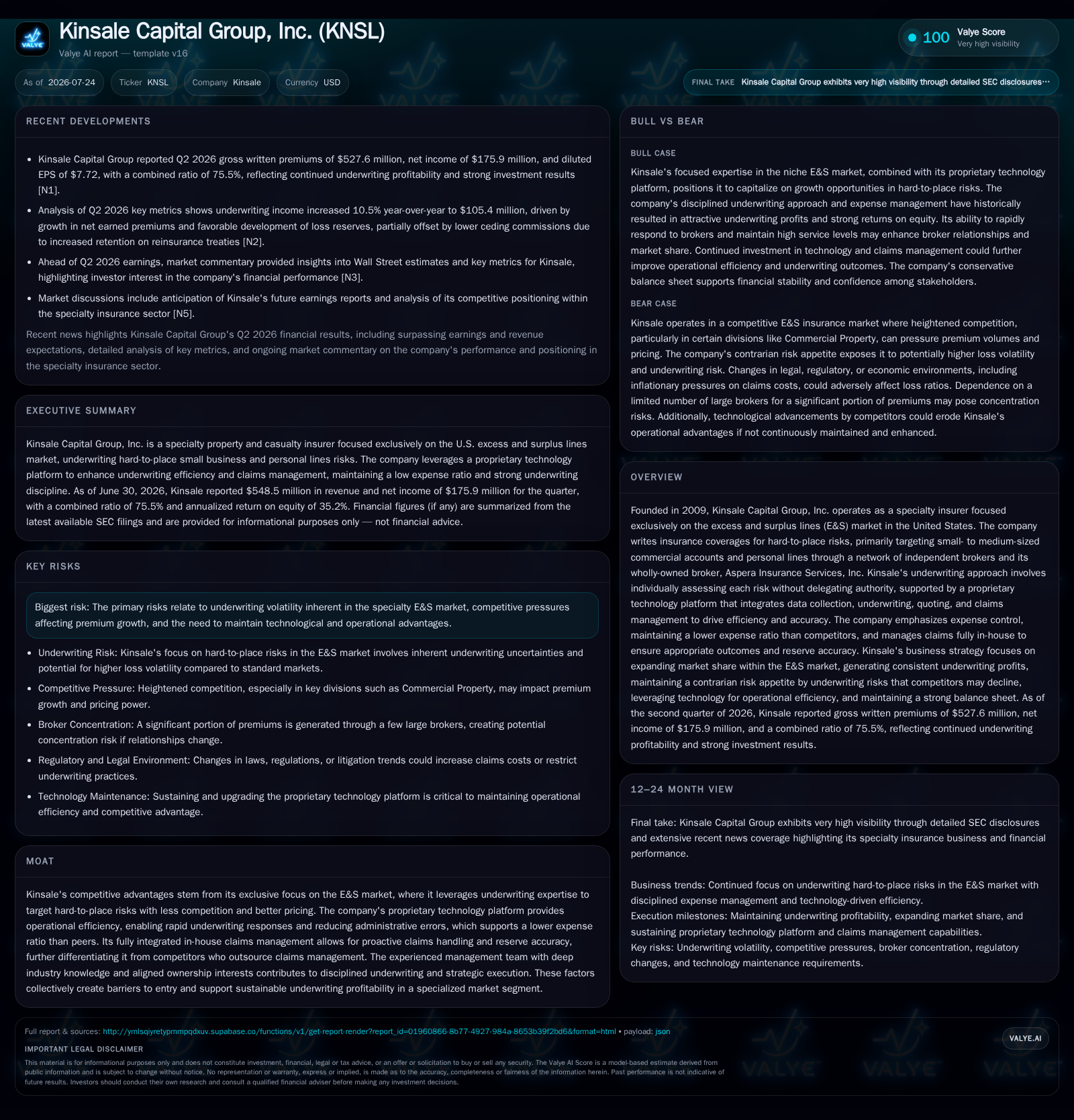
In its Q2 2026 filing, Kinsale Capital Group demonstrated robust growth in gross written premiums and maintained underwriting discipline amid a competitive Excess & Surplus (E&S) insurance market. The company's proprietary technology platform and in-house claims management continue to differentiate its operational model, driving efficiency and expense control. While underwriting volatility and social inflation pose risks, Kinsale's focused broker network and capital strength underpin sustainable profitability. Watch for trends in combined ratio, expense ratio, and policy retention as key markers of execution going forward.
Recent Operating Update: Q2 2026 Emphasizes Growth and Discipline
Kinsale Capital Group released its Form 10-Q on July 23, 2026, providing the most current view of its operating results and financial health [S2]. The company reported an increase in gross written premiums (GWP), reflecting continued demand within its niche specialty Excess & Surplus (E&S) lines market where it writes primarily small to medium-sized commercial risks. For H1 2026, casualty lines comprised 74.1% of GWP while property accounted for 25.9%, underscoring the commercial tilt in the portfolio [S2]. This mix signals sustained focus on traditionally higher-margin casualty products within the hard-to-place risk segment.
Expense discipline remains a hallmark for Kinsale; the underwriting expense ratio rose modestly year-over-year to 21.7% of earned premiums plus fee income but continues to compare favorably against many E&S peers [S2]. This benefit derives from Kinsale's proprietary technological platform that integrates data collection, underwriting workflows, quote management, and claims processing into a unified system. This digital infrastructure allows quick turnaround on quotes and reduces administrative overhead—a critical advantage in a broker-mediated distribution channel where speed affects conversion.
Investment income also experienced material growth—net investment income increased by approximately 23% in the first half of 2026 compared to the prior year period [S16]. The company attributes this improvement mainly to expansion of its investment portfolio funded through strong operating cash flows generated from premiums received upfront.
Business Model: Underwriting Expertise Meets Technology-Enabled Operations
Founded in 2009 with a pure-play E&S strategy across all U.S. states plus territories, Kinsale positions itself as a specialty insurer targeting difficult-to-place commercial risks that conventional carriers avoid or price inefficiently [S1]. The company varies risk appetite across a broad set of underwriting divisions — from small business and construction to professional liability and energy sectors — allowing diverse risk pools that reduce correlation.
Revenue derives primarily from premiums collected upfront for typically one-year policies; these premiums are earned ratably over the policy term [S1], less amounts ceded under reinsurance agreements used strategically to limit exposure on large losses [S1]. Fee income from policy fees supplements premium revenue but is secondary.
Critically, Kinsale retains all underwriting authority internally rather than delegating binding or pricing decisions to brokers or agents. This feature supports more granular risk selection which helps maintain attractive combined ratios through careful charge adequacy and reserve setting [S1]. Claims management is fully internal as well, enabling closer oversight of loss settlement costs and accurate reserve development—the latter vital given industry-wide concerns around social inflation and rising claim severity.
The broker network is essential for new business flow; independent brokers serve as intermediaries between Kinsale and insureds seeking coverage outside standard markets. The proprietary technology platform reduces quote turnaround time, improving broker satisfaction and win-rates on new submissions. This ecosystem strengthens policy retention—a key driver of sustainable net earned premium growth.
Industry Structure and Competitive Positioning
The E&S market consists of property & casualty insurers specializing in coverage for high-risk or non-standard accounts not served by admitted carriers due to regulatory constraints or risk complexity. Peers like Markel Corporation, RLI Corp., and Arch Capital operate in overlapping spaces though each may differ in product focus or scale.
Kinsale’s competitive moat stems from:
- Its exclusive fix on E&S lines without dilution into standard P&C markets,
- Proprietary technology delivering operational efficiency leading to lower expense ratios than peers,
- A fully integrated in-house claims team increasing reserve accuracy relative to competitors outsourcing this function,
- Experienced management averaging over 30 years in insurance underwriting [S1],
- Agile capital deployment backed by stable debt facilities including senior promissory notes totaling $175 million plus $100 million credit line with covenants amended recently for flexibility [S7][S8].
Unlike some rivals that extend limited delegated underwriting to brokers or agents risking higher loss ratios, Kinsale’s tight control improves risk selection but requires deep expertise, which the company has cultivated.
Growth Drivers
Several factors underpin Kinsale’s growth potential:
Market Share Expansion: Despite a modest reported share (~1.5%) of a $130 billion+ E&S market [S1], Kinsale’s focused segmentation targets underserved niches with less direct competition.
Underwriting Expertise: Accurate pricing of hard-to-place risks allows maintaining favorable combined ratios even amid inflating claims environments.
Technology Enablement: Its integrated platform shortens underwriting cycle time—critical for capturing volume from brokers prioritizing responsiveness.
Broker Network Strength: Diverse independent brokers drive submission flow; increasing new business conversion can boost gross written premiums steadily.
Product Diversification: Coverage spans multiple specialties such as casualty, property, professional liability enabling mitigation of line-specific shocks.
Capital Flexibility: Ongoing share repurchases ($250 million authorized as of mid-2026) demonstrate financial confidence facilitating prudent scaling without diluting returns [S7][S8]
Risks and Watchpoints
Kinsale faces industry-typical risk exposures:
- Underwriting Volatility: Loss frequency/severity spikes could erode underwriting margins despite current discipline. Occurrence policies accounting for over 80% of casualty reserves expose the firm to long-tail claim emergence [S1].
- Claims Inflation: Wage inflation, medical cost increases, materials costs alongside social inflation (litigation environment worsening) may pressure loss ratios unexpectedly.
- Competitive Pressures: Rate softness especially in commercial property lines suggests intensifying competition possibly limiting premium rate increases [S10].
- Reserve Adequacy: Estimation uncertainties inherent in actuarial assumptions call for vigilant monitoring; reserve redundancy or deficiency impacts earnings materially.
- Regulatory Changes: Compliance with evolving state regulations and capital frameworks imposes constraints on dividend flows or capital allocation flexibility.
- Broker Dependence: Reliance on independent brokers exposes growth to channel dynamics including relationship retention risks.
- Catastrophic Losses: Natural disasters remain unpredictable large loss sources despite reinsurance programs managing peak exposure effectively.
What To Watch Next
Key milestones include monitoring:
- Quarterly combined ratios trending above or below historical ~75% levels indicating underwriting margin sustainability [S22].
- Expense ratio movements relative to earned premiums reflecting operational leverage gains or cost pressures [S2].
- Policy count growth rates revealing success in new business origination via broker channels.
- Average premium per policy shifts signaling pricing environment dynamics or product mix changes [S10].
- Retention rates staying firm amidst competitive bids critical for stable net earned premium bases.
- Reserve development patterns exposing actuarial assumption soundness versus adverse prior-year reserve adjustments.
- Investment portfolio returns sustaining current yields benefiting net income contribution amid fluctuating interest rates.
- Share repurchase activity levels signaling management confidence versus need for balance sheet preservation [S7].
Financial Profile Discussion
As of June 30, 2026, Kinsale held $210.5 million in cash and equivalents supporting liquidity needs comfortably [F1]. The most recent total debt figure available is approximately $226 million as of December 31, 2025, with net debt estimated at about $15.5 million after cash offsets [F1]. This reflects a manageable leverage position relative to a capital base exceeding $2 billion in equity reported at mid-year [F1][S22].
The company’s conservative capital deployment approach is evidenced by incremental increases in share repurchase authorizations totaling $500 million capacity combining December 2025 and July 2026 board approvals—their timing suggests confidence anchored by well-funded operations plus sufficient regulatory surplus thresholds permitting discretionary distributions without impairing solvency requirements [S7][S8][S15]
Operating return on equity remained elevated at approximately 24% annualized pace during H1 2026 despite modest compression from equity base expansion—this reflects profitable growth balanced against cautious capital management [S16][S22]. Investment yields sustained around mid-4% annualized drawing partly on allocations into fixed maturity securities diversified across maturities balancing liquidity needs versus yield optimization [S2][S16].
Premium cash inflows received upfront underpin strong operating cash generation which coupled with disciplined claims outflows afford reinvestment capacity sustaining steady portfolio enlargement without reliance on dilutive financings [S2]
Conclusion
Kinsale Capital demonstrates a compelling combination within the specialty insurance sector: focused E&S niche expertise supported by cutting-edge technology delivering operational efficiency; prudent underwriting discipline yielding attractive combined ratios even against sector-wide inflation headwinds; experienced management committed to shareholder returns through share buybacks; robust broker relationships feeding an expanding premium base; and capital strength preserved by flexible debt structures ensuring solvency compliance across states. While typical specialty insurer risks remain present — including claims volatility and competitive rate pressures — Kinsale’s decisive control over underwriting authority coupled with proactive claims handling offer durable operational advantages unseen among many peers who outsource these functions. Near-term indicators such as combined ratio trends, expense control metrics, renewal retention rates, and policy count will be key monitors as the company pursues profitable scaling beyond its modest market share currently around 1.5%.
This analysis relies strictly on data disclosed through recent Q2 filings complemented by prior annual reports without extrapolating unverified projections or peer comparisons lacking direct citations. Investors should track emerging quarterly disclosures for updates regarding claims development patterns amid social inflation dynamics reshaping specialty P&C profitability paradigms.
This report is intended solely for informational purposes based on publicly available disclosures dated up to July 23, 2026. It does not constitute investment advice nor an endorsement of any securities mentioned herein.
Disclaimer: This is research-only, informational analysis and not investment advice. It may include AI-generated interpretation and general industry context. Always verify important details using primary sources.

Comments