
Quest Diagnostics Unlocks Value Amid Operational Advances and Network Strength
Quest Diagnostics leverages its expansive laboratory network and IT modernization to enhance revenue quality and operational efficiency amid evolving payer dynamics.
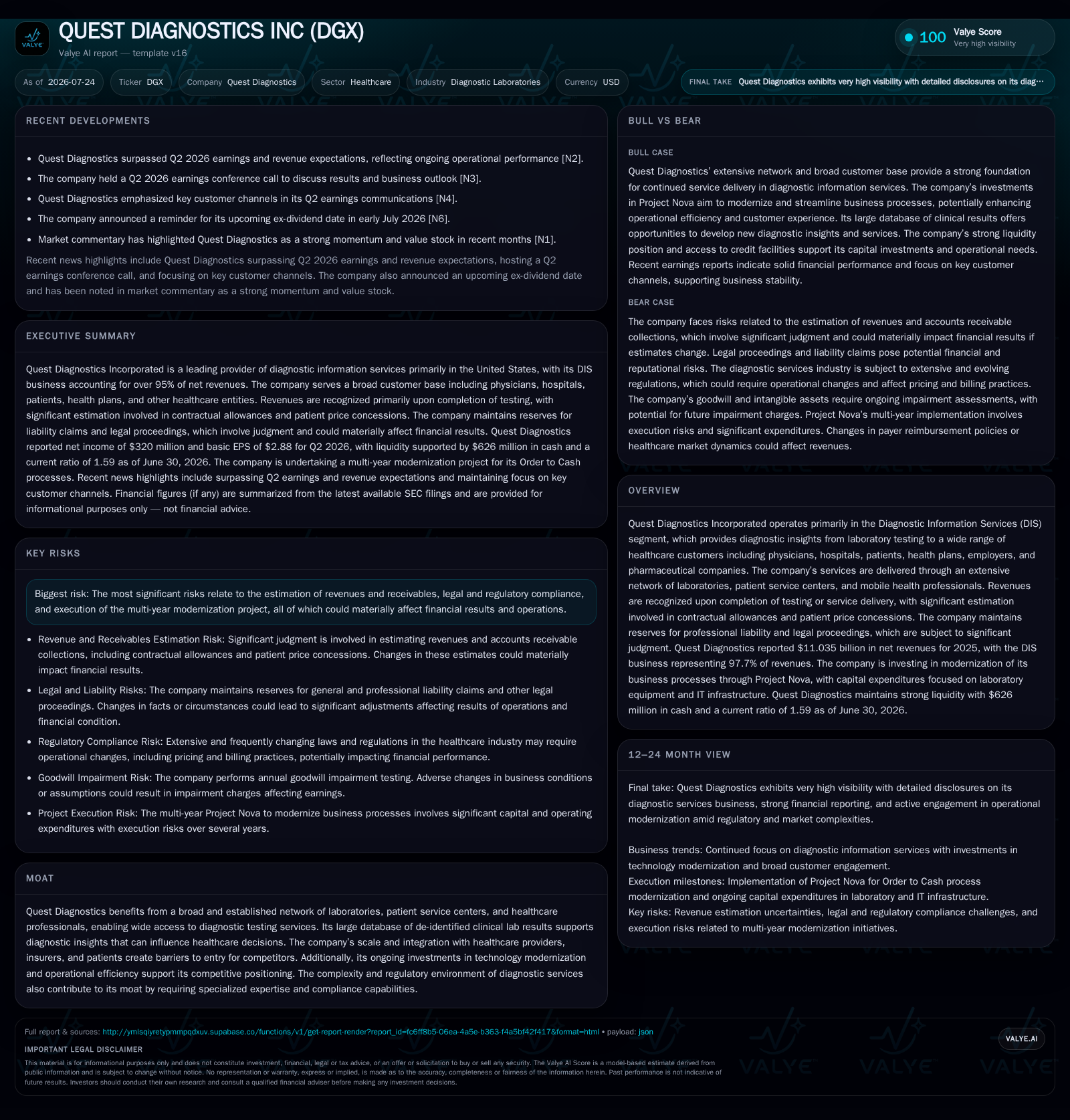
In its latest quarterly filing, Quest Diagnostics demonstrated stronger-than-expected operational performance, prompting a raised FY26 outlook. Core revenue recognition nuances tied to complex payer mixes and contractual allowance estimation continue to influence revenue reliability. The company’s extensive laboratory and patient service center network underpins volume-driven economics, while the multi-year Project Nova IT modernization aims to improve billing accuracy and collections. Regulatory compliance complexity and professional liability risks remain important watchpoints. Successful execution of IT upgrades and next-gen diagnostic rollouts will be critical milestones for sustaining competitive advantage.
Quarterly Momentum: Operational Performance Drives Revised FY26 Outlook
Quest Diagnostics’ Q2 2026 earnings release marked a notable positive inflection point, with revenue surpassing consensus expectations driven by increased test volumes and stable pricing realizations within its Diagnostic Information Services (DIS) segment, which accounts for over 97% of total revenues [S2][N1][N7]. Organic volume growth outpaced prior forecasts despite ongoing macroeconomic pressures, reflecting robust demand across outpatient, physician office, and employer channels. This operational strength underpinned management’s decision to raise fiscal 2026 guidance for both sales and adjusted earnings per share [N7]. The improved cash flow trajectory supports reinvestment initiatives, notably the multi-year Project Nova technology modernization, while maintaining capacity for debt servicing and capital allocation [S2].
Critical Revenue Recognition Dynamics: Payer Mix Impact on Receivables Quality
Quest’s revenue recognition process is inherently complex due to the diverse payer mix, which includes commercial healthcare insurers, government payers such as Medicare and Medicaid, client payers, and self-pay patients [S1]. Revenues are recognized primarily upon completion of clinical laboratory testing or delivery of diagnostic reports. However, the company must estimate contractual allowances—discounts negotiated with payers or denials—and implicit patient price concessions using a portfolio approach. These estimates rely on historical collection data and the aging profile of accounts receivable, with adjustments recorded in the current period as estimates evolve or settlements occur [S1].
The quality of billing operations is a critical determinant of collectability and revenue reliability [S1][N2]. Quest prioritizes accurate capture of insurance and patient information at order entry, increasingly through electronic requisitions, to reduce denials and rework costs. Billing error rates and accounts receivable turnover serve as key operating KPIs signaling revenue health beyond headline volume growth. Project Nova aims to enhance these processes by improving data accuracy and streamlining claims submission workflows
Network Scale Meets Diagnostic Innovation: Business Model Economics & Service Delivery
Quest operates one of the largest national laboratory networks in the United States, comprising high-capacity central laboratories supported by thousands of patient service centers and mobile phlebotomy units that facilitate convenient sample collection [S1]. This extensive footprint enables broad access to healthcare providers, hospitals, health plans, employers, and pharmaceutical companies engaged in clinical trials, as well as direct-to-patient channels.
The company’s revenue model depends on efficiently scaling test volumes—ranging from routine blood panels to specialized genetic and molecular assays—while maintaining rapid turnaround times to meet clinical decision-making needs [S1]. Laboratory utilization rates directly influence fixed-cost absorption and operating margins. Regulatory compliance with Clinical Laboratory Improvement Amendments (CLIA) and other accreditation standards requires substantial investment in quality control and data integrity systems, which in turn support physician referral patterns and payer confidence
Technology Modernization Enhancing Billing Operations and Collectability
A centerpiece of Quest’s strategic initiatives is Project Nova, a multi-year Order to Cash modernization program implemented in partnership with Epic Systems [S1]. This initiative consolidates legacy billing platforms into integrated workflows designed to reduce manual interventions and billing errors. Enhancements include improved electronic order capture accuracy, contract management analytics, real-time payment tracking, and claims adjudication efficiency.
These improvements are expected to reduce billing error rates and days sales outstanding (DSO), which historically has remained steady around 48 days but presents upside potential if operational efficiencies materialize [S1][N2]. Enhanced upfront eligibility verification and claims accuracy should also reduce bad debt expense and improve collection rates, thereby supporting operating margin expansion. While IT implementation costs are front-loaded, the anticipated free cash flow improvements provide a compelling return on investment.
Competitive Landscape: Integration Scale vs. Niche Players
Within the Diagnostic Information Services industry, Quest Diagnostics and Laboratory Corporation of America Holdings (LabCorp) represent the two largest integrated clinical laboratory networks in the United States, offering broad geographic coverage and deep provider relationships. This scale affords them significant negotiation leverage with payers and enables extensive capital allocation toward compliance accreditation, automation, and technology modernization.
Conversely, specialty diagnostic firms focusing on molecular diagnostics, genetic testing, or oncology minimal residual disease assays operate with advanced scientific platforms but lack the breadth and volume scale of integrated networks. Quest’s recent acquisitions targeting oncology diagnostics aim to broaden its portfolio while leveraging existing distribution infrastructure and payer contracts.
Regulatory complexity, including CLIA accreditation and Health Insurance Portability and Accountability Act (HIPAA) data privacy requirements, creates high barriers to entry, protecting incumbents but necessitating rigorous compliance monitoring and cybersecurity investments overseen by dedicated governance committees [S1].
Growth Levers: Rising Diagnostic Demand Amid Preventive Care Trends
Structural industry tailwinds support growth opportunities for Quest Diagnostics. Aging populations and increasing chronic disease prevalence drive higher demand for routine and specialized diagnostic testing. Expansion into personalized medicine, including genetic profiling and biomarker assays, introduces higher-margin test offerings.
Outpatient care models and preventive health initiatives shift emphasis toward early detection and monitoring, increasing test volumes outside traditional inpatient settings. Pharmaceutical collaborations for clinical trial support provide incremental revenue streams through sophisticated diagnostic assays linked to drug efficacy and safety monitoring.
Adoption of electronic ordering and billing systems enhances provider convenience and expands test mix potential within existing client bases. However, physical laboratory capacity constraints and reimbursement policy shifts, particularly from government payers, remain potential growth headwinds.
Risks in Execution: Revenue Estimation Uncertainty & Regulatory Compliance
Quest faces several risk vectors, notably the inherent uncertainty in estimating revenues amid evolving payer contract terms that could affect reimbursement timing and amounts [S1][S7][S12]. Increases in reserve levels for contractual allowances or patient price concessions could negatively impact near-term financial results.
Legal risks persist from government investigations and class action lawsuits related to historical billing practices. The company maintains reserves of approximately $20 million for general and professional liability claims, reflecting prudent estimation but inherent uncertainty [S12]
Technological obsolescence risk exists if competitors successfully commercialize next-generation diagnostics that commoditize existing test lines or offer lower-cost alternatives. Regulatory environments remain dynamic, with intensifying data privacy enforcement requiring sustained cybersecurity investments. Governance structures include a Cybersecurity Committee and Quality and Compliance Committee that regularly report to the Board, ensuring oversight of these critical risks [S1].
Delays or operational disruptions in Project Nova pose execution risks that could delay anticipated efficiency gains and margin improvements.
Milestones to Monitor: Next-Gen Diagnostics Rollout & Project Nova Progress
Key milestones include phased deployments of Project Nova, with quarterly disclosures expected to detail reductions in billing errors, improvements in collection cycles, and operating margin expansion correlated with implementation stages [S2][N2]
Monitoring adoption rates of new diagnostic tests, particularly from recent oncology-focused acquisitions, will provide insight into diversification beyond routine testing services.
Earnings commentary on payer mix evolution—shifts between commercial insurers, government payers, and self-pay patients—and accounts receivable aging profiles will illuminate underlying revenue quality trends and cash flow stability [S2][N2]
Financial Profile Discussion
As of June 30, 2026, Quest Diagnostics held $626 million in cash and equivalents against $5.63 billion in total debt, resulting in net debt of approximately $5.0 billion [F1]. Current assets of $2.84 billion and current liabilities of $1.79 billion yield a current ratio of 1.59x, indicating adequate short-term liquidity [F1].
Capital expenditures remain focused heavily on technology modernization, including Project Nova, reflecting the company’s commitment to operational efficiency and billing accuracy improvements [S2]. The improved operating cash flow from volume growth and enhanced collections supports ongoing debt servicing and reinvestment capacity.
Disclaimer: This analysis is for informational purposes only and does not constitute investment advice. All financial data and operational insights are sourced from the latest SEC filings and company disclosures.
Disclaimer: This is research-only, informational analysis and not investment advice. It may include AI-generated interpretation and general industry context. Always verify important details using primary sources.

Comments