
RenaissanceRe’s Dual Engine: Underwriting Discipline and Investment Upside in Q2 2026
In Q2 2026, RenaissanceRe demonstrated strong underwriting discipline combined with elevated investment income, reinforcing its capital position amid evolving regulatory pressures.
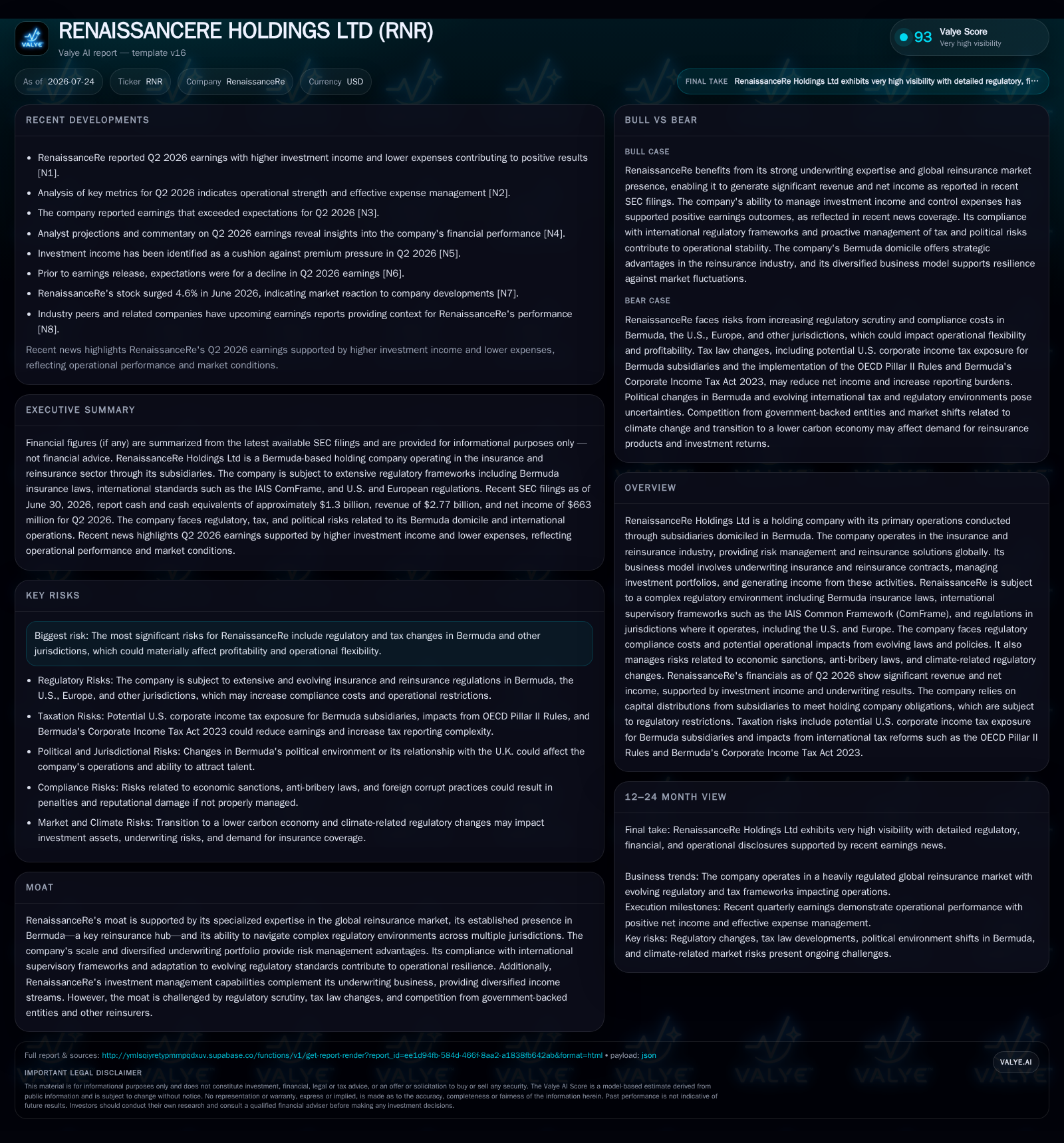
RenaissanceRe Holdings Ltd reported a Q2 2026 earnings beat driven largely by higher net investment income and disciplined underwriting results that improved combined ratio metrics. The company operates as a Bermuda-domiciled reinsurer, benefiting from jurisdictional advantages but facing rising regulatory compliance costs tied to IAIS ComFrame implementation and new tax regimes. While catastrophe loss volatility remains a factor, RenaissanceRe maintains expense control and capital adequacy. Peer comparisons underscore shared challenges with other Bermuda reinsurers like Arch Capital Group and Everest Re, particularly around regulatory constraints and market pricing competition. Upcoming focuses include capital movements, reserve adequacy, and the impact of regulatory developments on operational flexibility.
Q2 2026 Results Spotlight: Investment Income Boosts Underwriting Discipline
RenaissanceRe Holdings Ltd reported strong second-quarter 2026 results driven by a notable increase in net investment income alongside disciplined underwriting execution. According to the company’s 10-Q filing for the period ended June 30, 2026, RenaissanceRe achieved a modest improvement in its combined ratio, reflecting controlled underwriting losses despite ongoing catastrophe claim pressures [S2]. The combined ratio, a key industry metric that aggregates loss and expense ratios to assess underwriting profitability, benefited from lower attritional losses and stable expense management [N2]. Concurrently, rising bond yields and prudent portfolio positioning contributed to a significant uplift in net investment income, which materially supported earnings beyond underwriting profits [N1][N3]. This dual revenue engine—underwriting and investment income—is central to RenaissanceRe’s business model, helping to offset volatility inherent in catastrophe-exposed reinsurance underwriting.
Regulatory Environment: Bermuda Domicile Advantages and Emerging Compliance Costs
RenaissanceRe operates primarily through subsidiaries domiciled in Bermuda, a jurisdiction offering strategic advantages such as favorable tax treatment and proximity to global reinsurance markets. However, the recent embedding of the International Association of Insurance Supervisors (IAIS) Common Framework for the Supervision of Internationally Active Insurance Groups (ComFrame) into Bermuda’s Insurance Act in December 2025 has introduced more stringent group-wide supervisory requirements [S1]. These include enhanced risk-based capital standards that could increase prescribed capital thresholds, restrict intercompany capital transfers, and suspend debt repayments, thereby elevating regulatory compliance costs and potentially constraining capital deployment flexibility.
Additionally, Bermuda’s introduction of a Corporate Income Tax (CIT) regime adds fiscal complexity that may compress net profitability over time unless offset by pricing or operational efficiencies [S1]. While these regulatory developments strengthen systemic stability and reinforce Bermuda’s reputation as a reinsurance hub, they also impose cost pressures that RenaissanceRe must navigate carefully to maintain competitive underwriting capacity and capital adequacy.
Underwriting Performance: Premiums, Loss Ratios, and Expense Control
RenaissanceRe’s underwriting operations focus on global insurance and reinsurance treaty contracts, generating revenue primarily through net premiums earned. In Q2 2026, gross written premiums remained stable, with net earned premiums reflecting the timing of contract recognition [S2]. The reported loss ratio showed moderate improvement, driven by lower-than-expected attritional losses despite some impact from catastrophe claims associated with recent natural events. The expense ratio remained steady, reflecting effective cost controls and investments in claims management technology that enhance operational efficiency [S2][N2].
Together, these factors contributed to a combined ratio improvement, signaling disciplined underwriting performance amid a challenging catastrophe environment. Maintaining combined ratio discipline is critical for preserving policyholder surplus and supporting return on equity (ROE), key metrics monitored by reinsurers to assess profitability and capital strength.
Competitive Landscape: Peer Comparison and Market Dynamics
RenaissanceRe’s competitive set includes Bermuda-based reinsurers such as Arch Capital Group and Everest Re, which operate under similar regulatory regimes and face comparable market dynamics [S1]. These peers also emphasize underwriting discipline supported by sophisticated catastrophe modeling and risk selection processes designed to price risks adequately while preserving capital buffers.
The reinsurance sector contends with pricing pressure from government-backed entities like the Florida Hurricane Catastrophe Fund, which provide alternative risk transfer solutions that can compress private market premiums [S1]. This competitive pressure incentivizes innovation in retrocession treaty structures and risk-capital optimization strategies. RenaissanceRe’s ability to maintain market access and underwriting capacity depends on its effectiveness in balancing risk appetite with capital efficiency within this evolving regulatory and competitive landscape.
Emerging Risks: Catastrophe Volatility, Taxation, and Regulatory Scrutiny
Key risks for RenaissanceRe include heightened catastrophe loss volatility, which can exceed modeled expectations due to increasing frequency and severity of natural disasters linked to climate change. Such volatility directly impacts underwriting results, loss reserves adequacy, and capital requirements.
Taxation risks have intensified with Bermuda’s CIT implementation and Pillar II tax rules in other jurisdictions where RenaissanceRe operates, increasing tax liabilities and reporting complexity that may compress net margins unless mitigated through pricing or operational adjustments [S1]
Regulatory scrutiny under ComFrame standards raises compliance costs and may limit operational flexibility, including restrictions on intercompany capital flows and debt repayments. These factors collectively heighten the importance of robust capital management and risk governance frameworks.
Operational risks related to cybersecurity are addressed through comprehensive governance involving senior technology officers and multidisciplinary teams. The company maintains incident response, business continuity, and data backup plans designed to mitigate system disruptions and ensure rapid recovery of critical infrastructure [S1].
Growth Drivers: Capital Efficiency, Specialty Lines, and Geographic Diversification
Growth opportunities for RenaissanceRe are anchored in macro trends driving reinsurance demand, notably the global rise in natural catastrophes which increases primary insurers’ reliance on retrocession arrangements to manage risk appetite and optimize capital usage.
Expansion into specialty insurance lines provides diversification away from traditional catastrophe-exposed portfolios, while strategic partnerships facilitate geographic diversification into emerging markets with growing insurance penetration.
Innovations in treaty structuring, including alternative risk transfer mechanisms such as insurance-linked securities, enhance capital efficiency by transferring portions of catastrophe risk off-balance-sheet without diluting return potential [S1][N5]. These initiatives position RenaissanceRe to capitalize on growth prospects, albeit moderated by regulatory and market constraints.
Key Monitoring Points: Guidance, Capital Movements, and Reserve Adequacy
Upcoming quarterly disclosures will be important to monitor for management’s guidance updates reflecting evolving underwriting conditions and investment outlooks [S2]. Movements in policyholder surplus and capital ratios will provide insight into the company’s capitalization trends and ability to sustain underwriting capacity under tightening risk-based capital requirements
Loss reserve reviews ahead of catastrophe reporting cycles are critical indicators of reserve adequacy and potential impacts on combined ratios [N4]. Early signals from these operational metrics will help assess whether RenaissanceRe maintains its underwriting discipline and capital resilience amid ongoing catastrophe volatility
Financial Profile: Liquidity, Debt, and Profitability
As of June 30, 2026, RenaissanceRe held approximately $1.3 billion in cash and cash equivalents, providing a liquidity buffer to support operational needs and regulatory solvency requirements [F1]. Total debt stood near $2.3 billion as of December 31, 2025, with net debt approximating $1.0 billion after accounting for cash balances [F1]. This capital structure balances leverage with liquidity to maintain financial flexibility.
The improvement in net investment income during Q2 2026 contributed materially to overall profitability, supplementing underwriting results that remain subject to catastrophe claim variability [S2][F1]. This investment income uplift supports return on equity by cushioning earnings volatility inherent in the reinsurance underwriting cycle
DISCLAIMER: This analysis is based solely on publicly available information as of July 2026 and does not constitute investment advice or research views regarding any security or financial instrument.
Disclaimer: This is research-only, informational analysis and not investment advice. It may include AI-generated interpretation and general industry context. Always verify important details using primary sources.

Comments