
D.R. Horton Balances Inventory Growth and Market Headwinds in Q3 2026
Despite flat revenue and margin pressures in Q3 2026, D.R. Horton’s increased inventory and strong mortgage operations highlight resilience amid housing market headwinds.
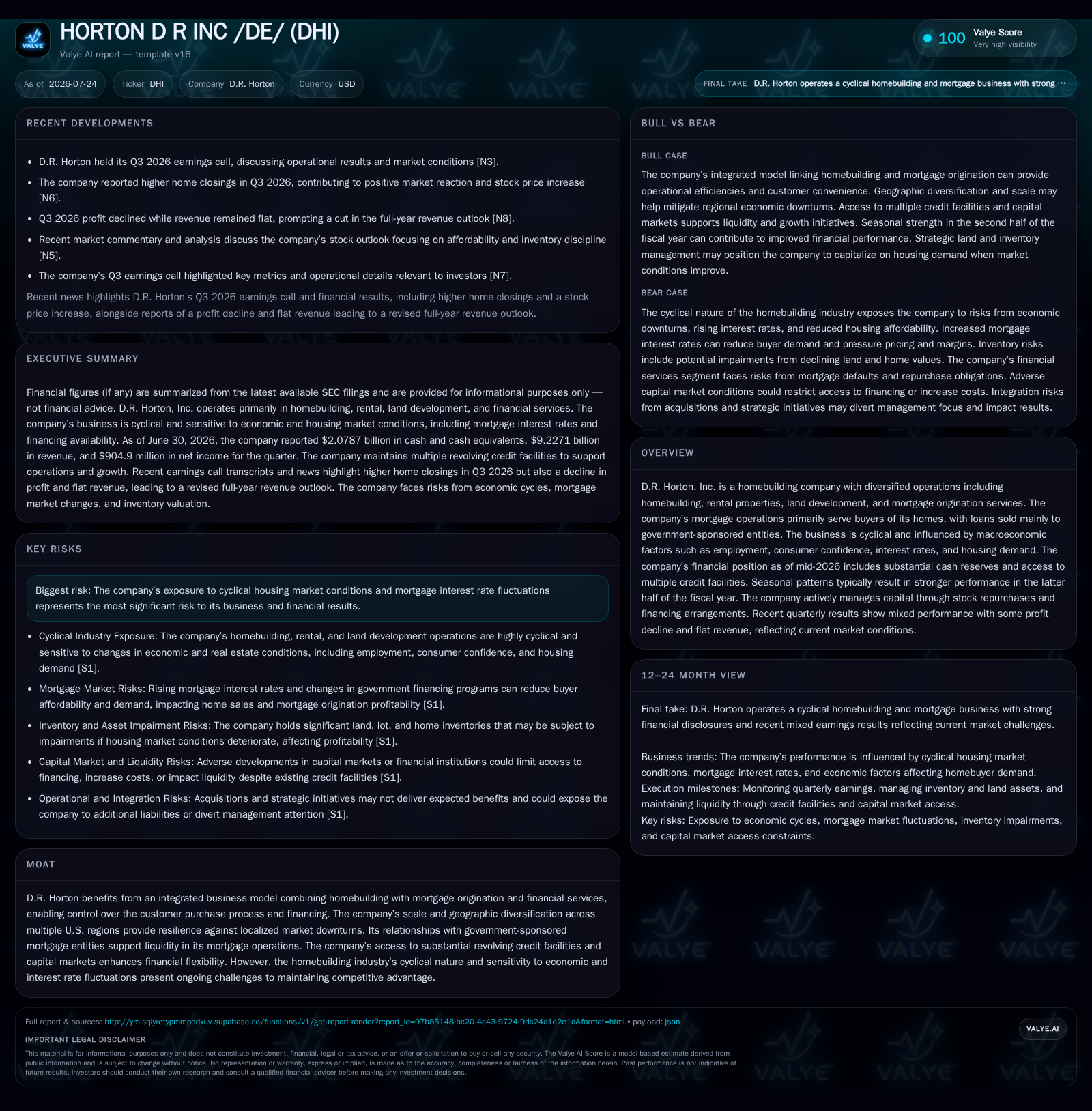
D.R. Horton’s latest quarterly results reveal a cautious buildup of homebuilding inventory across multiple U.S. regions, signaling strategic positioning amid softening demand due to higher interest rates and consumer uncertainty. The integrated mortgage origination business continues to support liquidity by selling loans predominantly to government-sponsored entities, stabilizing cash flow despite industry cyclicality. While profit declined reflecting pricing pressures and seasonal patterns, the company maintains ample liquidity through expanded revolving credit facilities and substantial cash reserves, positioning it to sustain operations amidst uncertain macroeconomic conditions.
Q3 Operational Snapshot: Inventory Trends Signal Balanced Risk Management
In its Q3 2026 10-Q filing dated July 23, D.R. Horton reported an increase in total homebuilding inventory across all reporting segments compared to September 30, 2025. Notably, inventories rose modestly in the Northwest ($1.91B vs $1.89B), Southwest (to $3.08B from $3.07B), South Central ($4.07B from $3.93B), Southeast ($4.23B from $4.06B), East ($4.83B from $4.40B), North ($2.82B from $2.64B), and Corporate/unallocated assets ($378M from $327M) [S2]. While on the surface this inventory build may raise concerns about potential overhangs or weak sales absorption, it also demonstrates company management’s deliberate accumulation of homes and lots ahead of anticipated demand cycles, reflecting cautious operational stewardship amid market uncertainty.
The flat revenue backdrop alongside a decline in reported net income underscores the challenges posed by macroeconomic headwinds including elevated mortgage interest rates compressing affordability and necessitating pricing adjustments or incentives [S2], [N8]. This phenomenon aligns with known industry cyclicality where rising financing costs dampen buyer willingness, extending sales cycles or pressuring margins.
Integrated Model Strength Amid Flat Revenues and Margin Pressures
D.R. Horton's vertically integrated model combines land acquisition, home construction, sales, rental operations, and notably mortgage origination through subsidiaries that primarily serve buyers of its own homes. The mortgage division sells most loans to government-sponsored enterprises such as Fannie Mae, Freddie Mac, or Ginnie Mae, transferring mortgage credit risk while maintaining liquidity via repurchase facilities [S1], [S2]. This integration provides a dual-side revenue mechanism: revenue from home sales is complemented by origination fees and servicing revenues tied to the company's loan portfolio.
This structure smooths variations in demand by enabling tailored financing solutions supporting buyer purchase power even when external credit markets tighten—a notable moat relative to peer national homebuilders such as PulteGroup or Lennar which similarly emphasize mortgage integration but may differ in scale or geographical exposure [S1]. Still, flat revenue with declining profitability signals that margin recovery depends heavily on improved demand conditions or pricing power restoration.
Regional Inventory Profiles Illuminate Geographic Diversification
The company’s geographic diversification strategy spans multiple U.S. regions characterized by divergent economic and housing cycle timelines—Northwest, Southwest, South Central, Southeast, East, and North segments each reported rising inventories reflecting both build-to-order pipeline growth and strategic lot banking [S2]. This spread mitigates localized downturn risk; for example, weakness in one metropolitan area may be offset by strength elsewhere.
However, the simultaneous buildup suggests exposure to broader national factors such as uniform interest rate hikes affecting housing affordability widely rather than isolated market shocks—a double-edged sword for regional risk dispersion [S2]. Monitoring backlog trends regionally will be crucial to ascertain whether specific markets decelerate more sharply than others.
Mortgage Origination as Financial Services Strategic Lever
DHI Mortgage operates under committed and uncommitted repurchase facilities totaling around $1.9 billion capacity with obligations subject to routine renewal. At March 2026 reporting dates, these facilitated liquidity while allowing DHI Mortgage to transfer eligible loans effectively into secondary markets backed predominantly by government agencies' guarantees—limiting credit risk concentration within D.R. Horton’s balance sheet [S1], [S2], [S14].
Compliance with extensive state and federal regulations (CFPB, HUD among others) inculcates operational rigor but also layering of complexity with periodic regulatory exam exposures that may influence cost structures or business practices especially if market stresses intensify [S1].
Mortgage volume trends are thus a critical driver of cash conversion efficiency linked directly to home sales velocity but can amplify cyclical sensitivity if refinancing activity wanes amid rising rates.
Growth Catalysts: Demand Drivers against Economic Headwinds
Underlying demand drivers include demographic trends such as increasing household formation coupled with relatively low existing home inventories which structurally support new construction needs over mid-to-long-term horizons [S1], industry knowledge context.
However, near-term growth faces obstacles from elevated borrowing costs following Federal Reserve tightening efforts aimed at inflation control—this reduces affordability thresholds prompting tighter pricing strategies or incentives on part of builders including D.R. Horton as evidenced in Q3 earnings commentary [S2], [N8].
Working capital swings driven by inventory holding increases create tension between growth ambition and liquidity maintenance—overextension could lead to asset impairments or margin dilution if demand softens longer than expected [S2]. Continuing construction cost inflation and labor shortages also impose upward pressure on gross margins absent offsetting price increases.
Watching Q4: Backlog Conversion and Pricing Power Signals
The housing backlog—contracts signed but not yet closed—is pivotal as a leading indicator of upcoming sales conversion fueling revenue visibility beyond quarter-end snapshots; changes here will confirm whether the current inventory buildup translates into orderly delivery or signs of demand weakening manifesting as backlog declines or cancellations [S2], [N3].
Pricing power measured via incentives versus list prices will signal whether builders like D.R. Horton can recapture margin compression or must endure sustained discounting.
Market intelligence gathering through continued earnings calls announcements and segment-specific updates will be key markers tracking whether economic headwinds abate sufficiently in H2 2026 for stabilized growth.
Financial Profile Discussion: Credit Facilities and Cash Position Support Flexibility
Amid uncertain macroeconomic outlooks tempering housing demand prospects, D.R. Horton’s expanded revolving credit facility for homebuilding operations – increased in March 2026 from $2.3 billion to $3.3 billion with maturities extended into 2027-2031 – provides robust liquidity buffer enhancing operational flexibility for working capital needs including inventory funding [S2]
Forestar (the majority-owned residential lot development subsidiary) maintains an independent revolving credit facility sized at $715 million with maturities extending to late 2029, further diversifying capital sources [S2]
As of June 30, 2026 report dates supported by companyfacts data show cash & equivalents totaling approximately $2.08 billion [F1]. While total debt was last reported at approximately $1.6 billion as of September 30, 2025 [F1], the company’s net cash position and liquidity profile as of the latest quarter suggest a solid balance sheet position without immediate refinancing pressure [S2].
Meanwhile the company has substantial remaining authorization for stock repurchases up to $500 million which signals confidence yet is discretionary depending on liquidity demands going forward.
This analysis synthesizes D.R.
Subsequent quarters’ backlog trends and pricing movements will be instructive gauges alongside evolving macro factors like interest rate trajectories influencing consumer buying power for new residential construction.
Disclaimer: This is research-only, informational analysis and not investment advice. It may include AI-generated interpretation and general industry context. Always verify important details using primary sources.

Comments