
Comstock Inc.'s Strategic Asset Sales and Solar Recycling Expansion Define Q2 2026 Trajectory
Comstock Inc. advances its capital position through significant mining asset sales and royalty agreements while expanding solar module recycling operations amid ongoing challenges in its metals extraction business.
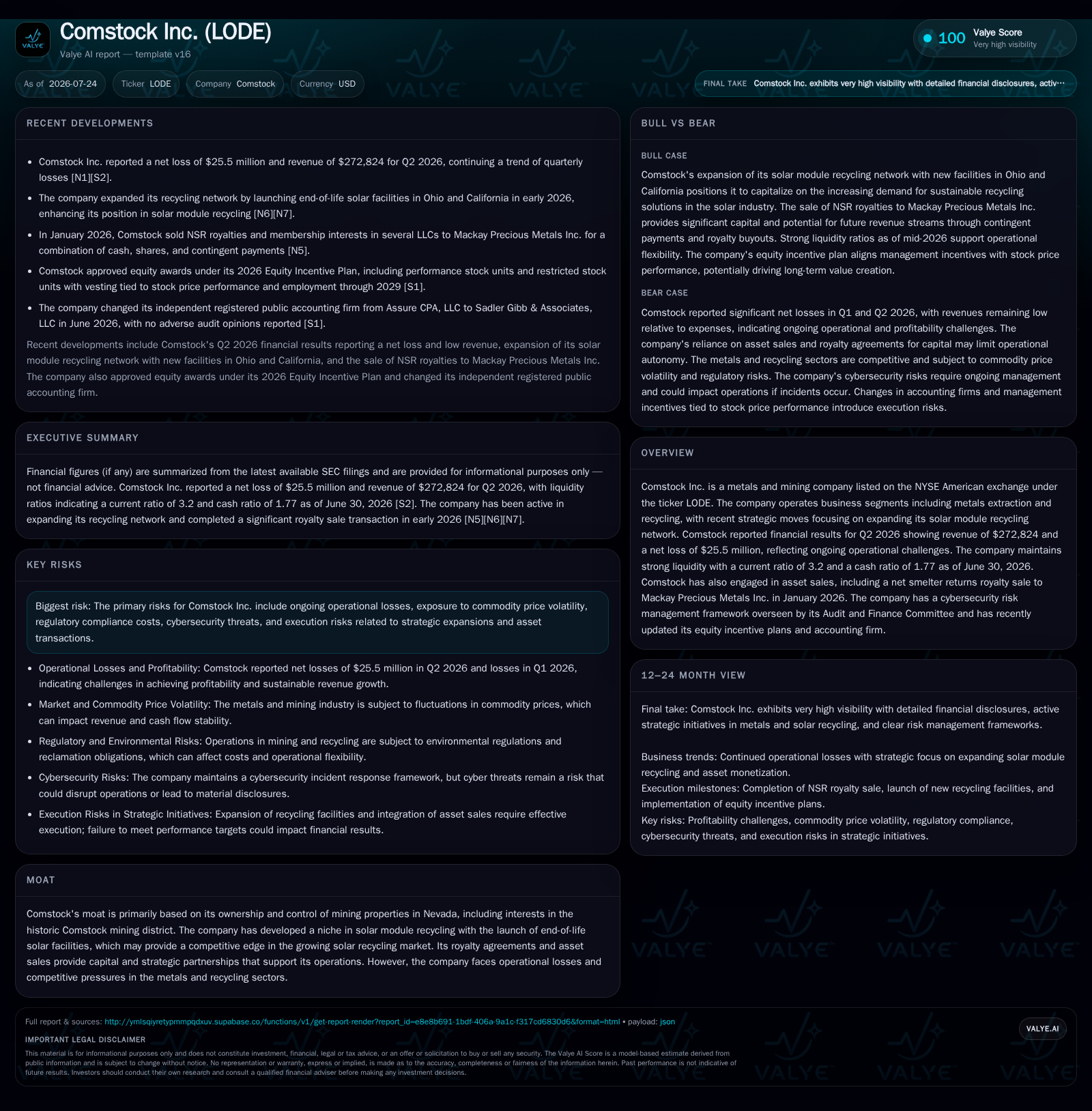
In Q2 2026, Comstock Inc. reported revenues of approximately $273,000 and a net loss of $25.5 million, reflecting persistent operational headwinds in core metals extraction and recycling activities [S2][N1]. The company materially strengthened liquidity by divesting mining entity interests and related real estate to Mackay Precious Metals for $20 million in cash plus equity and contingent payments, while retaining a 1.5% net smelter returns royalty with defined buyer repurchase rights [S3][S16]. Comstock’s strategic pivot into solar module recycling positions it within a growing sustainability-driven niche distinct from traditional mining, supported by capital raised earlier in 2026 [S1][S20]. With cash reserves near $31.4 million and no debt as of June 30, 2026, the company maintains solid short-term financial flexibility (current ratio 3.2) to navigate commodity price volatility and fund operational scaling, though execution risks and regulatory cost pressures remain significant watchpoints.
Q2 2026 Operating Update: Asset Sales Enhance Liquidity Amid Persistent Losses
Comstock Inc. reported Q2 2026 revenues of approximately $273,000 alongside a net loss of $25.5 million, underscoring ongoing operational challenges within its metals extraction and recycling segments [S2][N1]. These losses reflect elevated cost structures and limited operational efficiencies in ore extraction and metal recovery processes. Despite these headwinds, the quarter marked a pivotal financial restructuring through a significant asset divestiture.
On June 21, 2026, Comstock executed a definitive agreement to sell all membership interests in several mining-related entities, including Comstock Mining LLC, and associated real estate holdings in Nevada’s historic Comstock district to Mackay Precious Metals Inc [S3][S16][N1]. The transaction generated an upfront payment of $20 million in cash, complemented by two million shares in Mackay’s parent company and contingent milestone-based payments potentially reaching $17 million over seven years post-closing
Integral to this deal is Comstock’s retention of a 1.5% net smelter returns (NSR) royalty on mineral production from the divested properties. Mackay Precious Metals holds repurchase rights exercisable between $3.5 million and $7 million depending on timing, a capital management approach common in mid-tier mining to monetize assets while preserving future revenue streams [S3][S16]. This structure allows Comstock to balance immediate liquidity enhancement with ongoing exposure to mineral output upside.
Dual Business Model: Traditional Mining Assets and Emerging Solar Module Recycling
Comstock’s operations span traditional precious metals mining and an emerging solar module recycling business. The mining segment centers on ore extraction from Nevada properties, where revenue generation depends on ore grade, volume mined, and metal recovery rates. However, this segment remains vulnerable to commodity price volatility and operational cost pressures.
Conversely, the solar module recycling segment targets the recovery of critical metals such as silver and aluminum from end-of-life photovoltaic panels. This niche aligns with growing regulatory mandates and sustainability trends promoting circular economy practices. Comstock is scaling its solar recycling capacity at its second industry-scale facility under Comstock Metals LLC, supported by capital raised through equity offerings earlier in 2026 [S1][S20]. While still nascent relative to traditional mining volumes, this diversification addresses increasing demand for renewable materials recycling, a market led by established players like First Solar employing advanced refining technologies [N2].
Industry Context: Managing Commodity Cycles and Sustainability Pressures
The metals mining and recycling industry is capital intensive and cyclical, with profitability closely tied to commodity price fluctuations and operational efficiency metrics such as cost per ton processed and metal recovery yields. Mining companies must manage production downtime, safety incident rates, and capital expenditures to sustain margins.
Recycling operations, including solar module processing, require substantial investment in processing facilities capable of achieving high metal recovery rates and throughput volumes while complying with stringent environmental regulations. The emergence of solar module recycling introduces new operational complexities but also growth opportunities as the volume of retired photovoltaic panels increases globally.
Comstock competes with larger-scale miners such as Barrick Gold Corporation, which benefit from scale and resource breadth, as well as specialized recyclers like First Solar in the renewable materials segment. This competitive landscape necessitates continuous innovation and operational scaling to improve margins and market positioning [S1][N2].
Strategic Capital Management Through Royalties and Asset Monetization
The recent mining asset sale exemplifies Comstock’s strategic approach to capital management amid persistent operating losses. By monetizing mining properties upfront while retaining a 1.5% NSR royalty, Comstock secures immediate liquidity without fully relinquishing future revenue potential tied to mineral production [S3][S16]
Royalty agreements provide a recurring income stream linked to metal sales without requiring Comstock to bear ongoing operational or capital expenditure burdens. Contingent milestone payments tied to construction progress or ownership changes further align incentives and defer some financial risk to the buyer.
This model is consistent with industry practices where mid-tier miners leverage royalty and streaming agreements to optimize balance sheets and fund growth initiatives, balancing risk and reward between operators and capital providers.
Growth Outlook: Scaling Solar Module Recycling Amid Margin Pressures
Comstock’s solar module recycling expansion targets a growing market driven by increasing photovoltaic panel retirements and tightening environmental regulations. Key performance indicators include processing throughput capacity, metal recovery efficiency per ton of recycled material, and cost control to improve operating margins.
Early-stage process development and capital expenditures weigh on near-term profitability, but successful scaling depends on securing consistent feedstock supply chains and optimizing logistics. Monitoring quarterly recycling volumes and recovery rates will be critical to assessing operational progress and margin improvement [S20]
Risks: Commodity Price Volatility, Execution Complexity, and Regulatory Costs
The company faces significant risks from commodity price fluctuations that directly impact revenue and profitability in its metals extraction segment. Execution risks are pronounced in integrating newly divested assets and scaling solar recycling operations amid competition from better-capitalized peers.
Regulatory compliance costs are rising globally, particularly in environmental and sustainability domains, potentially increasing operational expenses or imposing restrictions. Additionally, cybersecurity governance is embedded at the board level through the Audit and Finance Committee, reflecting the importance of protecting critical operational systems from cyber threats prevalent in capital-intensive mining environments [S1].
Key Operational and Financial Milestones to Monitor
Upcoming developments include the completion of stock issuance related to the Mackay asset sale and timing of contingent milestone payments, which are vital for liquidity projections [S16]. Sequential quarterly data on solar module recycling throughput and metal recovery rates will provide insight into the scalability and efficiency of new processing facilities.
Progress on refining process innovations announced earlier in 2026 remains a key variable influencing Comstock’s competitive positioning relative to peers focused on traditional mining or legacy recycling methods [S7][S20]. Additionally, fluctuations in precious metals market conditions will continue to affect the near-term viability of Comstock’s core mining operations.
Financial Position and Liquidity
As of June 30, 2026, Comstock held $31.4 million in cash and cash equivalents with zero debt, resulting in a strong current ratio of 3.2 based on current assets of $58.1 million and current liabilities of $18.2 million [F1]. This liquidity position provides a buffer against commodity price volatility and operating losses, enabling the company to fund ongoing operations and invest in solar module recycling expansion without reliance on leverage.
The absence of debt reduces financial risk but also indicates dependence on equity financing and asset monetization strategies for capital needs, contrasting with larger peers like Barrick Gold or Freeport-McMoRan that employ more diversified capital structures. Achieving positive operating cash flow remains a challenge until operational efficiencies improve or commodity prices recover.
Disclaimer: This analysis is for informational purposes only and does not constitute investment advice or research views regarding Comstock Inc. It incorporates company filings and industry context without endorsement.
Disclaimer: This is research-only, informational analysis and not investment advice. It may include AI-generated interpretation and general industry context. Always verify important details using primary sources.

Comments