
Gentherm Expands Thermal Management Reach via Strategic Acquisitions and Operational Realignment in Q2 2026
Gentherm's latest quarter shows resilience through diverse automotive and medical segments amid ongoing industry cyclicality and a transformative acquisition.
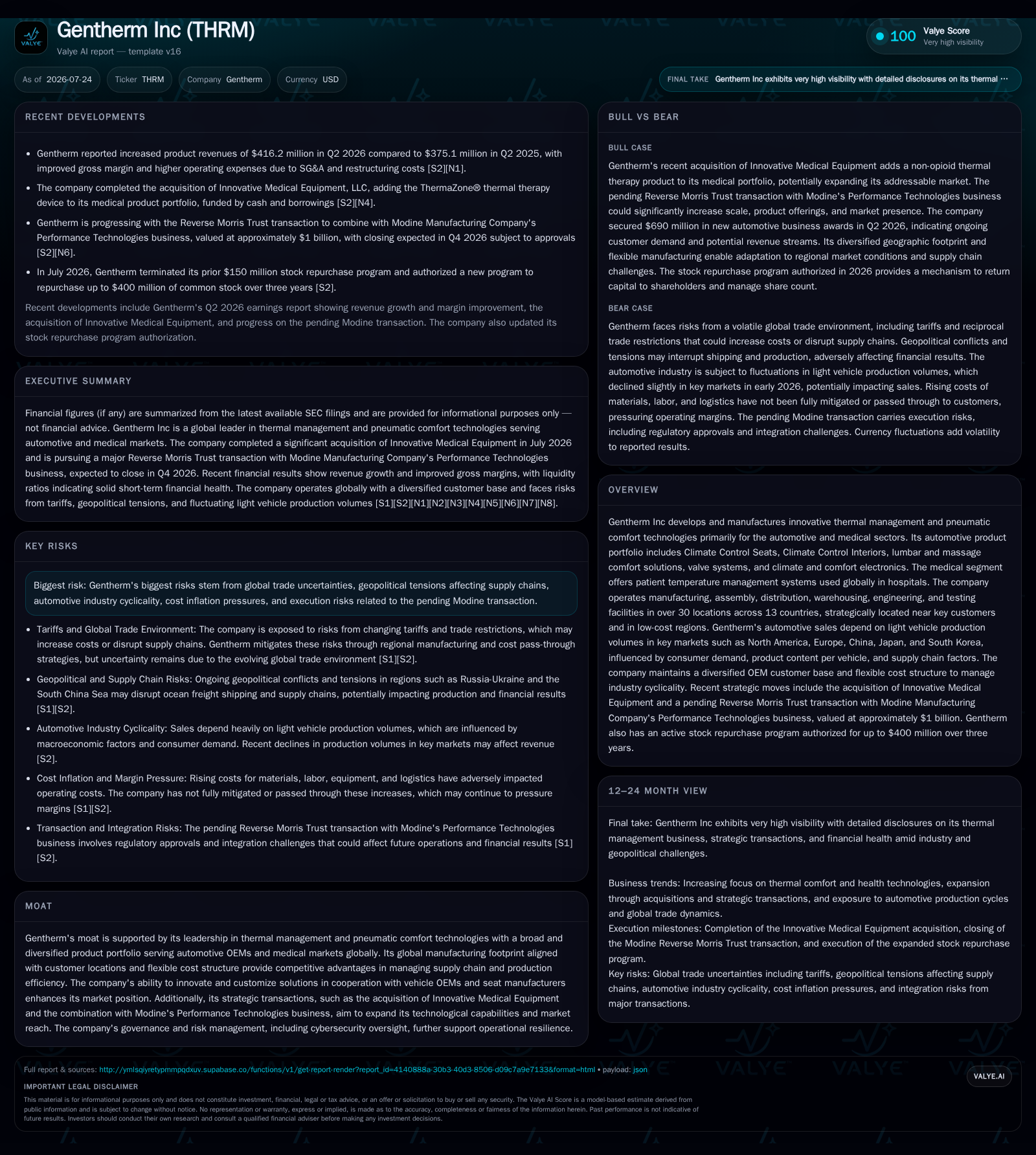
In its latest quarterly filing, Gentherm Inc demonstrated operational resilience driven by diversified automotive and medical product lines, supported by ongoing technological innovation and strategic transactions including the acquisition of Innovative Medical Equipment (IME) and progress on the Modine reverse Morris trust deal. The company's revenue growth remains sensitive to global light vehicle production trends and OEM product content dynamics. Gentherm's global footprint, flexible cost structure, and close OEM partnerships underpin competitive positioning despite automotive cyclicality and inflationary pressures. A pronounced focus on integrating new acquisitions, managing supply chain costs, and capitalizing on rising comfort and wellness feature adoption will be critical milestones ahead.
Latest Operating Update: Strategic Growth and Operational Realignment Amid Industry Cyclicality
Gentherm Incorporated’s second quarter 2026 results demonstrate operational resilience amid ongoing automotive production volatility and transformative corporate developments [S2][S3]. The company reported a slight compression in operating income driven by increased selling, general and administrative expenses, as well as restructuring charges related to global manufacturing footprint realignment [S22]. On July 1, 2026, Gentherm completed the acquisition of Innovative Medical Equipment (IME), expanding its patient temperature management capabilities within the medical segment—a market supported by aging demographics and rising healthcare demand [S2]. Concurrently, the pending Modine reverse Morris trust transaction remains on track, subject to customary closing conditions, and is expected to significantly broaden Gentherm’s automotive thermal management technology portfolio through the addition of Modine’s Performance Technologies business [S1][S3]. These strategic moves highlight Gentherm’s deliberate diversification beyond the cyclically sensitive automotive segment.
Business Model: Dual Segments Anchored in OEM and Healthcare Partnerships
Gentherm operates two primary reportable segments: Automotive and Medical. The Automotive segment encompasses the design, engineering, manufacturing, and sales of advanced thermal management and pneumatic comfort solutions including Climate Control Seats (CCS®), Climate Control Interiors (CCI™), lumbar support systems, massage comfort solutions, valve systems, and climate and comfort electronics tailored to global automotive OEMs [S1]. Revenue in this segment is closely tied to light vehicle production volumes in key markets such as North America, Europe, China, Japan, and South Korea, with product content per vehicle—a measure of feature penetration—serving as a critical growth lever [S2]. Increasing consumer demand for wellness-oriented vehicle interiors, including personalized climate and comfort features, supports sustainable content growth even amid fluctuations in vehicle production volumes.
The Medical segment focuses on patient temperature management systems deployed globally across hospitals and healthcare facilities, addressing therapeutic warming and cooling needs in acute, chronic, and surgical care settings [S1]. The IME acquisition enhances this segment by expanding Gentherm’s technology base in critical care thermal management, complementing existing product lines [S2]. Both segments rely on close collaboration with OEMs and healthcare providers to integrate Gentherm’s proprietary technologies into final products, creating high switching costs and reinforcing long-term customer relationships.
Industry Structure and Competitive Positioning
Gentherm occupies a specialized niche at the intersection of automotive thermal management and pneumatic comfort technologies and regulated medical temperature management devices. As a Tier 1 supplier, Gentherm serves OEMs worldwide with a manufacturing and engineering footprint spanning over 30 facilities across 13 countries, including strategic locations in China, Mexico, Germany, and South Korea [S1]. This global presence supports supply chain optimization by balancing proximity to key customers with cost-efficient production in lower-cost regions.
Competitive dynamics include established suppliers such as Gentex Corporation, known for automotive comfort electronics; Johnson Controls, a leader in seating systems; and Modine Manufacturing Company, a peer in thermal management technologies—soon to be integrated into Gentherm’s portfolio via the reverse Morris trust transaction [S1]. Success in this environment depends on continuous innovation in thermal and pneumatic comfort technologies, co-development partnerships with OEMs to increase product content per vehicle, and rigorous compliance with the complex regulatory landscape governing medical devices.
Growth Drivers: Innovation, Market Trends, and Strategic Acquisitions
Gentherm’s growth is primarily driven by increasing product content per vehicle amid a broader industry shift toward human comfort, health, and wellness features—trends accelerated by the rise of electric vehicles, which introduce new thermal management challenges [S1]. The integration of climate control interiors with lumbar and massage comfort solutions generates incremental revenue streams that are less sensitive to base vehicle production cycles. Geographic expansion into emerging automotive markets further supports growth.
In the medical segment, demographic aging worldwide fuels demand for advanced patient temperature regulation therapies. The recent IME acquisition adds complementary technologies that enhance Gentherm’s critical care offerings, positioning the company to capture a larger share of this growing market [S2]. The anticipated Modine transaction will further expand Gentherm’s thermal management capabilities and product breadth, enabling cross-segment synergies. Continued R&D investment in next-generation thermal and pneumatic comfort solutions underpins the company’s competitive advantage and responsiveness to evolving OEM and healthcare provider needs.
Risks and Operational Watchpoints
Gentherm faces risks common to automotive component suppliers, including exposure to light vehicle production cyclicality influenced by macroeconomic factors such as interest rates, consumer confidence, and government incentives [S17][S23]. Volatility in OEM production schedules can impact order backlogs and revenue timing. Inflationary pressures on raw materials and labor costs, compounded by global supply chain uncertainties and geopolitical tensions in key manufacturing regions, pose margin risks.
Integration risks are significant for the recently completed IME acquisition and the pending Modine reverse Morris trust transaction. Realizing anticipated synergies depends on effective employee retention, operational system harmonization, and cultural alignment [S1][S19]. The medical segment’s regulatory environment requires ongoing compliance vigilance to mitigate risks of costly delays or disruptions [S17][S23]. Additionally, currency exchange rate fluctuations present financial translation risks given Gentherm’s diverse global operations.
Key Performance Indicators and Upcoming Milestones
Critical near-term milestones include the closing of the Modine reverse Morris trust transaction, contingent on shareholder approval and regulatory clearances, with post-close integration progress to be closely monitored [S1][S3]. OEM order backlog trends in major markets such as North America and China will serve as leading indicators of automotive revenue trajectory, given their strong correlation with light vehicle production volumes. Tracking product content penetration rates on flagship vehicle platforms will provide insight into the pace of wellness feature adoption and associated revenue growth.
Operationally, the execution of restructuring initiatives aimed at optimizing Gentherm’s global manufacturing footprint—targeted at reducing fixed costs and improving capacity utilization—will be key margin drivers [S12][S13][S15]. In the medical segment, scaling IME’s technologies and validating adoption through hospital metrics will be important for segment expansion. Capital expenditures directed toward advanced manufacturing capabilities and R&D platforms will offer signals of readiness for future innovation cycles.
Financial Position and Liquidity
As of June 30, 2026, Gentherm held approximately $213 million in cash and cash equivalents against total debt of about $272 million, resulting in net debt near $59 million, reflecting a balanced capital structure supportive of strategic investments [F1]. The company’s current assets of $880 million versus current liabilities of $426 million yield a current ratio of approximately 2.06x, indicating solid short-term liquidity [F1]. This financial flexibility underpins Gentherm’s ability to fund acquisitions, invest in R&D, and execute restructuring initiatives while managing cyclicality in its end markets.
Disclaimer: This analysis is for informational purposes only and does not constitute investment advice. It incorporates company filings and publicly available data as of July 2026.
Disclaimer: This is research-only, informational analysis and not investment advice. It may include AI-generated interpretation and general industry context. Always verify important details using primary sources.

Comments