
Ankam, Inc. Charts Growth and Liquidity Risks with Asian Expansion and Mobile Apps
Ankam’s Q2 2026 filing reveals operational progress tempered by liquidity challenges amid efforts to scale proprietary mobile apps and expand in Asia.
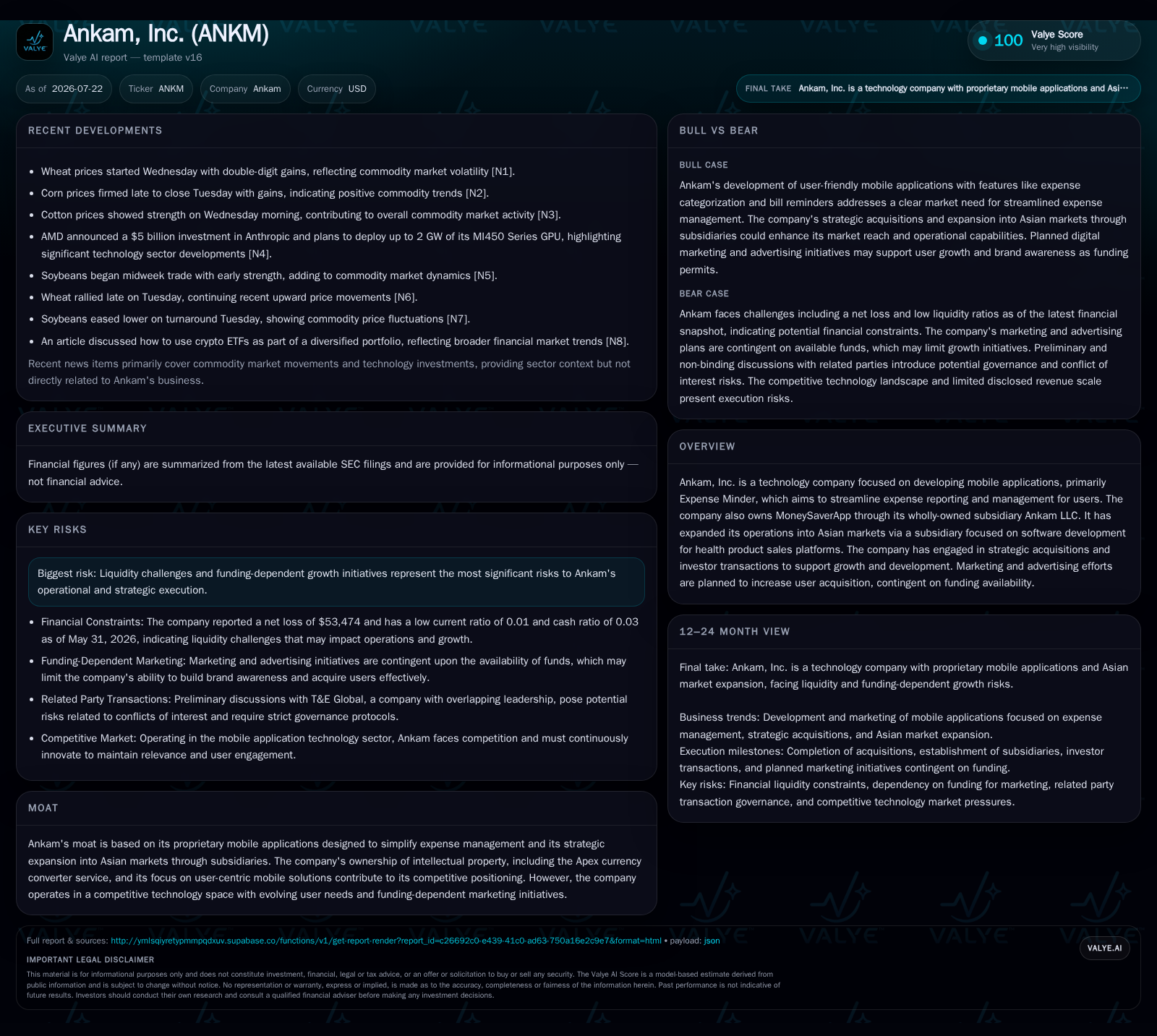
Ankam, Inc.'s latest quarterly report underscores the company’s dual focus on growing its proprietary mobile applications—Expense Minder and MoneySaverApp—and expanding its footprint into key Asian markets through its subsidiary Mei Sheng Corporation Limited. While these strategic moves position Ankam for potential user base growth and product differentiation via intellectual property assets like the Apex currency converter, the company faces considerable liquidity constraints highlighted by a very low current ratio. Growth initiatives, particularly marketing campaigns vital for driving user acquisition in a competitive SaaS/mobile app landscape, remain funding-dependent, creating execution risk. Monitoring user engagement KPIs and successful milestones in its Asian subsidiary will be critical indicators of Ankam’s ability to balance growth ambitions with financial sustainability.
Q2 2026 Unveils Operational Traction Amid Funding Gaps
Ankam's July 2026 quarterly filing paints a picture of cautious advancement tempered sharply by financial constraints. The company continues developing its proprietary Expense Minder app while operating MoneySaverApp through its wholly owned subsidiary Ankam LLC [S2], [S1]. However, financial snapshots show a stark liquidity imbalance with current assets around $6,330 against current liabilities exceeding $679,000 as of May 31, 2026 — yielding a critically low current ratio near 0.01 [F1]. This level of liquidity stress suggests that while operational developments are ongoing, the company's ability to execute growth initiatives hinges heavily on securing additional capital.
Such a tight cash position is particularly acute in the SaaS/mobile application industry where user acquisition efforts often demand upfront marketing outlays before generating recurring subscription or licensing revenues. Hence, Ankam’s operational progress is essentially moderated by an underlying tension between growth ambitions and funding availability.
Proprietary Mobile Apps Anchor Core Revenue Model
At its core, Ankam operates within the Software as a Service (SaaS) mobile application development space focusing on proprietary products designed for expense management [S1]. Expense Minder aims to automate expense reporting with features like categorization, saving goals tracking, bill reminders, and customizable categories, targeting individual consumers or small businesses seeking streamlined financial tracking [S1]. Complementing this is MoneySaverApp housed under Ankam LLC following a November 2023 transfer of operations [S1].
Revenue mechanics likely blend subscription fees for premium features alongside potential in-app purchases or licensing agreements typical of SaaS/app monetization models although explicit breakdowns are not detailed publicly. The company’s acquisition of Apex Intelligence LLC further adds a currency converter service into its IP portfolio—Apex technology adds functional breadth that could augment cross-selling or enhance user retention by addressing multi-currency digital payment needs [S1]. Such IP ownership supports Ankam’s competitive positioning by enabling proprietary feature sets not easily replicated by generic app developers.
Expanding Footprint: Asian Market Entry through Subsidiaries
In August 2024, Ankam strategically expanded into the Asian tech market by incorporating Mei Sheng Corporation Limited focused on Hong Kong, Taiwan, and adjacent regions [S4]. Mei Sheng’s mandate includes developing software applications geared towards health product sales platforms—via contractual partnership with Taiwan-based Consummation International Business Co., Ltd—which signals diversification beyond pure expense management toward synergetic vertical SaaS offerings in emerging markets.
Asian market entry provides both significant opportunity given smartphone penetration growth but also distinct operational challenges ranging from localization hurdles and regulatory compliance to forming effective distribution partnerships. Compared to peers that target regional specialization via subsidiaries or joint ventures—a common approach among mid-size regional software firms—Mei Sheng's progress will be a key bellwether for Ankam’s ability to convert geographic expansion into tangible revenue and user growth gains.
Competitive Dynamics in SaaS Expense Management Spaces
The mobile app expense management landscape is densely populated with generalist FinTech platforms and niche SaaS providers competing fiercely on pricing power, user interface innovation, and ecosystem integration. Ankam’s moat primarily derives from owning proprietary apps with integrated IP assets like Apex alongside targeted geographic presence.
However, sustaining monthly active users (MAU) with manageable churn rates remains challenging as switching costs for consumers are often low in this category. Companies that succeed typically combine aggressive digital marketing strategies with continuous feature rollouts enhancing Average Revenue Per User (ARPU) while maintaining efficient Customer Acquisition Cost (CAC) payback periods. Without strong capital backing to fuel marketing spend efficiency or rapid product iteration cycles, retaining competitive relevance may prove difficult for Ankam given its reported funding constraints.
Growth Drivers Centered on Marketing and Product Enhancements
Ankam envisions scaling its user base through strategic online marketing initiatives tailored towards building brand recognition for Expense Minder and MoneySaverApp [S1], [S14]. Digital campaigns leveraging targeted channels alongside planned offline advertising seek to create awareness essential for driving future subscription growth. App store optimization efforts complement these by improving visibility within crowded marketplaces.
Moreover, cross-promotion between its owned apps aims at maximizing internal conversion rates and fostering sticky engagement critical for long-term retention. Product development roadmaps emphasize enhanced automated features designed to reduce users’ manual effort further—an increasingly valued attribute as remote work models boost demand for mobile productivity tools.
Nonetheless, the pace and effectiveness of these growth drivers remain tightly coupled with available funding. The company explicitly notes that advertising budget expansions are contingent upon capital influxes—spotlighting an execution risk inherent to their growth model [S14].
Funding-Dependent Risks Constrain Expansion Potential
Underlying Ankam's strategic plans is a pronounced dependency on external financings that elevates operational risk. Despite recent stock purchase transactions conferring controlling interest to an investor group led by CEO Wang Wen Lung in August 2024 [S6], liquidity remains heavily strained as reflected in the current ratio of approximately 0.01 reported as of May 2026 [F1].
Ankam has utilized convertible promissory notes as part of fundraising mechanisms—including a $500,000 proposed note canceled later—and has converted some past debt into equity shares at pre-defined prices [S1], [S4]. This financing mix introduces dilution considerations alongside timing risks associated with maturity dates looming within months.
The firm must navigate balancing runway extension while preserving sufficient capital allocation towards essential user acquisition marketing activities and backend software development requirements. Failure to sufficiently raise funds or manage burn rates could delay marketing ramp-ups or prolong roadmap milestones jeopardizing competitive positioning.
Key KPIs Reflect User Engagement Challenges
User retention linked closely to feature adoption rates will dictate revenue predictability since many mobile SaaS companies depend heavily on recurring subscriptions rather than one-time purchases. Given competitive pressures and lower switching costs characteristic of expense management apps, any upward drift in churn or CAC could materially weaken net retention—a red flag for durable growth prospects absent expanding functionality or superior localization efforts realized via subsidiaries.
Strategic Intellectual Property Role in Differentiation
The acquisition of Apex Intelligence LLC including their currency converter service integrates an important IP asset allowing Ankam to provide differentiated offerings addressing multi-currency financial needs—a feature relevant especially given its Asian market ambitions where cross-border transactions are common [S1].
Ownership of such proprietary technology contrasts favorably against peers relying solely on third-party APIs or commoditized fintech stacks which may lack customization scope or price bargaining power. Furthermore, control over intellectual property facilitates insourcing future feature development reducing vendor dependencies—a strategic advantage as Ankam advances software development lifecycle maturity.
What Next for User Metrics, Subsidiary Developments, and Cash Management?
Looking ahead, critical milestones include observable shifts in key performance indicators such as Monthly Active Users growth rates post-marketing campaigns launch and churn rate moderation linked with enhanced app functionalities. Concurrently monitoring progress milestones related to Mei Sheng Corporation Limited’s software platform deployment schedules is necessary given their role in geostrategic expansion plans [S4], [S2].
On the financial front, upcoming convertible note maturity dates coupled with any planned equity issuances represent pivotal events impacting liquidity profiles directly influencing operational flexibility. Stakeholders should focus keenly on announcements regarding capital raises or debt restructurings indicative of sustainability pathways.
Financial Profile Discussion: Liquidity Under Pressure
From a financial standpoint leveraging latest filings reveals a pressing liquidity bottleneck that imposes immediate constraints on strategic options [F1]. Reported cash equivalents stood at approximately $19k as of August 31, 2024—dated but consistent with trend indications reflecting minimal buffer versus liabilities totaling nearly $680k currently due within one year creating solvency tension.
The reported operating loss magnitude near $67k in prior reporting underscores ongoing cash burn typical of early-stage SaaS firms yet accentuated here by limited working capital availability [F1]. Such dynamics underscore an urgent imperative for fresh capital infusions enabling adequate investment into both customer acquisition engines via marketing as well as critical backend product enhancements without derailing financial stability.
This analysis provides a layered view anchored firmly on latest SEC quarterly disclosures combined with industry-specific context pertinent to SaaS-driven mobile application companies competing in paced markets requiring ongoing funding support for scalable growth trajectories. Investors and analysts should track upcoming milestone releases around user engagement metrics, subsidiary progress updates in Asia, alongside financing maneuvers clarifying Ankam's runway extension possibilities.
Disclaimer: This is research-only, informational analysis and not investment advice. It may include AI-generated interpretation and general industry context. Always verify important details using primary sources.

Comments