
StoneBridge Acquisition II Corp Charts SPAC Strategy Focused on APAC and EMEA Growth Verticals
Latest quarterly disclosures reveal a stable governance transition and robust liquidity as StoneBridge Acquisition II Corp advances its search for an international business combination.
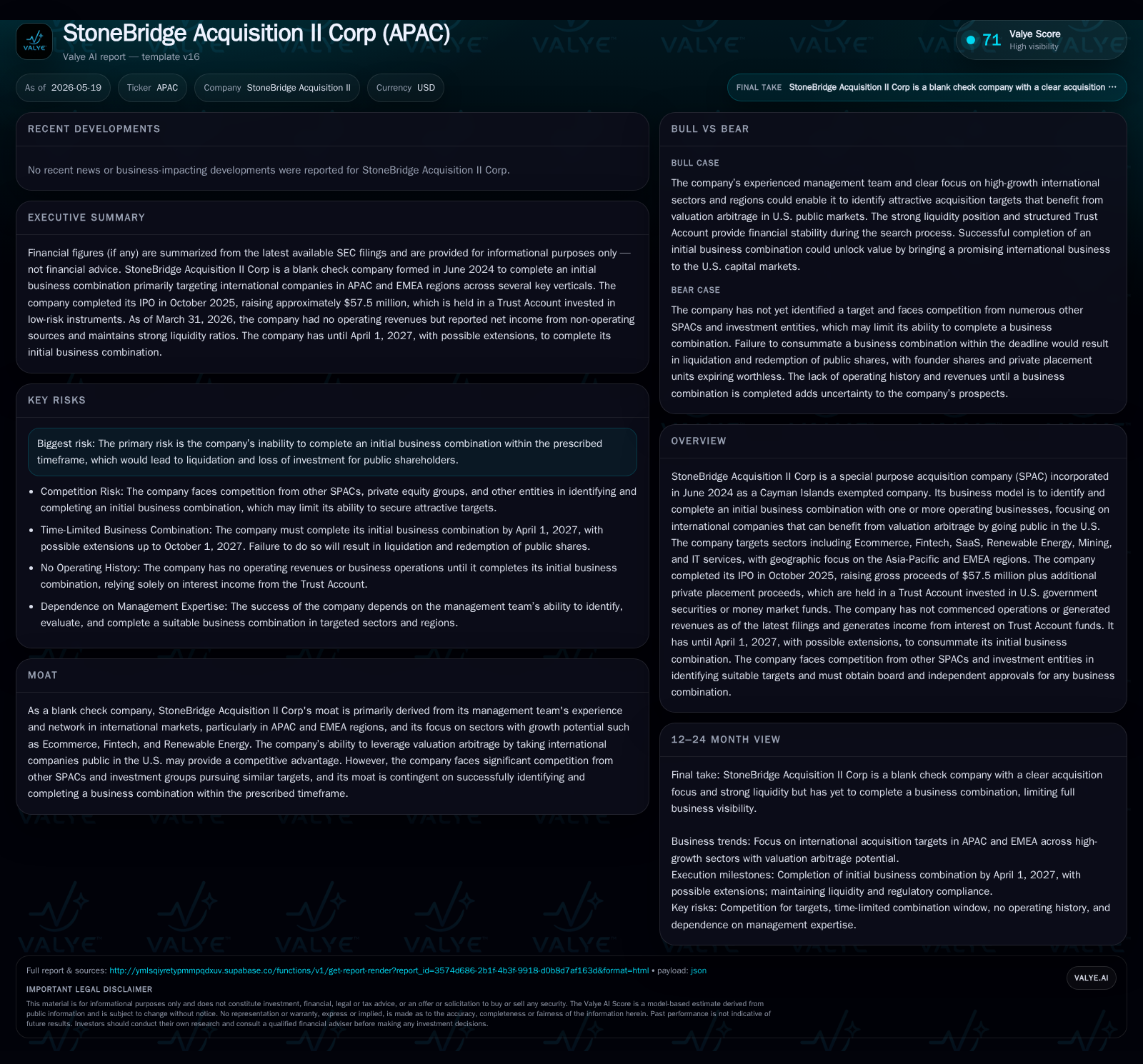
StoneBridge Acquisition II Corp remains a pre-combination special purpose acquisition company with a focused pursuit of targets in the Ecommerce, Fintech, SaaS, Renewable Energy, Mining, and IT services sectors—primarily across Asia-Pacific and EMEA regions. The May 2026 quarterly report confirms no material operational changes but notes the voluntary resignation of a board member, signaling minor shifts in oversight during the critical deal-sourcing phase. With $57.5 million initially raised and cash held in trust producing modest interest income, the SPAC's value proposition hinges on leveraging experienced management networks and valuation arbitrage opportunities to successfully consummate a combination within regulatory timelines.
Latest Quarterly Update Highlights and Corporate Governance Shift
The most recent filing dated May 15, 2026 (Form 10-Q) provides an operational snapshot confirming that StoneBridge Acquisition II Corp ("the Company") remains in its pre-business combination stage. As expected of a blank check company, it has not commenced revenues but generates non-operating interest income from its cash reserves held predominantly in a Trust Account invested in U.S. Treasury securities or money market funds [S2], [F1]. The cash position stands robust at approximately $330k as of March 31, 2026, supported by an exceptionally strong current ratio over 9x [F1], underscoring ample liquidity available for transaction-related expenses.
A notable corporate governance development occurred shortly before this reporting period with the resignation of Board Member Richard Saldanha effective May 8, 2026 [S3]. Importantly, his departure stems from no disagreement with management or board policies, suggesting benign realignment rather than governance disruption. While such transitions warrant monitoring for oversight continuity during the critical deal-sourcing months ahead, existing management appears stable.
Business Model: Structure, Financial Mechanics, and Sector Focus
StoneBridge Acquisition II Corp operates as a Cayman Islands-domiciled special purpose acquisition company specifically formed to effectuate an initial business combination via merger or acquisition of one or more operating businesses [S1]. It executed its initial public offering (IPO) in October 2025 raising gross proceeds of $57.5 million [S1], [F1]. These proceeds reside in a Trust Account earning modest interest income until deployed.
The Company's business model hinges fundamentally on identifying undervalued or growth-oriented international companies—primarily within the Asia-Pacific (APAC) and Europe, Middle East & Africa (EMEA) regions—that stand to benefit materially from public listing on U.S. securities exchanges through valuation arbitrage mechanisms [S1]. Valuation arbitrage here refers to the phenomenon where companies access comparatively higher valuations due to U.S. capital market depth and investor enthusiasm for growth-focused sectors.
Targeted verticals span several dynamic sectors: Ecommerce, Financial Technology (Fintech), Software-as-a-Service (SaaS), Renewable Energy, Mining, and IT & IT-enabled services. This sector diversity reflects the team's strategy to back scalable businesses leveraging digital transformation trends alongside traditional resource-driven industries showing promise through ESG-linked investment flows [S1].
As typical with SPACs, no operating revenues have been recognized pre-business combination; income is limited to interest accrued on IPO proceeds buffered within conservative U.S. government investments [S1]. Founder shares owned by sponsors carry significant voting weight post-IPO enabling control over transaction approvals—founder ownership was adjusted downward from initial issuance but remains strategically aligned with successful deal closure incentives [S1].
Competitive Landscape and Industry Dynamics Shaping Acquisition Targets
The hunt for suitable targets is occurring against a backdrop of heightened competition among numerous SPACs targeting cross-border deals in similar sectors and regions [S9]. The "valley of competition" effect means multiple players vie for a limited set of high-quality international candidates amenable to U.S. public market entry.
Traditional private equity groups and strategic acquirers also increase competitive tension by pursuing these assets using alternative deal structures. Moreover, many international targets may be early-stage or financially less stable companies—heightening due diligence complexity and execution risk [S9], [S6].
Barriers to entry that might underpin sustainable post-combination competitive advantages include established market share presence within verticals like fintech platforms or renewable energy developers operating under regional regulatory frameworks supportive of clean tech expansion [S4], [S5]. Successfully navigating such dynamics requires not only financial resources but deep local insight often derived from management team's regional networks.
Strategic Advantages through Management Expertise and Valuation Arbitrage
The Company cites management expertise as its primary moat—a common theme among blank check entities which lack standalone products or services but depend heavily on sponsor capabilities to source deals with asymmetric value potential [S1]. Longstanding experience running international businesses affords valuable access channels into promising firms within APAC/EMEA economies growing their footprint into western capital markets.
This human capital advantage ties directly into maximizing valuation arbitrage: capturing opportunities where target companies may command premium multiples on U.S. exchanges relative to their domestic listings or private valuations due to increased investor appetite for tech-enabled growth stories internationally [S1]. However, absent effective post-merger integration plans or weak governance post-transaction could erode perceived advantages—underscoring importance of public-market-ready leadership among targets.
Growth Drivers Underpinning Target Selection in APAC and EMEA Markets
Key structural factors driving growth prospects include rapid digital adoption accelerating demand for ecommerce platforms and fintech solutions across emerging Asia-Pacific economies; burgeoning SaaS penetration enabling scalable enterprise software monetization; regulatory tailwinds championing renewable energy development aligned with global climate commitments; mining industry revitalization linked to battery metals extraction necessary for electrification; alongside IT outsourcing poised for incremental growth amid global supply chain realignments [S1], [S4], [S5].
Execution complexity heightens when targeting foreign companies subject to unpredictable legal systems, political volatility, currency fluctuations, or compliance challenges with Sarbanes-Oxley internal control standards necessary for public filings post-merger [S1], [S7], [S19].
Additionally, typical of SPAC structures are voting rights imbalances where founder shares controlled by sponsors possess disproportionate influence over approving the business combination—even if majority public shareholders oppose it—which may raise governance concerns or dampen minority shareholder protections long-term [S1]. Market reception risks involve uncertain public market enthusiasm upon announcement: achieving attractive valuation premiums depends critically on selecting target businesses whose narratives resonate strongly with institutional investors accustomed to growth consistency and regulatory transparency.
Catalysts and Key Milestones Ahead for Investors
Moving forward, immediate focus centers on confirmation of initial business combination target(s). Market watchers should track announcements detailing specific candidate companies alongside terms underpinning proposed deals—including cash-versus-stock consideration decisions which materially impact existing shareholder value composition [S2], [S3], [S1].
Subsequent milestones involve shareholder approval processes if legally required—given that StoneBridge may elect tender offers as alternatives—and navigation through regulatory approvals complicated by cross-border layers involving multiple jurisdictions’ compliance requirements.
Given recent board member exit though unrelated directly to operations completion risk—the composition changes prompt attention toward possible shifts in strategic diligence priorities or advisor engagement reflecting fresh governance dynamics during transaction negotiation phases.
Ultimately execution speed coupled with quality target validation will be crucial signals influencing goodwill perception among existing investors anticipating value creation beyond trust-account preservation.
This analysis is based solely on publicly filed SEC documents as of May 19, 2026. No investment advice is offered herein. Readers should consider this review informational only within their broader due diligence framework before forming any opinions regarding StoneBridge Acquisition II Corp’s eventual business combination prospects or equity participation.
Disclaimer: This is research-only, informational analysis and not investment advice. It may include AI-generated interpretation and general industry context. Always verify important details using primary sources.

Comments