
AppFolio Expands Property Management Scale and Revenue with Enhanced SaaS and Transaction Services
Q1 2026 growth driven by increased units under management and higher adoption of transaction-based services.
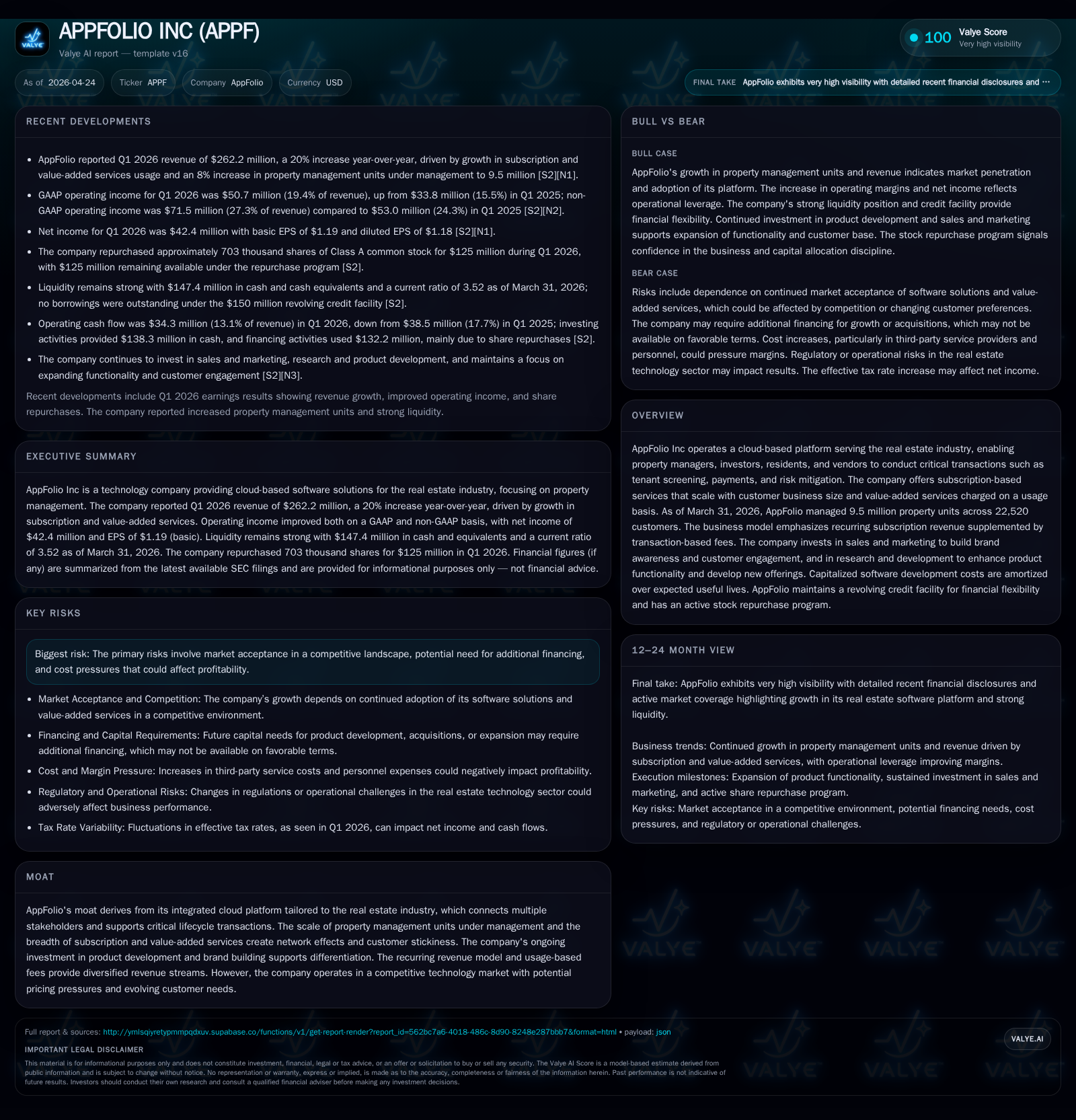
AppFolio reported 20% year-over-year revenue growth in Q1 2026, reaching $262.2 million, fueled by an 8% increase in property management units under management to 9.5 million and rising usage of value-added services such as electronic payments and tenant screening. The company’s cloud-based SaaS platform generates subscription revenue that scales with customer size and complements it with transaction fees from payment processing and risk mitigation, creating recurring and usage-driven streams. While maintaining robust liquidity with $151.7 million in cash and no debt drawn on its revolving credit facility, AppFolio reinvests heavily in R&D and sales to support competitive differentiation and future growth amid an intensifying industry landscape.
Recent Operating Update
In its latest quarterly filing for Q1 ended March 31, 2026 [S2], AppFolio announced revenue growth of 20% year-over-year to $262.2 million. This acceleration was driven primarily by an 8% rise in property management units under management (9.5 million units compared to 8.8 million in Q1 2025), signaling expanding market presence. The company’s GAAP operating income improved significantly to $50.7 million (19.4% of revenue) versus $33.8 million (15.5%) in the prior year period. Non-GAAP operating income similarly rose to $71.5 million (27.3% margin) from $53 million (24.3%).
AppFolio highlighted robust demand for its value-added services—particularly electronic payment processing—which experienced increased usage as both residents and property managers conducted more online transactions [S2]. This transactional activity complemented stable subscription revenue tied to customers’ portfolio sizes.
Liquidity remains strong with cash, cash equivalents, and investment securities totaling approximately $151.7 million as of quarter end [S2]. Additionally, the company executed $125 million in stock repurchases during Q1 against a repurchase authorization of up to $300 million [S11].
Business Model
AppFolio operates primarily as a cloud-based software-as-a-service (SaaS) provider serving property managers along with associated stakeholders such as investors, residents, and vendors [S1]. Revenue streams bifurcate into two segments:
- Subscription Services: Monthly or annual fees linked to the number and type of managed properties that scale with customer business size; recognized on a straight-line basis over contract terms.
- Value Added Services: Usage-based fees from transactional offerings including electronic payments (processed gross before interchange fees), tenant screening reports, and insurance-related risk mitigation; recognized as the services are rendered.
This hybrid model leverages a recurring base through subscriptions supplemented by growth in per-use transactional fees that provide variable upside linked directly to user engagement [S9]. Other revenue sources entail setup fees for implementation and legacy service contracts that have yet to be migrated onto core platforms.
The business logic capitalizes on creating an integrated ecosystem connecting multiple parties involved in real estate operations—from lease origination screening through rent payments to risk services—all residing on a unified platform for operational efficiency and data-driven insights.
Industry Structure and Competitive Position
AppFolio competes within a dynamic real estate technology sector marked by evolving customer expectations around digital management capabilities. Its cloud-native SaaS platform differentiates via comprehensive coverage spanning critical lifecycle transactions that combine essential tenant-facing functions with back-office operational tools.
The scale—managing over 9.5 million units across approximately 22,520 customers—generates network effects that reinforce customer retention through entrenched workflows and data integrations enhancing switching costs [S1]. Competitors face challenges bridging breadth of functionality with ease of use tailored specifically for real estate verticals.
Continued investments in product development enhance feature set depth while sales and marketing efforts bolster brand visibility among property managers ranging from small portfolios to larger enterprise operators [S12]. Nonetheless, the market remains competitive with pressure from other proptech firms seeking modular or lower-cost alternatives which could impose pricing or churn risks.
Growth Drivers and Constraints
Growth is structurally driven by:
- Expansion of Units Under Management: More units directly convert into higher subscription fees as pricing scales accordingly.
- Greater Adoption of Transactional Services: Increased resident engagement online fuels usage fees from electronic payments, tenant screening activity, and insurance products.
- Product Innovation: Introducing new features or additional Value Added Services can unlock adjacent revenue opportunities.
- Industry Digitalization Tailwinds: Broader trends towards automation in property operations favor SaaS providers vested across the ecosystem.
Conversely, constraints stem from:
- Third-Party Cost Inflation: Higher service provider fees related to transaction handling materially raise the cost base alongside revenue gains [S10].
- Competition Induced Pricing Pressure: Emerging tech entrants or commoditized offerings might limit pricing power or force incremental sales costs.
- Investment Needs: Sustained R&D (+13% YoY to nearly 19% of revenue) plus marketing spend (+21%; flat % of revenue) require balancing immediate profitability against long-term differentiation [S12].
- Regulatory or Market Shocks: Real estate market dynamics impacting unit count or digital behavior could transiently disrupt growth trajectories.
What to Watch Next
Key metrics for monitoring include:
- Continued growth rate of property management units which signals new customer additions or expanded footprint per client.
- Adoption pace of Value Added Services that underpin scalable usage revenues.
- Gross margin resilience given rising payment processing expenses which comprise sizable third-party costs.
- Operating leverage trends evaluating expense control amid ongoing R&D and sales investments.
- Liquidity position relative to capital allocation choices such as share repurchases or potential acquisitions.
- Management guidance updates relating to full-year revenue expectations reflect confidence in scaling dynamics [N1][N2].
Financial Profile Summary
Historical performance (annual)
| FY | Net ($mm) | CFO ($mm) | OpInc ($mm) | Capex ($mm) | Net YoY |
|---|---|---|---|---|---|
| 2025 | 141 | 242 | 153 | 3 | -30.9% |
| 2024 | 204 | 188 | 136 | 2 | +7452.5% |
| 2023 | 3 | 60 | 1 | 9 | +104.0% |
| 2022 | -68 | 25 | -72 | 7 |
Source: SEC companyfacts cache [F1].
Capital returns and efficiency (annual)
| FY | Buybacks ($mm) | FCF ($mm) | ROE% |
|---|---|---|---|
| 2025 | 146 | 239 | 26.0 |
| 2024 | 186 | 39.3 | |
| 2023 | 51 | 0.9 | |
| 2022 | 0 | 19 | -25.7 |
Source: SEC companyfacts cache [F1].
Annual revenue detailed in filings but not extracted here; latest quarterly figures illustrate continued top-line growth.
Operating margins improved both on GAAP (19.4%) and non-GAAP (27.3%) bases showing effective cost control even as personnel-related expenses increased alongside sales/marketing and R&D increments [S6][S7][S12]. Depreciation declined somewhat due to asset lifecycle maturation indicating potentially lower fixed charges ahead [S13].
Disclaimer
This analysis is intended solely for informational purposes reflecting documented filings and publicly available sources as of April 2026 without providing investment recommendations or forecasts beyond cited evidence.
Disclaimer: This is research-only, informational analysis and not investment advice. It may include AI-generated interpretation and general industry context. Always verify important details using primary sources.

Comments