
Adaptin Bio Advances Clinical Progress with BRiTE Platform Amid Funding Challenges
Latest quarterly disclosures show important clinical trial progress for APTN-101 while revealing constrained liquidity and mounting operational expenses.
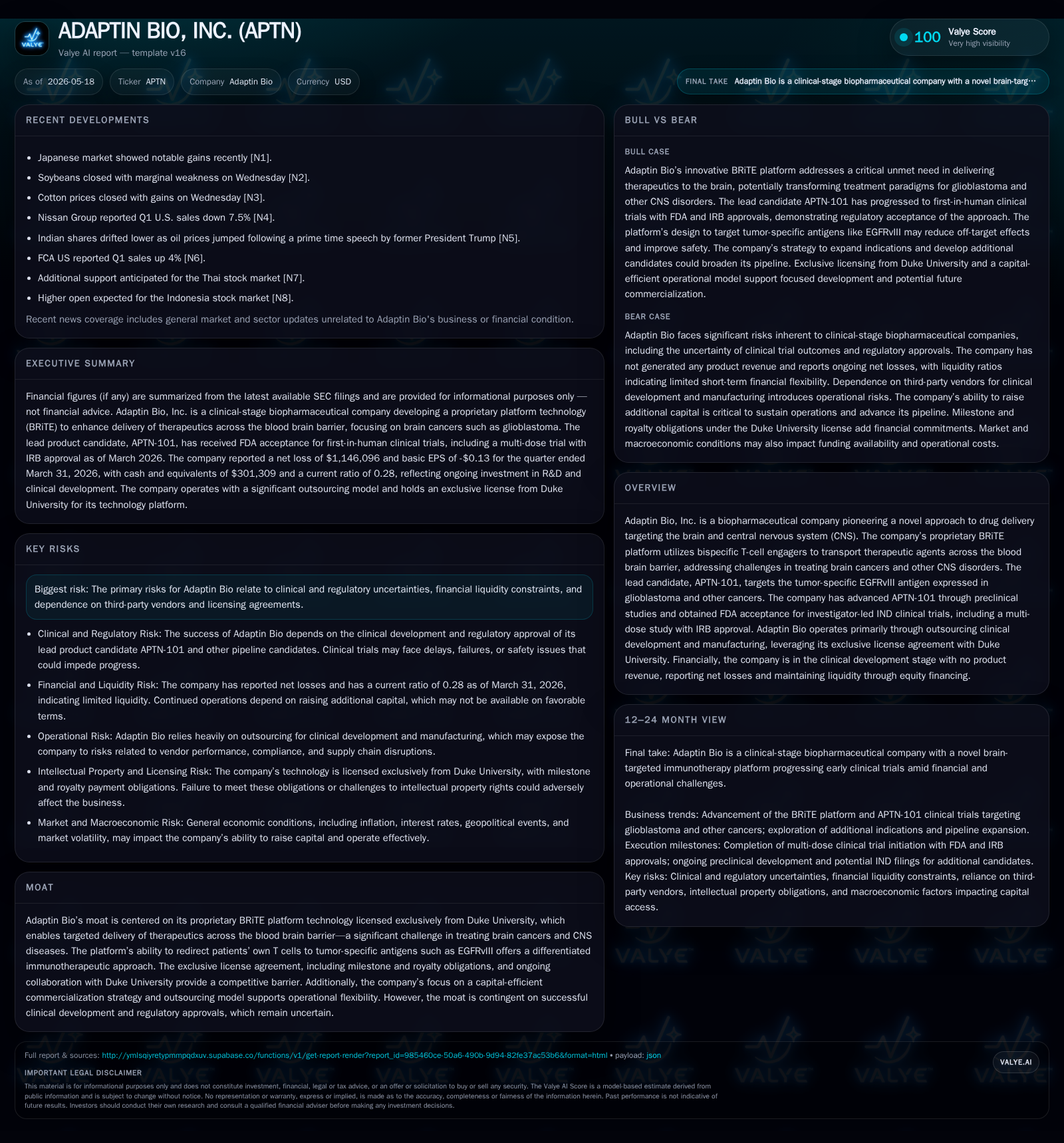
Adaptin Bio entered a new phase in clinical development with FDA acceptance of its investigator-led IND trials for APTN-101, targeting glioblastoma via its proprietary BRiTE platform. Despite proprietary technology advantages addressing blood brain barrier delivery challenges, the company faces significant financial constraints manifested by a working capital deficit and low current ratio. Its capital-efficient business model relies heavily on exclusive licensing from Duke University and outsourced development, but execution risks persist amid regulatory and funding uncertainties. Near-term growth depends critically on advancing clinical milestones and securing additional capital.
Quarterly Update: Clinical and Operational Developments
In its 10-Q filing dated May 15, 2026, Adaptin Bio reported significant regulatory progress enabling clinical validation of its lead asset APTN-101. The FDA accepted an investigator-led Investigational New Drug (IND) application that include a multi-dose study protocol backed by Institutional Review Board (IRB) approval. These concrete steps demonstrate movement beyond preclinical phases into human trials targeting glioblastoma multiforme (GBM), a notoriously challenging brain cancer indication due to blood brain barrier (BBB) constraints on drug delivery [S2]. This update builds upon April’s OTCQB listing which granted broader market quotation access but leaves the company's fundamental liquidity situation unchanged, highlighting the gap between clinical momentum and capital resources [S3]. Outsourcing remains integral to operations including clinical trial management and manufacturing, underscoring Adaptin's asset-light approach while also exposing it to vendor risks and dependency dynamics in this phase-sensitive developmental window [S2], [S3].
Business Model and Technology Differentiation
Adaptin Bio monetizes its efforts through exclusive license rights to the BRiTE platform technology acquired from Duke University in early 2023. The company’s revenue model if successful will derive from future commercialization royalties and milestone payments embedded in the Duke License agreement; however, currently no milestones have been met nor sales generated as Adaptin remains solely in clinical development stages [S1], [S19]. This specialized IP position creates a competitive moat rooted in technological differentiation and exclusive rights but depends heavily on successful trial progression.
Operationally, Adaptin pursues a capital-efficient commercial strategy primarily involving outsourcing of R&D activities including CRO services for clinical development and contract manufacturing organizations (CMOs) for product supply [S1]. While this reduces fixed costs and capital intensity relative to building internal capabilities, it increases reliance on third parties' performance at key inflection points. The rarity of bispecific T-cell engager approaches targeting CNS cancers gives it technical edge versus incumbent immuno-oncology competitors who have largely struggled with therapeutic delivery into brain tissue. This niche specialization confers differentiation but also constrains scale absent broader platform adoption.
Without current commercial products or revenues, pricing power remains nascent; pricing dynamics will only emerge post-approval influenced by payor coverage decisions amid increasing cost scrutiny prevalent in oncology drug markets [S26]. Given the complexity of CNS oncology care channels involving specialists, hospitals and insurers, commercial launch would require substantial infrastructure buildout or partnership arrangements further underscoring Adaptin's current operational focus on licensing IP rather than direct commercialization.
Growth Catalysts Driving Future Momentum
Near-term growth drivers are anchored on advancing clinical development milestones linked to APTN-101’s Phase 1 investigator-led program including completion of multi-dose dosing studies and associated safety/toxicology data readouts planned for forthcoming periods headquartered in fiscal 2026–2027 timelines as implied by regulatory submissions [S2]. Successful demonstration of safety and preliminary efficacy signals could unlock subsequent larger Phase II/III trials triggering Duke License milestones valued cumulatively near $11.7 million across geopolitical regions notably the United States, European Union, and Japan where market exclusivity rights are targeted per licensing terms [S19].
Expansion beyond glioblastoma indications leveraging the modularity of the BRiTE platform presents medium-term optionality for pipeline diversification adding resilience to growth trajectories contingent on technological proof points. Lastly, improved market visibility post OTCQB listing could facilitate fundraising efforts necessary to propel these development programs forward.
Risks and Constraints Impacting Development Pathway
Critical risks stem from inherent uncertainties surrounding first-in-class CNS-targeted immunotherapies including unproven clinical efficacy in humans despite promising preclinical data—a common challenge in novel biotechnology innovation cycles impacting timelines and cost escalations potentially diluting shareholder value if extended delays occur [S1].
Financially, Adaptin confronts immediate funding pressures evidenced by a March 2026 cash balance just over $300K contrasting sharply with current liabilities over $2.4 million resulting in a working capital deficit that constrains operational flexibility severely reflected by a low current ratio near 0.28—a level typically signaling short-term liquidity distress requiring urgent capital raises or restructuring measures to avoid curtailing R&D programs or other commitments [F1], [S2].
Dependency on licensing agreements with Duke University incorporating milestone and royalty obligations introduces contractual complexity; failure to meet critical trial progress markers could impede milestone payments or strain relations impacting long-term IP control. Moreover, reliance on third-party service providers enhances operational execution risk especially amid volatile macroeconomic conditions that could disrupt supply chains or increase service costs unexpectedly further squeezing burn rates without immediate revenue inflows [S1]. Regulatory hurdles remain formidable given FDA scrutiny over novel immune-based CNS therapies posing substantial time and resource requirements before commercialization viability materializes.
Key Near-Term Milestones and What to Watch Next
Investor attention should focus closely on announcements related to progress reports from the ongoing multi-dose trial under FDA IND acceptance—specifically safety profiles and any emerging efficacy signals critical for advancing into larger pivotal trials. Updates regarding additional IND filings or expansion of indications utilizing the BRiTE platform would signal strategic momentum beyond GBM-focused assets.
Further regulatory communications clarifying pathway expectations, patient enrollment rates in investigator-led studies, partnership developments especially related to manufacturing or commercialization channels, and most importantly corporate financing events aimed at extending runway will serve as essential barometers for Adaptin's operational viability moving forward [S2],[S3].
Financial Health and Capital Structure Overview
Operating losses deepened substantially with net loss exceeding $5.16 million for full-year 2025 driven largely by rising general & administrative expenses linked partly to public company costs alongside stable research & development spend focused on APTN-101's advancement [F1],[S7].
Management acknowledges these financial pressures explicitly, disclosing substantial doubt about ability to continue as going concern absent successful fundraisings consistent with typical emerging biotech profiles transitioning through costly clinical validation phases [S23],[S24]. The company’s path forward hinges critically on synchronizing positive clinical developments with timely access to capital markets.
Disclaimer: This report is an analytical assessment grounded exclusively in publicly filed SEC documents up to May 15, 2026 (), supplemented by companyfacts snapshot data ([F1]) as permitted under analysis policy. It is intended solely for informational purposes without any investment advice or research view.
Disclaimer: This is research-only, informational analysis and not investment advice. It may include AI-generated interpretation and general industry context. Always verify important details using primary sources.

Comments