
AppYea Advances Blockchain Lottery Platform with Gambian Deployment and Strategic Pivot
AppYea's latest quarterly update underscores its shift to blockchain lottery technology, revealing operational progress in The Gambia alongside notable liquidity risks.
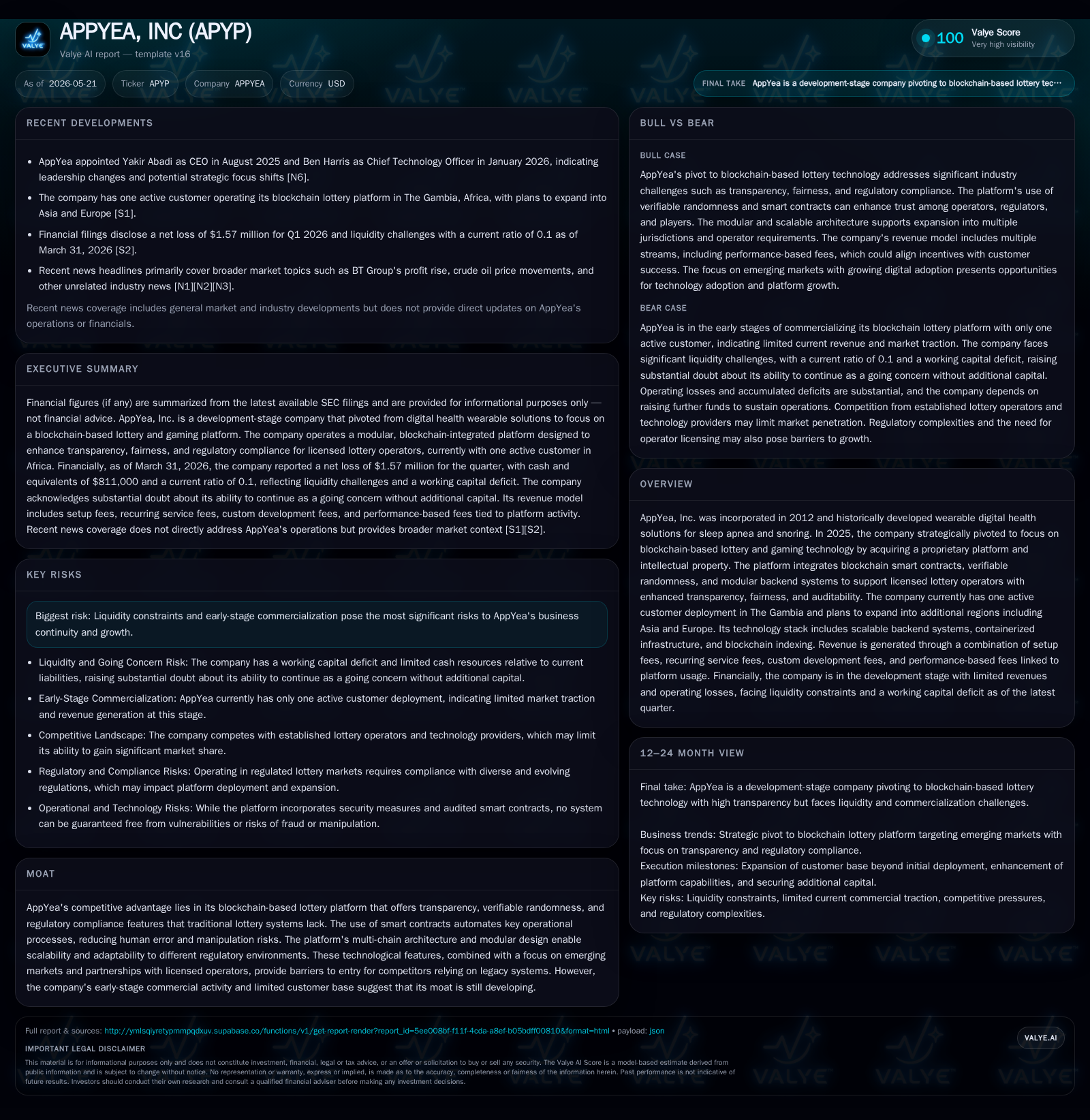
In its May 2026 10-Q, AppYea disclosed the operational deployment of its blockchain-based lottery platform in The Gambia, marking a significant milestone following its 2025 strategic pivot from digital health wearables to blockchain gaming. The company's technology emphasizes transparency and regulatory compliance through smart contracts and verifiable randomness, positioning it against aging legacy lottery providers. However, challenges remain substantial due to early-stage commercialization, concentrated customer exposure, and critical liquidity constraints reflected by a low current ratio. Growth depends heavily on geographic expansion and institutional partnerships, while near-term focus includes securing capital and navigating ongoing legal proceedings.
Latest Quarterly Operating Update: Validating the Blockchain Pivot
AppYea’s May 20, 2026 Form 10-Q marks an important inflection point for the company as it executes on its blockchain-based lottery strategy acquired from Techlott Enterprises Ltd. Most notably, the company has achieved live deployment of its proprietary lottery platform in The Gambia—its first active commercial customer [S2]. This operational proof-of-concept validates the foundational tech stack and supports AppYea’s repositioning beyond its historical digital health roots. Despite this milestone, no material changes were reported in risk factors, underscoring continued liquidity concerns highlighted by an extremely low current ratio (~0.1) at quarter-end March 31, 2026 [F1]. The constrained cash availability alongside concentrated liabilities signals near-term financing must be raised to sustain expansion efforts.
Business Model Evolution: From Digital Health to Blockchain Lottery Solutions
Historically focused on wearable devices for sleep apnea detection via SleepX subsidiary until late 2024-2025 [S1], AppYea pivoted decisively with the August 2025 acquisition of Techlott’s blockchain-enabled lottery platform [S1]. This transaction included not only production-ready software but also extensive intellectual property covering innovative features such as smart contracts and verifiable randomness mechanisms. The new business model monetizes through a layered revenue mix:
- Setup fees for initial platform integration
- Recurring service fees for ongoing hosting and maintenance
- Custom development charges for operator-specific features
- Performance or transaction-based fees linked to lottery usage volume
This model inherently aligns revenue growth with increasing user engagement and regional licensing deals but remains nascent commercially with limited current traction outside The Gambia.
Technology Differentiation: Smart Contracts, Verifiable Randomness, and Modularity
AppYea’s technology is engineered to disrupt traditional lottery platforms by embedding transparency and fairness at the core via blockchain smart contracts. These contracts automate transactional flows—ticket issuance, random draws, prize disbursement—minimizing human intervention and fraud risk [S1]. Crucially, the integration of verifiable randomness operators (VROs) ensures that lottery outcomes are provably fair and auditable in real time by regulators and end-users alike.
The platform’s modular backend design allows rapid customization for different regulatory environments and market requirements. Hybrid fiat-crypto payment compatibility further differentiates AppYea from incumbents bound by legacy systems that lack seamless crypto support—a critical advantage as lotteries explore crypto wagering globally. Containerized infrastructure underpins scalable deployment while blockchain indexing facilitates robust data analytics.
Industry Positioning: Competing Against Legacy Lottery Providers
The lottery industry remains dominated by entrenched players such as Intralot—an established multinational vendor with operations spanning over 40 countries generating nearly €400 million revenue in recent years [S1]. However, Intralot relies heavily on legacy IT stacks often criticized for lack of transparency and limited blockchain integration.
AppYea targets emerging markets where legacy penetration is less pronounced yet regulatory frameworks increasingly demand enhanced auditability and fairness features. By focusing initially on smaller jurisdictions like The Gambia and targeting expansions into Asian and European markets, AppYea aims to carve niche footholds leveraging regulatory tailwinds favoring advanced technology deployments.
Regulatory complexity poses both entry barriers—necessitating granular compliance capabilities—and market opportunity for companies like AppYea able to deliver certified trustworthy solutions.
Growth Drivers: Geographic Expansion, Platform Adoption, and Institutional Clients
Beyond its Gambian deployment, AppYea explicitly plans regional expansion into Asia and Europe where licensed lottery operators seek upgraded platforms supporting verifiable blockchain features [S1]. These mature regions present higher transaction volumes but require intensive local regulatory approvals which could protract commercialization timelines.
Partnerships with licensed operators underpin revenue stability and provide distribution leverage; proprietary software combined with white-label arrangements can accelerate uptake. Network effects emerge as transactional volume scales across operators using the same blockchain infrastructure—facilitating data-driven product enhancements and augmenting recurring fee streams.
The institutional orientation—serving regulated operators rather than direct consumers—defines a B2B revenue profile relying on long-term contracts; such dynamics can enhance retention but lengthen sales cycles.
Key Risks: Commercialization Stage, Liquidity Constraints, and Legal Proceedings
AppYea faces several substantial headwinds:
- Commercialization is at an embryonic stage: revenues remain negligible post-pivot ($7,625 reported in 2025 primarily from legacy device sales) despite substantial operating losses climbing to $15 million in fiscal 2025 [S4][F1].
- Liquidity is severely constrained with $811K cash against $8.85 million current liabilities as of Q1 2026-end ([F1]). This deep working capital deficit yields a dangerously low current ratio (~0.1), emphasizing urgent funding needs [S2][F1].
- Legal risks stem from ongoing lawsuits involving key executive shareholders alleging undisclosed transactions related to SleepX acquisitions [S1]. Pending litigation adds uncertainty around governance stability.
- Heavy reliance on equity or debt raises brings dilution risk; absence of secured financing magnifies going concern doubts openly disclosed in filings [S3][S7].
What Investors Should Monitor Next: Customer Wins, Funding Milestones, and Regulatory Approvals
Key forthcoming developments to assess execution momentum include:
- Confirmation of additional customer contracts or deployments beyond The Gambia validating scalability.
- Progression into Asian or European regulated jurisdictions reflecting effective market entry agility.
- Successful completion of funding rounds necessary to relieve liquidity pressure while supporting operational expansion.
- Resolution or settlement of outstanding legal disputes involving founders or subsidiaries that could impact corporate governance.
- Regulatory approvals establishing the platform’s certified compliance across key target markets enhancing competitive barriers.
Updates on these fronts will materially influence AppYea’s path from developmental startup toward sustainable enterprise-grade operator status.
Financial Snapshot: Liquidity and Capital Structure Overview
As of March 31, 2026 end Q1 reporting period [F1]:
- Cash & equivalents stand at approximately $811K versus current liabilities totaling $8.85 million,
- Current assets sum to $914K yielding a critically low current ratio around 0.1 indicating acute short-term liquidity stress;
- Total debt is nominal ($299K last reported at end-Dec 2019) suggesting leverage risk is low but reliance on equity dilution remains high;
- Past operating losses are cumulative exceeding $25 million with no significant revenue uplift post-blockchain pivot indicated yet [S4][F1];
- Management indicates they expect funds on hand only sufficient through December 2026 absent new capital raises highlighting near-term financing imperative [S3].
This financial profile frames liquidity management as a pivotal challenge potentially constraining growth momentum absent successful fundraising.
This analysis synthesizes publicly available SEC disclosures and company facts without offering investment advice. All forward-looking observations are confined strictly to verified filings as of May 2026.
Disclaimer: This is research-only, informational analysis and not investment advice. It may include AI-generated interpretation and general industry context. Always verify important details using primary sources.

Comments