
Comprehensive Analysis of Ares Capital Corp: Navigating Regulatory Complexities and Market Dynamics
An in-depth examination of Ares Capital Corp's operational framework, competitive positioning, and risk landscape as a leading business development company.
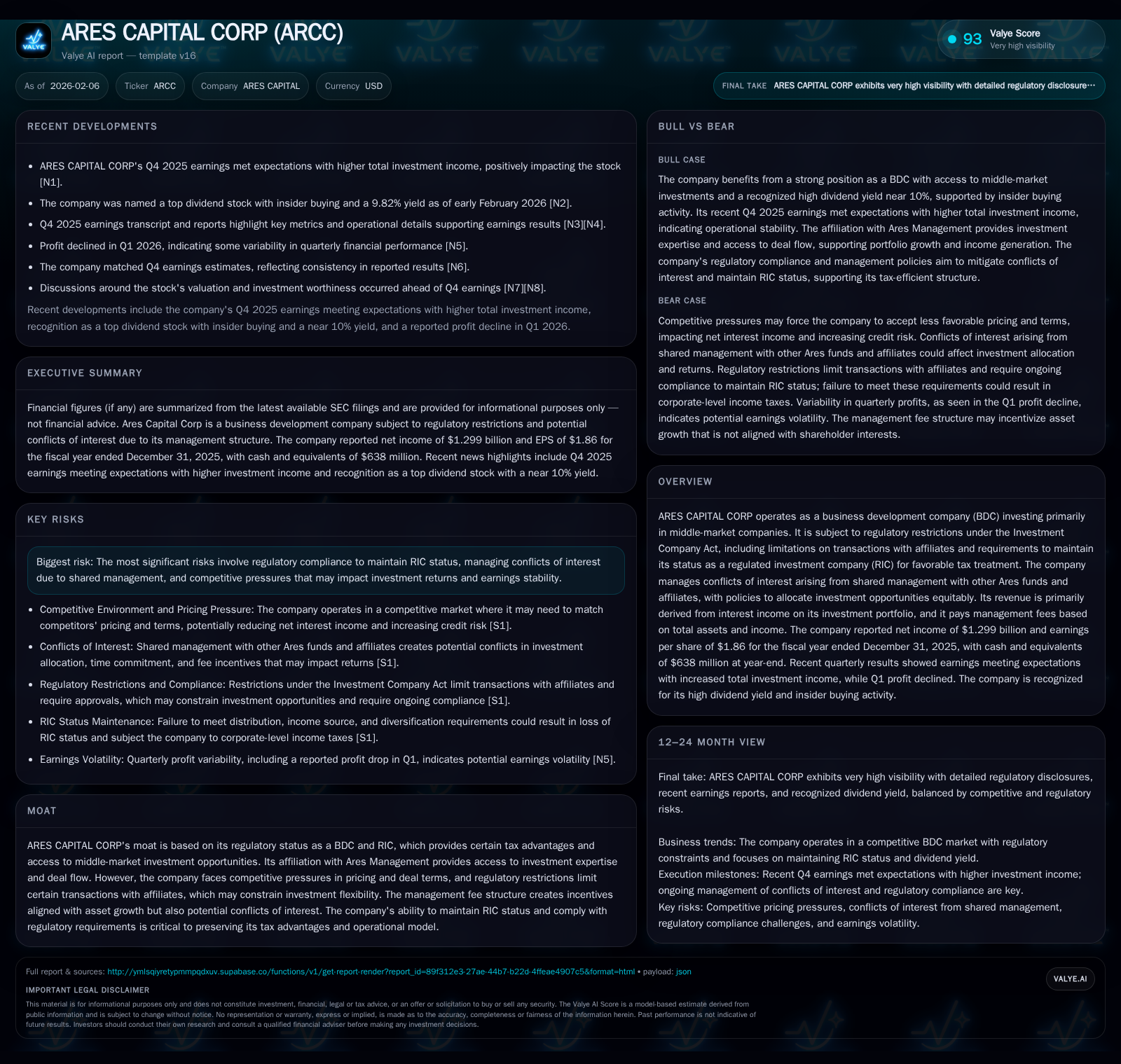
Ares Capital Corp (ARCC) is a prominent business development company (BDC) that specializes in originating and managing investments primarily within the middle-market segment. Leveraging its status as a regulated investment company (RIC) and affiliation with Ares Management, ARCC benefits from preferential tax treatment and deal sourcing capabilities but operates under stringent regulatory constraints that shape its investment flexibility. The company's recent financial outcomes demonstrate solid net income generation and stable earnings, supported by management fee structures aligned with asset growth. However, inherent challenges include competitive pressures on pricing, regulatory restrictions on affiliate transactions, and managing conflicts of interest arising from shared management with affiliated funds.
Company Overview
Ares Capital Corp (ticker: ARCC) functions primarily as a business development company (BDC), directing investment capital towards middle-market enterprises. Operating within the regulatory constructs of the Investment Company Act of 1940, ARCC leverages its status as a regulated investment company (RIC) to secure favorable tax treatment by passing through income without corporate taxation, contingent upon maintaining ongoing compliance with specific regulatory requirements [S1]. Its business model involves earning interest income from debt investments alongside generating returns from equity stakes within the portfolio.
Regulatory Environment and Impact on Operations
The BDC structure imposes several critical constraints on ARCC’s operations. These encompass transaction restrictions with affiliates under the Investment Company Act designed to prevent self-dealing or conflicts of interest. ARCC must obtain prior approval by independent directors—and in certain situations the SEC—to engage in joint or secondary market transactions involving portfolio companies related to affiliated funds [S1]. These limitations restrict investment flexibility but also safeguard shareholder interests.
A notable regulatory accommodation is the Co-Investment Exemptive Order granted by the SEC, allowing ARCC to co-invest alongside other affiliated entities managed by Ares Management subject to prescribed conditions. This exemption endeavors to expand deal flow access yet requires meticulous allocation policies enforced by management and overseen by the board to equitably distribute attractive opportunities among funds [S1].
Portfolio Valuation Practices
Most of ARCC’s investments lack readily available market quotations due to their illiquid nature, predominantly comprising private debt and equity instruments in middle-market firms. To address valuation challenges, the company employs a multi-tiered approach whereby an appointed Valuation Designee within management determines fair value estimates quarterly using inputs such as enterprise valuations, collateral analysis, discounted cash flows, and comparisons to public peers where feasible [S1]. Independent third-party valuation providers supplement these assessments to enhance objectivity.
The board of directors monitors this process closely given inherent uncertainties—particularly as realized recoveries or losses on disposed investments can diverge materially from prior fair value estimates. This valuation complexity underscores the importance of robust governance in asset appraisal due to potential volatility in reported net asset values.
Competitive Landscape and Investment Strategy
Operating in a highly competitive market for middle-market financing requires ARCC to navigate delicate trade-offs between securing deal flow through competitive pricing versus preserving yield and credit quality. The firm faces pressure both from other BDCs and alternative lenders. As disclosed, matching competitor pricing or terms may reduce net interest income or elevate credit risk; conversely, adopting conservative terms risks losing deals altogether [S1]. This dynamic fosters a complex decision matrix where risk-adjusted returns must be optimized continuously.
ARCC benefits from its affiliation with Ares Management — a global alternative asset manager providing substantial expertise and origination capabilities within private credit markets [F1]. This relationship augments ARCC’s deal sourcing effectiveness but introduces potential conflicts because shared management personnel oversee multiple affiliated funds targeting similar opportunities.
Financial Performance Snapshot
For the fiscal year ended December 31, 2025, ARCC reported net income of approximately $1.299 billion accompanied by earnings per share of $1.86 [F1][S1]. The company maintained liquidity with cash and equivalents totaling $638 million at year-end [F1]. Earnings performance aligns well with quarterly results that met consensus estimates amid robust total investment income growth [N1][N4].
The management fee framework comprises fixed fees based on total assets alongside incentive components linked to income generation, intended to align advisor incentives with portfolio expansion while ensuring disciplined asset management [S1].
Risks and Risk Management
Key risks include maintaining RIC status — vital for tax efficiency — contingent upon strict adherence to diversification rules, distribution requirements, and related regulations [S1]. Any failure here could result in adverse tax consequences impacting shareholder returns.
Conflicts of interest are an ever-present challenge given common management across multiple Ares vehicles potentially competing for overlapping investments. While governance structures establish allocation policies intended to mitigate these conflicts fairly, execution demands constant vigilance [S1].
Liquidity constraints arise due to the nature of illiquid underlying assets that can cause valuation swings or impair exited returns relative to initially recorded fair values. Forced liquidations could generate realized values well below book values under stressed market conditions [S1]. Moreover, competitive pressures might compel acceptance of less favorable lending terms negatively affecting yield or increasing default risk.
Industry Contextual Analysis (Analysis)
The business development company sector has evolved into a key conduit for capital markets access among middle-market firms underserved by traditional banks post-financial crisis regulation tightening. Demand for private credit remains robust driven by institutional investors seeking yield amidst low interest rate environments.
Yet BDCs like ARCC operate in an increasingly fragmented competitive environment featuring direct lending funds, private equity co-investors, and increasingly sophisticated capital providers competing aggressively on price and covenants. Simultaneously heightened regulatory scrutiny adds complexity compared to less regulated private credit pools.
Navigating these industry headwinds necessitates superior deal origination networks — an area where Ares’ scale provides discernible advantage — coupled with disciplined credit underwriting capable of balancing risk-reward tradeoffs prudently.
Conclusion: Strategic Positioning Amid Complexities
Ares Capital Corp stands out as one of the largest publicly traded BDCs by assets under management leveraging scale, institutional backing via Ares Management affiliation, and a structured regulatory framework fostering tax efficiencies. It continues delivering solid financial results while confronting ongoing challenges intrinsic to its operating model — notably regulatory compliance burdens, conflict mitigation requirements stemming from shared management resources, competitive pricing pressures affecting returns, and valuation uncertainties inherent in private credit investing.
The firm’s future trajectory will depend on its ability to sustain compliance rigorously while maintaining flexible yet prudent investment approaches capable of adapting swiftly within evolving middle-market credit environments. Governance vigilance in resolving conflicts of interest remains paramount alongside sustaining innovation in investment sourcing and risk assessment methodologies.
This analysis is based exclusively on publicly available information as of early February 2026 combined with general industry insight; it does not constitute investment advice or recommendations.
Disclaimer: This is research-only, informational analysis and not investment advice. It may include AI-generated interpretation and general industry context. Always verify important details using primary sources.

Comments