
American Resources Corp’s Shift from Coal Consolidation to Rare Earths Monetization
American Resources Corp faces Nasdaq compliance challenges while restructuring its business model towards critical minerals purification and recovery.
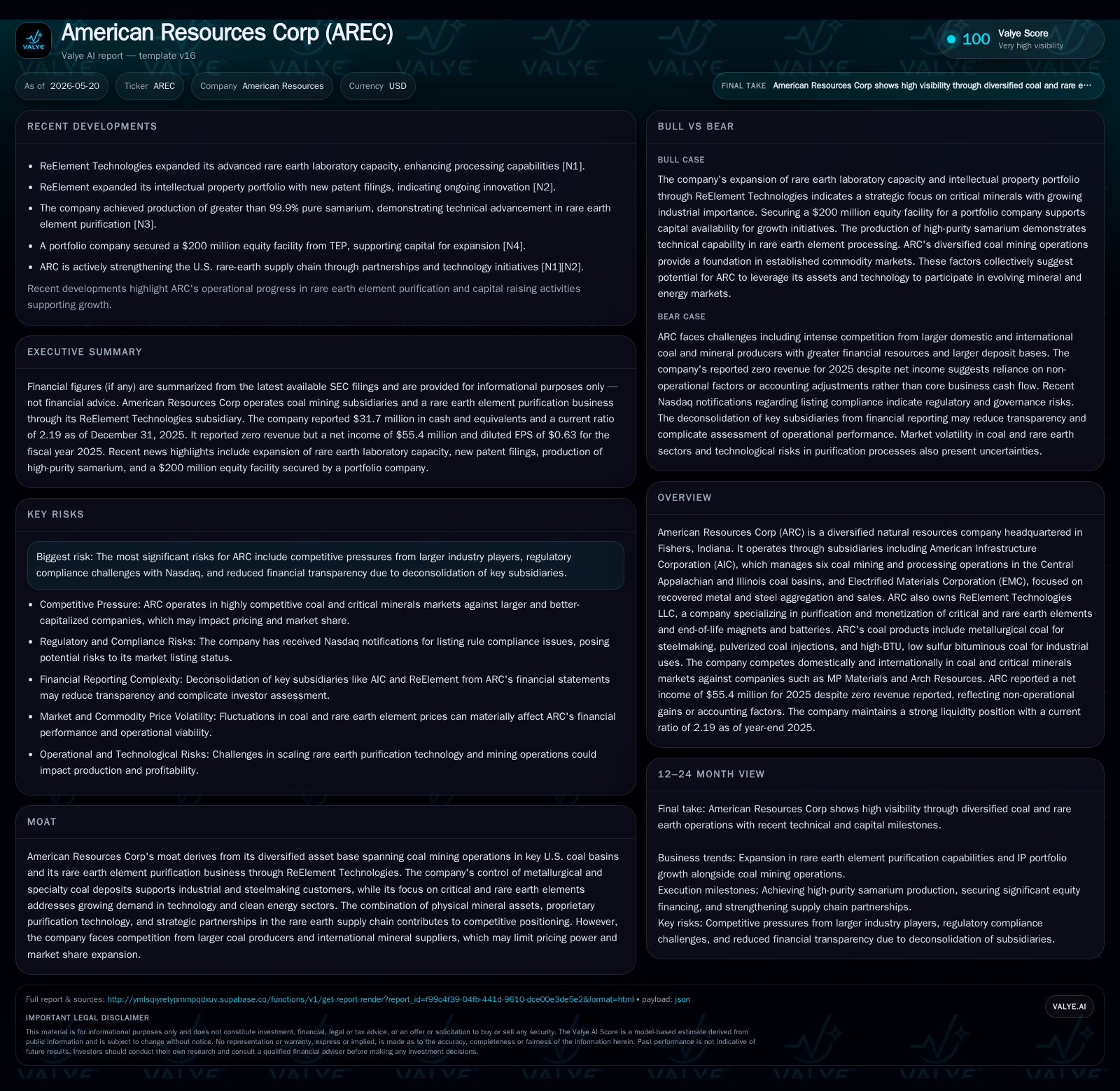
In April 2026, American Resources Corporation (ARC) received a Nasdaq non-compliance notice due to a delayed 10-K filing linked to its structural transition away from consolidating coal subsidiaries toward metal recovery and rare earth element purification. The company deconsolidated its American Infrastructure Corp and ReElement Technologies in late 2025, signaling a strategic pivot. This shift broadens ARC’s exposure from legacy coal products to critical minerals markets increasingly vital for clean energy technologies. However, the company encounters considerable regulatory scrutiny, competitive pressures from larger coal producers and rare earth suppliers, and faces transparency challenges due to deconsolidation. Monitoring the filing of its postponed 10-K, progress in subsidiary capital raises, and operational milestones within its rare earth purification business will be key to assessing ARC’s execution trajectory.
Nasdaq Listing Compliance Notice and Its Implications
On April 24, 2026, American Resources Corporation (ARC) disclosed receiving a notification from The Nasdaq Stock Market citing non-compliance with Listing Rule 5250(c)(1) due to failure to timely file its Annual Report on Form 10-K for fiscal year ending December 31, 2025 [S3]. While this does not immediately affect trading or listing status, ARC must submit a compliance plan within 60 days. Nasdaq may extend this period up to an additional 180 days if the plan is accepted.
This delay arises primarily from internal restructuring impacting financial consolidation boundaries—specifically the deconsolidation of key subsidiaries during late 2025. ARC is actively working with its independent auditors to complete the Form 10-K accurately reflecting these changes [S3]. This situation highlights near-term disclosure risks amid operational transition.
Company Structure Transition: Deconsolidation of Coal Subsidiaries
Effective December 25-26, 2025, ARC ceased consolidating American Infrastructure Corporation (AIC), which includes six coal mining subsidiaries located in Central Appalachian and Illinois basins. Concurrently, ReElement Technologies LLC—focused on critical and rare earth element purification—was also deconsolidated [S1,S4]. These moves mark a strategic shift away from traditional coal asset consolidation toward diversified resource operations.
Deconsolidation indicates reduced controlling interest or changes in contractual rights diminishing ARC’s accounting control over these entities [S1]. This likely reflects organizational streamlining or reallocating capital toward higher-growth opportunities such as critical minerals processing.
Importantly, Electrified Materials Corporation (EMC), which specializes in recovered metals aggregation and sales, remains fully consolidated under ARC control [S4], maintaining exposure to metals recycling markets.
Business Model Overview: Coal Mines, Rare Earths, and Metals Aggregation
ARC’s historical revenues derive from multiple coal types mined across its six operating units: metallurgical coal used in steelmaking; pulverized coal injection products employed in steel furnaces; and high-BTU low sulfur bituminous coals serving industrial customers requiring cleaner combustion [S1]. This diversified product mix addresses varied industrial demands.
Diversification efforts have resulted in two significant subsidiaries:
ReElement Technologies LLC operates advanced purification processes converting end-of-life magnets and batteries into monetizable rare earth elements. This leverages demand driven by electric vehicles, renewable energy infrastructure, and electronics sectors where domestic rare earth sourcing is strategic.
Electrified Materials Corporation (EMC) focuses on aggregating recycled metals and steel scrap for resale, supporting circular economy principles while supplementing supply chains [S4].
ARC competes by emphasizing mineral quality premiums coupled with delivered cost efficiency and supply reliability—critical factors influencing customer procurement decisions in cyclical commodity markets.
Competitive Landscape: Domestic and International Pressures
Domestically, ARC competes against larger coal producers such as Arch Resources, Contura Energy, Warrior Met Coal, Ramaco Resources as well as lithium-focused miners like Lithium Americas targeting overlapping critical minerals niches [S1]. These competitors benefit from larger deposit bases or greater financial resources enabling scale advantages that constrain ARC’s pricing power.
Internationally, U.S. coal faces competition from low-cost exporters including China, Australia, Colombia, Indonesia, and South Africa. Critical minerals also face competition notably from MP Materials—the leading U.S.-based rare earth supplier—and expanding global supply chains with integrated downstream capabilities [S4].
Pricing generally follows commoditized benchmarks influenced by purity specifications plus logistics costs rather than product uniqueness. Maintaining operational excellence in quality assurance and reliable delivery is essential for sustaining customer relationships.
Sector-Specific Considerations: Pricing, Quality, and Supply Reliability
Demand for metallurgical coal aligns closely with global steel production cycles; small variations in mineral content materially affect furnace efficiency [S1]. ARC supplies high-BTU low sulfur coals optimized for modern industrial usage supporting this value proposition
Supply chain reliability creates switching costs that favor vendors delivering consistent volumes with minimal disruption given process sensitivities around raw material inputs.
Rare earth element extraction involves complex metallurgy requiring proprietary purification technology to achieve chemical-grade concentrations suitable for electronics or magnet manufacturing. ReElement’s focus on end-of-life materials recycling aims to differentiate through intellectual property converting secondary sources into economically viable feedstock [S1,S4].
Growth Drivers: Critical Mineral Extraction and Technology-Driven Purification
The pivot toward critical mineral purification responds to accelerating demand driven by electrification trends in transportation energy storage systems and defense sector imperatives emphasizing domestic supply chains [S4].
ReElement Technologies’ transition from LLC to corporation during 2024 signals efforts to scale governance structures compatible with institutional partnerships or equity financing aligned with growth aspirations [S1]
Simultaneously, EMC contemplates a private capital raise ranging between $3 million - $20 million via convertible preferred stock aimed at expanding recovered metals aggregation capacity supporting operational scale-up [S8]
These initiatives represent structurally attractive growth vectors partially insulated from traditional thermal coal cyclicality but dependent on successful market penetration amid entrenched competitors.
Risks and Watchpoints: Regulatory Compliance and Transparency Challenges
Nasdaq compliance issues reveal governance vulnerabilities including delays in financial disclosures exacerbated by extensive deconsolidations reducing consolidated reporting clarity [S3,S7].
ARC’s smaller scale relative to major coal peers limits negotiating leverage on off-take agreements or pricing flexibility in commoditized product segments [S1]. Routine litigation risk typical of mining operations remains present mainly related to environmental or contractual matters [S7].
Deconsolidations complicate investor analysis since consolidated financials no longer fully capture cash flows or asset utilization at former subsidiaries necessitating supplemental disclosures for comprehensive evaluation [S1,S4]
Capital raising at EMC introduces potential dilution risk but is critical for funding growth milestones validating market opportunities [S8].
Next Steps for Investors: Key Milestones to Monitor
Immediate focus centers on timely filing of the outstanding Form 10-K reflecting all restructuring adjustments within Nasdaq’s compliance timeline preserving exchange listing privileges [S3].
Attention should also track outcomes of EMC’s private capital raise as successful financing would underpin expansion plans enhancing metals recovery throughput offering incremental revenue streams [S8]
Operational updates from ReElement Technologies indicating scalability progress in rare earth processing throughput alongside contract wins would evidence commercial traction in technology-driven sectors supporting sustainable price premiums [S4].
Governance developments such as appointment of director Mark LaVerghetta bring corporate strategy expertise potentially aiding turnaround credibility though ongoing regulatory scrutiny warrants monitoring [S23].
Financial Snapshot Summary (as of December 31, 2025)
According to the latest annual report data supported by companyfacts metrics [F1], ARC held approximately $31.7 million in cash & equivalents against total debt near $965 thousand resulting in a net cash position. Operating income was negative approximately $11.3 million reflecting transitional operational complexities rather than solvency concerns [F1,S1,S3]. Net income included significant non-cash components warranting cautious interpretation regarding core operational profitability amid consolidation changes reducing visibility into legacy coal contributions.
-- This analysis synthesizes recent SEC filings through April-May 2026 highlighting American Resources Corporation's evolving business model pivot away from traditional coal reliance toward critical mineral technologies amid regulatory compliance challenges. It offers informed sector context without providing investment research views.
Disclaimer: This is research-only, informational analysis and not investment advice. It may include AI-generated interpretation and general industry context. Always verify important details using primary sources.

Comments