
Artisan Consumer Goods: Survival Hinges on Funding and Rebuilding Supply Chains
With zero revenue, expiring inventory, and no manufacturing partner as of late 2026, Artisan Consumer Goods’ future depends on its ability to raise capital and reestablish production for its niche granola brand. The company’s current position highlights the precarious economics of small-scale consumer goods startups and the critical role of operational execution.
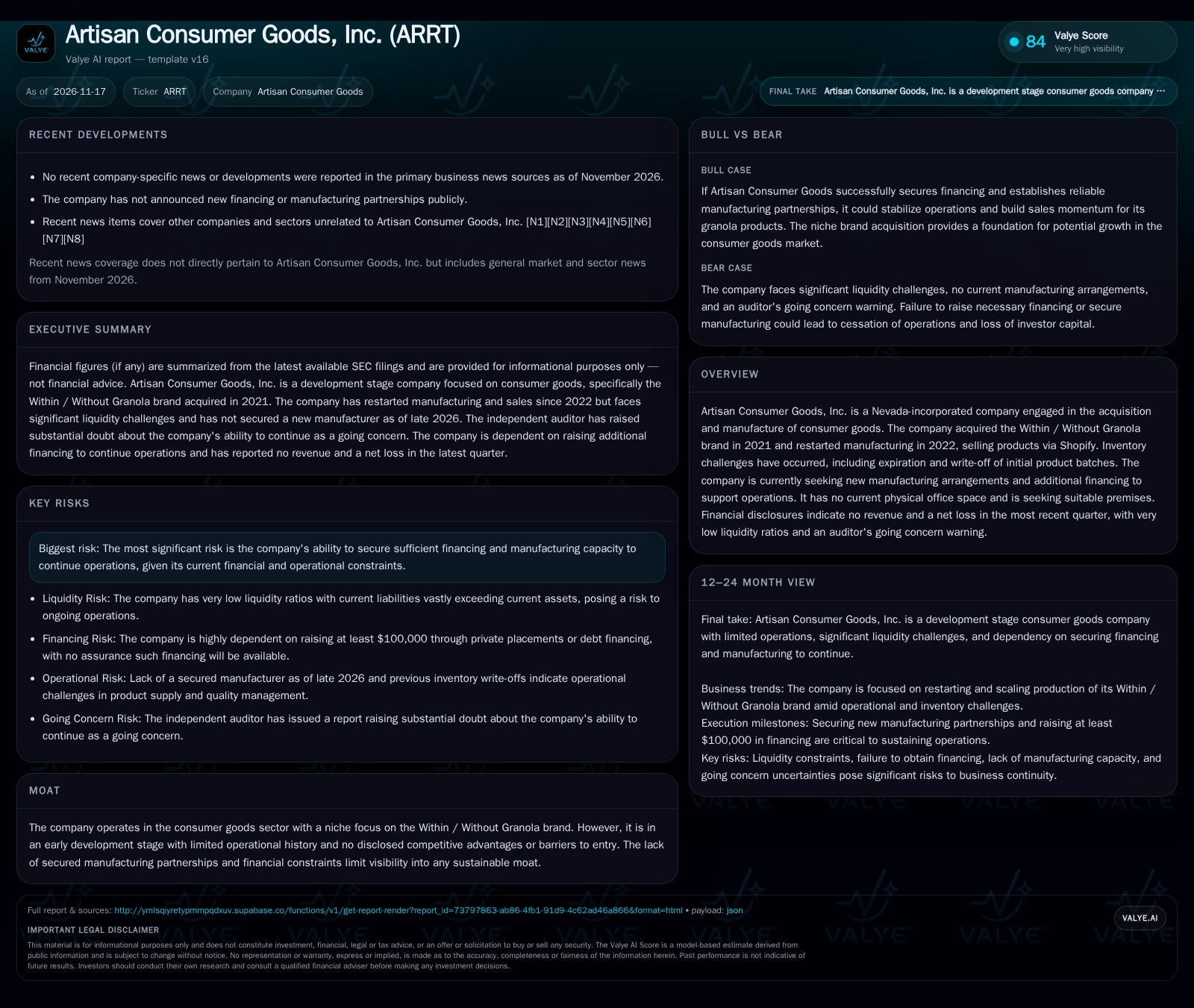
Artisan Consumer Goods, Inc. faces existential risk: it reported no revenue and a net loss in the latest quarter, has no active manufacturing, and is flagged by auditors as a going concern risk. Its only path forward is securing at least $100,000 in new financing and a reliable producer for its Within / Without Granola line. The company’s situation underscores the challenges early-stage consumer brands face in scaling operations without established supply chains or access to capital. [S2]
Artisan Consumer Goods, Inc. is at a make-or-break moment. After acquiring the Within / Without Granola brand and briefly restarting production, the company now finds itself with zero sales, no manufacturing partner, and an urgent need for capital. Its most recent filings reveal a stark liquidity crunch and an auditor warning of substantial doubt about ongoing viability. In this analysis, we examine the operational and financial mechanisms that shape Artisan’s prospects, the competitive dynamics of the niche consumer goods sector, and the specific inflection points that will determine whether the company can move beyond survival mode.
Liquidity Crisis and Production Halt Define Present Reality
Artisan Consumer Goods, Inc. has reported no revenue and a net loss of $11,331 for the most recent quarter, reflecting a total halt in commercial activity. As of September 30, 2026, the company’s current assets stand at just $6,563, dwarfed by current liabilities of $380,471, resulting in a current ratio of 0.02 and a cash ratio of 0.02. The company’s initial inventory expired and was written off, and it has not secured a new manufacturer for its Within / Without Granola brand. The independent auditor has issued a going concern warning, citing substantial doubt about the company’s ability to continue operations without new financing. There have been no public announcements of new manufacturing partnerships or funding deals as of November 2026. [S2]
Unit Economics and Capital Constraints in Early-Stage Consumer Brands
Artisan’s business model—acquiring and relaunching niche consumer food brands—depends on achieving enough scale to absorb fixed costs of production, marketing, and distribution. In practice, small-scale food brands often face high per-unit costs due to limited batch runs, minimum order requirements from contract manufacturers, and unfavorable payment terms. Without reliable production and sales, fixed costs (such as compliance, minimal staff, and inventory write-offs) become an outsized drag on cash flow.
The company’s need to raise at least $100,000 to restart operations highlights a fundamental capital requirement: consumer packaged goods (CPG) startups typically need sufficient funding to cover initial inventory builds, quality assurance, and working capital for several sales cycles before achieving positive cash conversion. Without sales velocity or recurring orders, each new production run is a risk event, and inventory expiration is a persistent threat. The lack of an established sales channel beyond Shopify further limits the potential for rapid volume growth or access to higher-margin wholesale accounts. Artisan’s extremely low liquidity ratios suggest that even a modest ramp in activity would require immediate external capital infusions or highly favorable payment terms from suppliers and co-packers.
Niche Brand, Commodity Competition: Barriers and Vulnerabilities
Within / Without Granola operates in a highly fragmented and competitive natural foods market, where category leaders benefit from scale, established retail relationships, and brand loyalty. Artisan’s lack of current manufacturing capacity, distribution reach, or brand differentiation limits its ability to command shelf space or premium pricing. Larger competitors can often absorb inventory shocks or negotiate better terms with co-packers, while smaller brands must either find a unique value proposition or operate at micro-scale with direct-to-consumer channels.
There are no disclosed proprietary formulations, intellectual property, or unique sourcing relationships that would confer a defensible moat. In the absence of recurring revenue contracts, subscription models, or integrated supply chains, switching frictions for both customers and retail partners are low. The company’s development-stage status and operational interruptions make it difficult to build trust with wholesale buyers or secure repeat business from consumers. Artisan’s only plausible edge may be speed and flexibility if it can operate with low overhead and quickly test new product-market fits, but this is counterbalanced by its acute funding and supply chain limitations.
A Turnaround If Financing Unlocks Manufacturing and Sales Momentum
The most constructive scenario for Artisan involves successfully raising $100,000 (or more) in new equity or convertible debt, securing a reliable contract manufacturer for small-batch production, and relaunching the Within / Without Granola line with a tightly managed inventory strategy. Initial sales could be focused on direct-to-consumer channels to minimize distribution costs and test demand before scaling to wholesale or specialty retail.
If the company demonstrates consistent sales growth, manages inventory to reduce expiration risk, and receives positive consumer feedback (potentially evidenced by repeat Shopify orders or favorable online reviews if disclosed), this could attract additional capital and allow for modest expansion. Confirmation would come from reported revenue resumption, new manufacturing agreements, and improved liquidity ratios in future filings. Falsification of this scenario would be indicated by continued lack of production, inability to raise funds, or inventory losses repeating historical patterns.
Stalled Operations and Ongoing Funding Strain Remain the Default
Given the absence of manufacturing and sales as of late 2026, the most plausible near-term scenario is continued operational dormancy pending financing. The company may attempt further private placements, but success is uncertain given its lack of traction and prior inventory write-offs. Even if minimal capital is raised, constraints on batch size, payment terms, and working capital may limit the scale and frequency of future production runs.
Confirmation of this scenario would be continued reporting of zero or negligible revenue, persistent negative working capital, and absence of new manufacturing or distribution announcements. Any partial restart—such as a pilot batch or test sale—would need to be closely monitored for evidence of sustainable demand and margin improvement. Falsification would require a clearly disclosed new funding round and manufacturing ramp in regulatory filings.
Failure to Secure Funding or Production Could Lead to Wind-Down
The adverse scenario is that Artisan fails to raise the required capital or arrange for new production, resulting in an inability to pay creditors, meet compliance obligations, or maintain corporate existence. This could lead to asset liquidation, dissolution, or a distressed sale of the brand at minimal value.
Evidence supporting this outcome would be continued auditor going concern warnings, further deterioration in liquidity ratios, delinquencies on accounts payable, and eventual SEC filings indicating wind-down actions or going dark. A lack of any announced operational progress or fundraising would also reinforce the risk of business cessation.
Milestones That Will Determine Artisan’s Prospects for Survival and Recovery
Disclosure of a successful capital raise—amount, terms, and investor identity if available—would directly impact the company’s ability to restart operations.
Announcement of a new manufacturing partnership, including batch size, production schedule, and quality assurance arrangements, would signal operational traction.
First reported revenue following the relaunch of Within / Without Granola would be evidence that product-market fit or sales channels are being re-established.
Disclosure of wholesale, retail, or distribution agreements, if any, would help validate demand and future revenue visibility.
Inventory management metrics, such as shrinkage, expiration rates, or turnover (if disclosed), would help test whether prior operational issues are being addressed.
Any disclosed customer repeat purchase rates or Shopify sales velocity would help assess brand resonance and potential for scaling.
Disclaimer: This is research-only, informational analysis and not investment advice. It may include AI-generated interpretation and general industry context. Always verify important details using primary sources.

Comments