
Arvinas Advances PROTAC Pipeline Amid Workforce Reductions and Persistent Losses
The company balances multiple clinical programs and collaborations against operational tightening and continued investment needs.
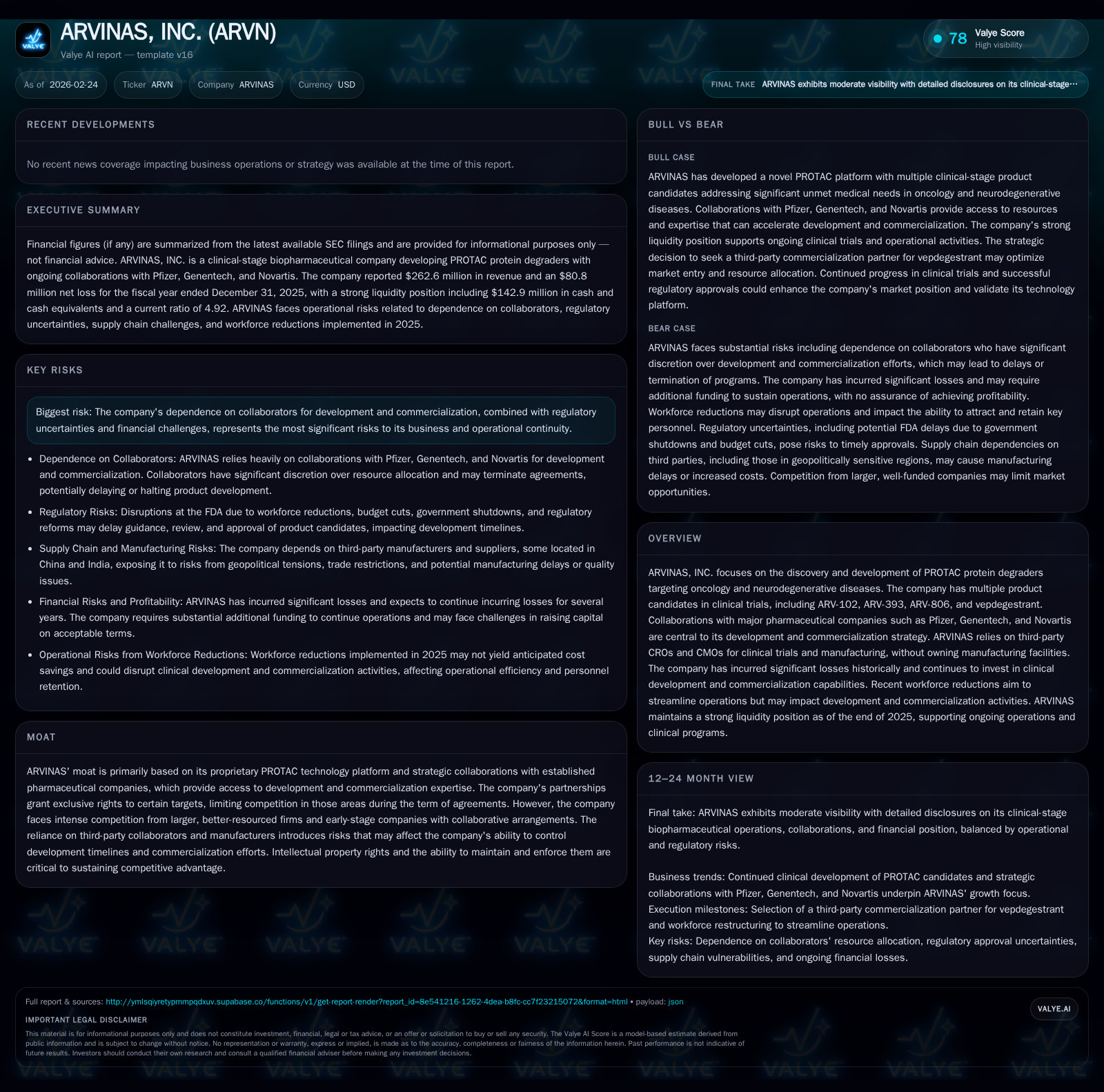
Arvinas, Inc. remains a key player in the emerging PROTAC protein degrader space, with several clinical-stage assets targeting oncology and neurodegeneration. Despite stable revenue near $260 million in 2025, the company continues to incur substantial operating losses reflective of heavy R&D and commercial investments. Recent workforce reductions aim to streamline operations but could impact commercialization efforts, particularly for its partnered breast cancer candidate, vepdegestrant. Strategic collaborations underpin development progress but also introduce execution risks amid regulatory and financial uncertainties.
Historical Performance and Growth Drivers
Arvinas has demonstrated substantial revenue growth since 2022, driven primarily by collaboration revenues linked to its proprietary PROTAC platform. Revenues increased sharply from $78.5 million in FY 2023 to approximately $262.6 million in FY 2025 [F1]. This growth largely reflects milestone payments and cost-sharing arrangements under partnerships such as the one with Pfizer for vepdegestrant (ARV-471).
Despite revenue gains, the company continues to operate at significant losses due to heavy R&D spending required for novel biologics development. Operating income improved markedly from a negative $401.5 million in 2023 to negative $118.5 million in 2025 [F1], indicating some expense management progress likely aided by workforce reductions. Net loss similarly improved from $367.3 million in 2023 to $80.8 million in 2025 [F1]. However, operating cash flow remained negative at approximately -$273.8 million for FY 2025 [F1], underscoring ongoing cash burn associated with advancing clinical programs.
Historical performance (annual)
| FY | Rev ($mm) | Net ($mm) | CFO ($mm) | OpInc ($mm) | Rev YoY | Net YoY |
|---|---|---|---|---|---|---|
| 2025 | 263 | -81 | -274 | -118 | -0.3% | +59.4% |
| 2024 | 263 | -199 | -259 | -250 | +235.5% | +45.8% |
| 2023 | 79 | -367 | -348 | -401 | -40.3% | -30.0% |
| 2022 | 131 | -282 | -273 | -263 |
Note: Omitted columns lack sufficient annual XBRL coverage in the provided tags (need ≥2 annual points): Capex, Div, Buybacks. Source: SEC companyfacts cache [F1].
Capital returns and efficiency (annual)
| FY | FCF ($mm) | ROE% |
|---|---|---|
| 2025 | -276 | -18.6 |
| 2024 | -261 | -35.4 |
| 2023 | -351 | -55.7 |
| 2022 | -280 | -50.0 |
Source: SEC companyfacts cache [F1].
Note: Buyback data is only available for FY2025; large year-over-year swings partly reflect low prior year bases.
Product Pipeline and Future Growth Prospects
Arvinas' core value proposition lies in its PROTAC platform—bifunctional molecules designed to selectively degrade disease-causing proteins rather than merely inhibit them—addressing oncology and neurodegenerative diseases.
Key clinical-stage candidates include:
- ARV-102 targeting LRRK2 implicated in Parkinson’s disease.
- ARV-393, targeting BCL6 relevant to hematologic cancers.
- ARV-806, focused on KRAS G12D mutations prevalent in solid tumors.
- Vepdegestrant (ARV-471) for ER+/HER2- breast cancer developed jointly with Pfizer [S1][N1].
Preclinical programs such as ARV-6723 and pan-KRAS degraders are progressing toward IND or CTA-enabling studies [S1]. The company seeks to expand its PROTAC Discovery Engine capabilities to broaden its pipeline.
Commercial advancement depends heavily on successful pivotal trials and regulatory approvals; however, operational risks persist due to reliance on third-party CROs/CMOs for clinical trial execution and manufacturing, along with intense competition from larger pharmaceutical companies and emerging biotech firms employing analogous degradation technologies [S1][S4].
Recent workforce reductions totaling nearly half of staff since early 2025 mainly affected commercialization roles tied to vepdegestrant [S2], which may constrain near-term marketing capacity.
Financial Health and Capital Allocation
As of December 31, 2025, Arvinas held cash and equivalents of $142.9 million against current liabilities of $142.5 million, resulting in a strong current ratio of approximately 4.92, supporting ongoing operations [F1]. Total current assets were about $700.7 million.
Capital expenditures remained low at around $1.9 million annually consistent with outsourced manufacturing strategies [F1]. The company repurchased $91.9 million of common stock during FY2025 despite ongoing operating losses [F1], indicating a capital allocation policy that includes shareholder returns through buybacks rather than dividends.
Return metrics highlight sustained challenges: approximate ROE was negative ~18.6% based on net loss relative to shareholders’ equity of roughly $433.9 million at year-end [F1]. Free cash flow remains deeply negative near -$275.7 million when subtracting capex from operating cash flow [F1]. Dividend payments are not disclosed or available from provided data tags.
Investors should monitor future expense guidance post-restructuring alongside partner contributions that may help reduce net cash burn going forward.
Competitive Landscape and Moat Considerations
Arvinas’ competitive moat is anchored by proprietary PROTAC technology combined with exclusive co-development partnerships involving Pfizer, Genentech, and Novartis [S1]. These alliances grant shared rights that potentially limit competitors targeting similar molecular mechanisms.
Nonetheless, the protein degrader field is rapidly evolving with intense competition from well-capitalized incumbents possessing larger pipelines and commercial infrastructures [S1]. Maintaining broad patent protection will be critical amid increasing industry focus on this modality.
Dependence on third-party vendors for manufacturing introduces operational risks compared to vertically integrated competitors maintaining tighter supply chain control.
Regulatory, Commercialization Risks, and Market Environment
The biopharmaceutical sector faces substantial regulatory uncertainty affecting approval timelines and launch success rates . Pricing pressures are mounting globally amid healthcare reforms aimed at drug cost containment—for example, proposed Medicare pilot programs that may impact reimbursement levels for new therapies like ARV-471 [S18][S22].
Compliance complexity increases due to regulations governing off-label promotion alongside stringent healthcare fraud & abuse statutes that necessitate robust internal controls [S24].
Product liability exposure remains material given ongoing clinical testing activities; insurance costs may escalate during eventual scale-up phases [S11][S13].
What To Watch Going Forward
Without formal guidance recently disclosed [N1][N2], key upcoming milestones include:
- Progression of pivotal clinical trials aiming for proof-of-concept data especially for ARV-806 targeting KRAS G12D mutations.
- Data readouts or regulatory submissions related to vepdegestrant developed jointly with Pfizer.
- Impact assessment of cost savings initiatives on operating expenses and net cash burn trajectory amid evolving commercialization strategy.
- Liquidity updates addressing whether existing cash buffers suffice given continued negative free cash flow.
- Potential expansions or new partnerships leveraging enhancements to the PROTAC Discovery Engine.
Conclusion
Arvinas exemplifies an innovative biotechnology firm balancing advanced pipeline development against operational rigor enforced through workforce streamlining amid challenging economics inherent in next-generation degrader drug development pathways. Its long-term success depends heavily on disciplined execution across multi-partner collaborations, timely regulatory approvals, intellectual property strength preservation, and effective navigation of dynamic reimbursement landscapes shaping sustainable competitive advantage toward eventual profitability.
This report compiles publicly filed financial statements, SEC filings, earnings call transcripts as of February 24, 2026 ([F1]-[N2]-[S1] et al.). It presents analysis without investment recommendations.
Disclaimer: This is research-only, informational analysis and not investment advice. It may include AI-generated interpretation and general industry context. Always verify important details using primary sources.

Comments