
Asana Advances Agentic Work Management with Proprietary Work Graph Innovation
Asana's latest quarter highlights progress in AI integration and platform adoption, reinforcing its role as a leading orchestrator of human-AI collaborative work.
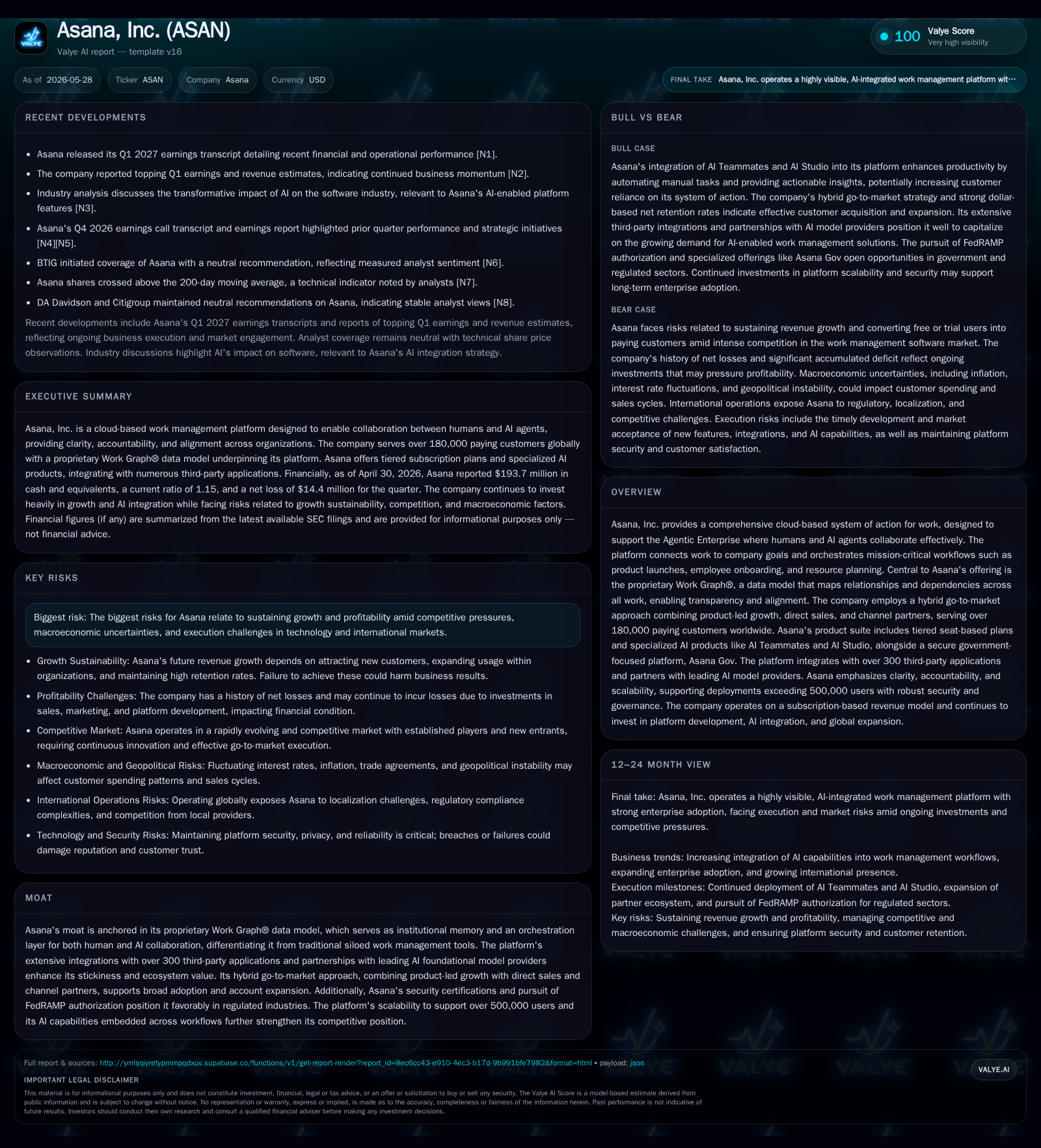
In its May 2026 quarterly filing, Asana demonstrated steady operational momentum fueled by rising dollar-based net retention and expanded AI product offerings. The company’s proprietary Work Graph® remains a key differentiator, enabling seamless orchestration across human and AI workflows for over 180,000 paying customers worldwide. Growth is underpinned by AI innovation, a hybrid go-to-market strategy, and an expanding ecosystem of integrations and channel partners. Risks persist around sustaining growth amid competitive pressures and macroeconomic uncertainties. Near-term milestones to watch include AI feature rollouts, regulatory certifications like FedRAMP, and international expansion execution.
Latest Quarterly Operating Update and Its Significance
Asana’s May 2026 quarterly filing [S2] signals important operational strides. The company reported noticeable improvements in its dollar-based net retention rate (DBNR), a vital metric reflecting expanded usage within existing customers. Management commentary alongside market reaction [N1][N2] underscore accelerating adoption of its AI-enhanced products such as AI Teammates and AI Studio modules—critical to boosting productivity gains leveraging the proprietary Work Graph®. These innovations underpin customer expansion beyond initial teams into broader enterprise portfolios.
On the capital front, Asana held approximately $194 million in cash and equivalents against about $38 million in total debt as of April 30, 2026 [F1], representing a net cash position supportive of ongoing investment. The current ratio stood at roughly 1.15, indicating solid near-term liquidity [F1]. Importantly, the company has begun generating positive operating cash flow on a fiscal year basis [S1], illustrating a transition from previous negative cash flow dynamics.
This quarter also marked renewed emphasis on regulatory readiness with ongoing FedRAMP authorization pursuit for its government-focused offering, Asana Gov. Key executive transitions completed earlier in the year have stabilized leadership execution [S3]. Overall, the latest filing frames a story of technological maturation accompanied by improved financial discipline.
Business Model and Product Differentiation: System of Action for Work
Asana operates a multi-product SaaS platform purpose-built as the "system of action for work," designed to connect organizational goals to individual tasks through its unique Work Graph® data model [S1][S11][S27]. This graph captures dependencies between objectives, projects, tasks, teams, and timelines—creating comprehensive institutional memory that enables both humans and embedded AI agents to coordinate effectively.
Revenue is primarily subscription-based from seat licenses sold in tiered pricing plans targeting organizations from SMBs to large enterprises. The platform supports diverse workflows ranging from product launches and strategic initiative tracking to employee onboarding and resource planning [S1]. Its product suite includes:
- Core seat-based subscriptions with differentiated tiers;
- Specialized AI offerings like AI Teammates for task automation and AI Studio enabling custom workflow intelligence;
- Secure variants such as Asana Gov catering to government clients requiring heightened compliance.
Customer acquisition follows hybrid motions: bottom-up product-led growth via freemium models and free trials leads to initial team adoption; top-down direct sales plus channel partners then expand usage within accounts globally [S11]. The partner ecosystem spans value-added resellers, system integrators, service providers across more than 50 countries—helping deepen penetration particularly in complex enterprises.
Integration breadth is notable with over 300 supported third-party applications encompassing collaboration tools (e.g., Slack), cloud storage (e.g., Google Drive), development platforms (e.g., Jira), and CRM systems—delivering high interoperability that raises switching costs [S1]. This interconnected approach reinforces platform stickiness.
Industry Structure and Competitive Positioning
Within the expansive work management software landscape—populated by legacy project management suites as well as emerging AI workflow platforms—Asana differentiates principally via its proprietary Work Graph® [S1]. Unlike traditional siloed tools which manage isolated projects or tasks without holistic linkage, Asana’s underlying data model maps relationships across all layers of work organization.
This architecture functions as an execution surface that governs who does what when why—a crucial capability for enterprises moving towards the Agentic Enterprise vision where human workers collaborate seamlessly with intelligent AI agents [S27]. Moreover, embedded AI capabilities throughout workflows provide intelligent suggestions, task prioritization, anomaly detection, and resource optimization unavailable in many competitors’ offerings.
Another dimension is compliance: Asana’s pursuit of FedRAMP authorization positions it uniquely to capture regulated public sector demand where data security certifications are gatekeepers [S1]. Scalability is robust allowing customers up to half a million users per deployment—a testament to engineering capable of handling complex organizational structures.
Though direct financial peer benchmarking is limited from available evidence, qualitatively Asana benefits from network effects as integrations increase ecosystem value while product-led expansions deepen account footprints. The hybrid go-to-market strategy combines low friction adoption with high-touch sales enablement—a balanced approach enhancing long-term retention particularly among core enterprise customers spending upwards of $5K annually [S11]
Growth Drivers Powered by AI Integration and Network Effects
Asana’s forward momentum hinges heavily on accelerating adoption of AI-infused workflows that amplify individual productivity while orchestrating complex cross-functional initiatives [S1][N1][N2]. The rollout of AI Teammates automates routine actions within existing project contexts; concurrently, AI Studio empowers customers to build tailored intelligent workflow automations anchored on the Work Graph®, unlocking novel use cases across industries.
User metrics such as increasing paid seats combined with improving dollar-based net retention reflect growing reliance on Asana not merely for task tracking but as an operational backbone integrating human decision-making with autonomous agent support. This shift fosters expansion inside existing accounts through securing more teams across departments—a classical land-and-expand dynamic strengthened by tangible productivity gains derived from proprietary data insights.
International expansion also offers incremental growth potential complemented by scaling channel partnerships in regions outside core U.S. markets. Investments in localization capabilities including multi-language support further enable reach into emerging geographies [S11].
Overall, growth drivers are largely structural rather than cyclical; demand derives from fundamental workplace digital transformation accelerated by hybrid work norms requiring seamless coordination enhanced by intelligent automation.
Risks and Execution Challenges in a Rapidly Evolving Market
The company’s risk disclosures outlined in the latest filings highlight several critical executional constraints [S16]: sustaining revenue growth amid intensifying competition from entrenched players (e.g., Microsoft Teams/Planner) alongside agile startups deploying next-gen AI features represents ongoing headwinds.
Macroeconomic factors such as inflationary pressures may dampen enterprise IT budgets impacting subscription renewals or seat expansion rates. Internationalization efforts add complexity given variable regulatory regimes affecting data privacy/security compliance.
Technologically, delivering innovative yet reliable AI capabilities at scale without compromising user experience or security remains challenging. Failure to maintain industry-leading security certifications or any material breach could impair trust especially among regulated clients relying on Asana Gov.
Additionally, operating expense growth driven by aggressive R&D investments must be balanced carefully against revenue advances lest profitability timelines be extended beyond investor expectations [S2]. High stock-based compensation expense continues contributing significant non-cash costs impacting GAAP profitability metrics.
Critical Milestones: What to Watch Next
Key near-term monitorables include:
- Quarterly updates on revenue growth trajectory and dollar-based net retention rates providing readouts on platform adoption strength.[S2]
- Progress towards full FedRAMP authorization which would unlock deeper penetration into federal/state government accounts [S1].
- Deployment milestones for enhanced iterations of AI Studio and AI Teammates indicating product innovation pace.[N1]
- Geographic expansion effectiveness measured by customer additions or partner signings outside North America.[S11]
- Execution against guidance targets reflecting management’s ability to convert R&D spend into commercial traction.[N2]
Tracking these indicators will clarify whether Asana can sustain differentiation in an accelerating competitive environment embedding human-AI hybrid workflows at scale.
Brief Financial Profile to Frame Strategic Execution
From a financial standpoint at April 30, 2026 quarter-end, Asana maintained approximately $194 million cash plus equivalents against total debt near $38 million resulting in a strong net cash position close to negative $156 million leverage [F1]. Current assets outpaced liabilities giving a current ratio near 1.15 signaling adequate liquidity buffers.[F1]
Operating income remains negative reflecting foundational investment phases (-$197 million trailing twelve months) though operating cash flow has improved markedly to roughly $90 million positive annually per fiscal 2026 data [S1][F1]. The improvement evidences increasing subscription collections offsetting elevated personnel-related expenses including stock-based compensation exceeding $200 million annually.[S1]
Capital allocation actions include aggressive share repurchase programs authorized through early 2026 totaling close to $200 million available supporting capital returns while balancing innovation funding [S13]. Despite continued GAAP losses (-$189 million net loss fiscal year ended January 31), the path toward breakeven is underscored by structural revenue drivers paired with disciplined cost management.[F1]
Overall solvency indicators paired with active capital deployment suggest financial flexibility sufficient for sustained technology-led scaling while addressing risks inherent in evolving SaaS business dynamics.
This analysis synthesizes operating disclosures from Asana’s most recent SEC filings alongside relevant market commentary without advocacy or investment advice. All financial figures are cited directly from official sources dated May 28, 2026 or earlier. Forward-looking observations reflect analytical extrapolation grounded solely in disclosed evidence.
Disclaimer: This is research-only, informational analysis and not investment advice. It may include AI-generated interpretation and general industry context. Always verify important details using primary sources.

Comments