
How Academy Sports & Outdoors Delivered a 231% Operating Income Surge in Fiscal 2025
Academy Sports & Outdoors posted a remarkable operating income increase in FY2025, powered by localized merchandising, private label strength, and omnichannel expansion amid regional growth opportunities.
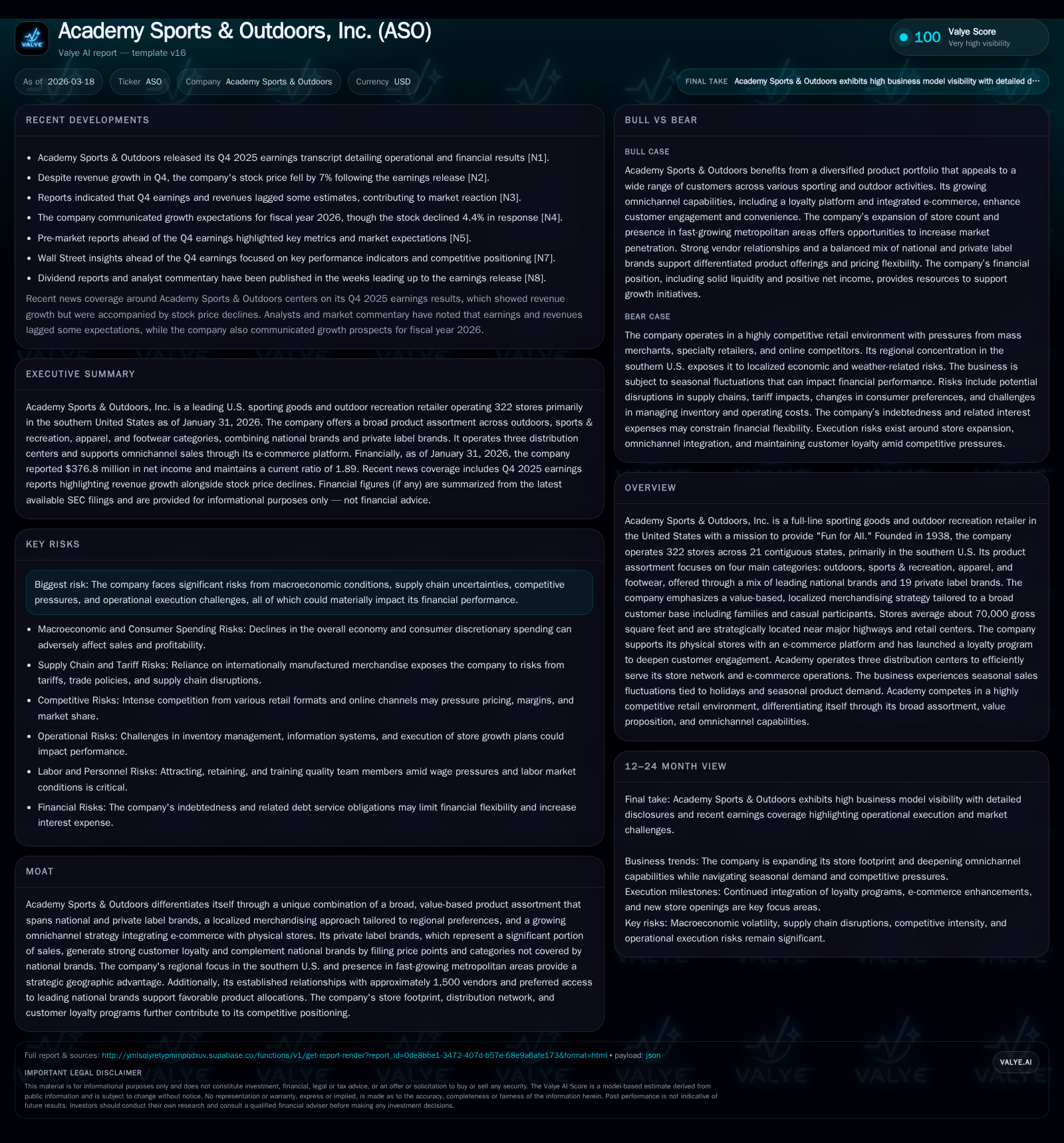
In fiscal 2025, Academy Sports & Outdoors achieved an extraordinary 231% jump in operating income and a nearly 182% rise in net income despite a noticeable decline in operating cash flow. This surge was primarily driven by the company’s value-based regional merchandising strategy and an expanding portfolio of private label brands tailored to its southern U.S. footprint. Academy's growing omnichannel capabilities—integrating its e-commerce platform and physical store network—also contributed materially to performance gains. Capital allocation remained disciplined with continued share repurchases and dividend growth, though free cash flow contracted amid elevated capital expenditures for store expansion. Key challenges persist around macroeconomic pressures and supply chain volatility that could temper future momentum.
Unpacking Fiscal 2025’s Earnings Leap: Drivers and Dynamics
Historical performance (annual)
| FY | Net ($mm) | CFO ($mm) | OpInc ($mm) | Capex ($mm) | Net YoY |
|---|---|---|---|---|---|
| 2025 | 377 | 435 | 512 | 213 | +181.9% |
| 2024 | 134 | 528 | 155 | 200 | -20.5% |
| 2023 | 168 | 536 | 204 | 208 | +6.7% |
| 2022 | 158 | 552 | 205 | 108 |
Source: SEC companyfacts cache [F1].
Capital returns and efficiency (annual)
| FY | Div ($mm) | Buybacks ($mm) | FCF ($mm) |
|---|---|---|---|
| 2025 | 35 | 199 | 222 |
| 2024 | 31 | 365 | 328 |
| 2023 | 27 | 203 | 328 |
| 2022 | 25 | 489 | 444 |
Source: SEC companyfacts cache [F1].
Academy Sports & Outdoors turned in spectacular financial results for fiscal year 2025 ending January 31, 2026. Operating income soared by roughly 231%, from $155 million to over $512 million [F1], reflecting a major operational turnaround after more modest prior year results. Net income similarly rose almost 182%, reaching $377 million against $134 million in the prior year [F1]. This outsized earnings growth occurred despite a nearly 18% decline in operating cash flow to approximately $435 million from $528 million the previous year (largely due to working capital demands and increased investment) [F1].
Revenue growth combined with meaningful margin expansion fueled this upward trajectory. Gross margin benefited from an improved merchandise mix weighted toward higher-margin private label products and enhanced cost controls amidst inflationary pressures [S7][S9]. SG&A expenses did rise moderately as a percentage of sales (from around 24.8% to 26.3%) owing mainly to strategic growth investments such as new store openings and infrastructure upgrades, yet operating leverage was sufficient to drive sharp bottom-line gains [S7].
The company also experienced typical seasonal fluctuations driven by summer holidays and back-to-school periods contributing disproportionately in Q2-Q3 [S1]. These dynamics magnified top-line momentum during those intervals. The interplay between strong product demand, optimized pricing strategies, and controlled promotional activities illustrated effective unit economics management within a complex retail environment.
| FY | Operating Income (USD mn) | YoY % Operating Income Change | Net Income (USD mn) | YoY % Net Income Change | CFO (USD mn) | YoY % CFO Change | Capex (USD mn) | YoY % Capex Change | Equity (USD mn) | ROE Approx. (%) |
|---|---|---|---|---|---|---|---|---|---|---|
| 2025 | 512 | 231 | 377 | 182 | 435 | -18 | 213 | 6.6 | 2,171 | 17.4 |
| 2024 | 155 | -24 | 134 | -20 | 528 | -1 | 200 | -3.8 | 2,004 | 6.7 |
| 2023 | 204 | * | 168 | * | 536 | * | 208 | * | 1,955 | * |
Note: ROE approximated as net income divided by average equity; negative or unavailable changes indicated by ''.*
Localized Merchandising and Private Brands: The Core Growth Engines
At the heart of ASO's success lies its distinctive value-centric merchandising strategy that leverages both national brands and a robust portfolio of nineteen private label brands that collectively represent a significant segment of total sales (~19-30%, inferred from product mix focus) [S1]. By tailoring assortments closely to local tastes within its core southern U.S. market—a region characterized by active families and outdoor enthusiasts—the company achieves superior consumer resonance.
These private labels fill important price points absent from national brand offerings while fostering brand loyalty through quality perception aligned with affordability. This approach also confers better margin control due to elimination or reduction of third-party markups [N2]. Categories such as outdoors gear (31%), sports & recreation (22%), apparel (27%), and footwear (20%) provide broad appeal but are merchandised with an eye towards locale-specific outdoor activities favored among customers [S1]. The mix enables flexible inventory presentations supporting seasonal campaigns like Memorial Day or back-to-school periods.
Competitor differentiation stems from this fine-tuned assortment localization plus expanded private label penetration—not merely as commodity entries but curated lines that complement regional sporting habits. This localized execution facilitates higher basket velocity per visit and strengthens the company’s position in its chosen catchment areas.
Omnichannel Strategy: Bridging E-commerce With Physical Footprint
ASO's omnichannel integration is emerging as another pivotal pillar for sustained growth. The company now operates over three strategically located distribution centers enabling fulfillment optimization capable of supporting up to ~150 stores each; this infrastructure supports both retail replenishment and direct-to-consumer shipment demands [S15][S16].
Features such as Buy-Online-Pickup-In-Store (BOPIS) programs have gained traction alongside upgrades in the mobile app user experience—encouraging repeat visits while increasing basket size through cross-channel synergies [N2][S1]. The seamless interplay between online touchpoints and physical stores leverages what sector insiders term 'click-and-collect' service enhancements which bolster convenience without cannibalizing brick-and-mortar sales.
This digital-physical nexus also streamlines inventory velocity allowing for precise stock positioning geared towards seasonal spikes or localized demand fluctuations. As ecommerce increasingly accounted for roughly 11–12% of FY2025 merchandise sales—a rising trend—the channel's maturity becomes essential for competitive moat development against pure-play online retailers [S20][F1].
Growth Prospects Amid Regional Focus and Market Penetration
Geographically concentrated primarily in twenty-one contiguous states spanning the southern United States—with over eighty percent of stores within metropolitan statistical areas exhibiting demographic tailwinds—ASO benefits from fertile whitespace potential across existing markets plus adjacent regions where consumer profiles align well with the company’s value proposition [S1][N9][N7].
The FY25 store count rose by twenty-four locations versus sixteen additions in FY24 as part of deliberate expansion pacing that balances market saturation risk versus growth capture opportunity [S1][S24]. Store sizes average roughly seventy thousand gross square feet optimized around high-traffic highway adjacencies boosting accessibility metrics.
Executive commentary highlights targeted MSAs where deepening penetration is planned through continued organic openings complemented by selective merchandise localization aiming for sustainable comparable sales uplift via engagement-driven loyalty programs such as their proprietary myAcademy Rewards platform launched mid-2024 to deepen customer ties across channels [S16][N2].
Consumers served encompass family units emphasizing active lifestyles ranging from casual participants through hobbyists underscoring broad customer reach within defined regional clusters that historically yield favorable lifetime value metrics.
Navigating Macroeconomic Risks and Supply Chain Complexities
Despite strong operational execution in FY25, ASO faces pronounced exposures typical within retail sectors amid inflationary trends affecting commodity inputs, freight costs, tariffs on imported goods prevalent from Asia sourcing hubs, plus episodic supply chain disruptions tied to pandemic aftereffects or geopolitical tensions [S1][S2][S7].
Management has implemented multi-pronged mitigation tactics including strategic pricing adjustments preserving overall value perception; vendor negotiations aimed at diversifying sourcing footprints away from tariff-vulnerable countries; inventory timing calibrations tightening working capital cycles; plus tariff relief claims monetization efforts albeit partially divested limiting upside contribution expectations [S1][S25].
Inventory shrinkage—an industry chronic challenge—is closely monitored given its material impact on gross margins with ongoing programs to detect fraud/loss leveraging advanced logistics analytics enhancing stock integrity controls further safeguarding margin health.
Competitive pressure remains intense from mass merchandisers, specialty outdoor retailers, large-format chains, and online pure plays requiring continual innovation in customer experience through omnichannel enhancements coupled with tactical marketing investments targeting brand recall/overtures at local youth sports participation networks totaling over one million outreach participants annually [S15][S16].
Capital Allocation Profile: Dividends, Buybacks, and Debt Structure
Financial stewardship exhibited disciplined capital allocation balancing shareholder returns with reinvestment needs supporting growth initiatives.
Dividend distributions grew steadily reaching $34.7 million in FY25 representing incremental annual increases reflecting confidence in underlying cash flow generation capacity despite some FCF compression stemming largely from stepped-up capex outlays [$212 million vs $200 million prior] dedicated mostly to new store openings plus technology-enabled fulfillment upgrades aimed at longer-term scalability gains [F1][S17][S24][S26].
Share repurchase activity moderated compared to previous years but still substantial at nearly $199 million spent under the renewed three-year $700 million buyback authorization approved late calendar ’24—marking prudent calibration amid macroeconomic uncertainties affecting liquidity preferences while delivering EPS accretion via share count reduction operations executed both openly in the market plus under Rule10b5-1 plans facilitating tactical flexibility [F1][S17]. On balance sheet structure: Outstanding long-term debt stood at about $486 million consisting chiefly of $400 million fixed-rate senior secured notes due November ’27 plus variable-rate term loans totaling ~$86 million maturing same period secured with comprehensive collateral packages including senior liens on substantially all tangible/intangible assets ensuring manageable leverage ratios backed further by ample liquidity buffers exceeding $990 million availability on revolving asset-based credit facilities bearing competitive interest rate spreads reflective of current SOFR-linked benchmarks replacing LIBOR references recently retired industry-wide standards [S4][S5][S8]. Collectively this framework supports stable financing cost management while retaining runway for capital project funding or opportunistic market maneuvers without undue refinancing risk concentration.
What to Watch: Forward Indicators and Strategic Milestones
Going forward investors should monitor:
- Comparable sales trends signaling organic location productivity shifts particularly during key seasonal quarters aligned with strategic campaign rollouts;
- Progression of private label penetration influencing overall margin trajectory measuring brand depth beyond national nameplates;
- Omnichannel conversion metrics tracking e-commerce revenue growth relative integration with physical store engagement measured through loyalty program KPIs;
- Capex efficiency analyzing ROI per newly opened store alongside fulfillment center throughput improvements coordinating capital spend tightness;
- Margin sustainability gauged amidst continued inflation uncertainty balanced against tariff mitigation successes plus competitive pricing dynamics;
- Operational leverage potential unfolding as scale benefits spread fixed-cost base amidst carefully managed SG&A action plans;
- Management’s cadence on share repurchases vis-à-vis dividend policy adaptations reflective of evolving cash flow generation realities.
Overall ASO stands positioned at an inflection point combining hard-earned earnings momentum sparked by core merchandising virtues married with emerging technological enablement aligning well with evolving consumer expectations centered on convenience plus value.[N1][N2][N7][S1]
This analysis is intended solely for informational purposes reflecting publicly available data sources including SEC filings ([F1],[S#]) and recent news transcripts ([N#]). It does not constitute investment advice or endorsement.
Disclaimer: This is research-only, informational analysis and not investment advice. It may include AI-generated interpretation and general industry context. Always verify important details using primary sources.

Comments