
ASP Isotopes Strengthens Position with Helium Assets and Nuclear Fuel Innovations
The latest quarterly results underscore ASP Isotopes’ advancing integration of helium production and nuclear fuel technologies, supported by robust liquidity.
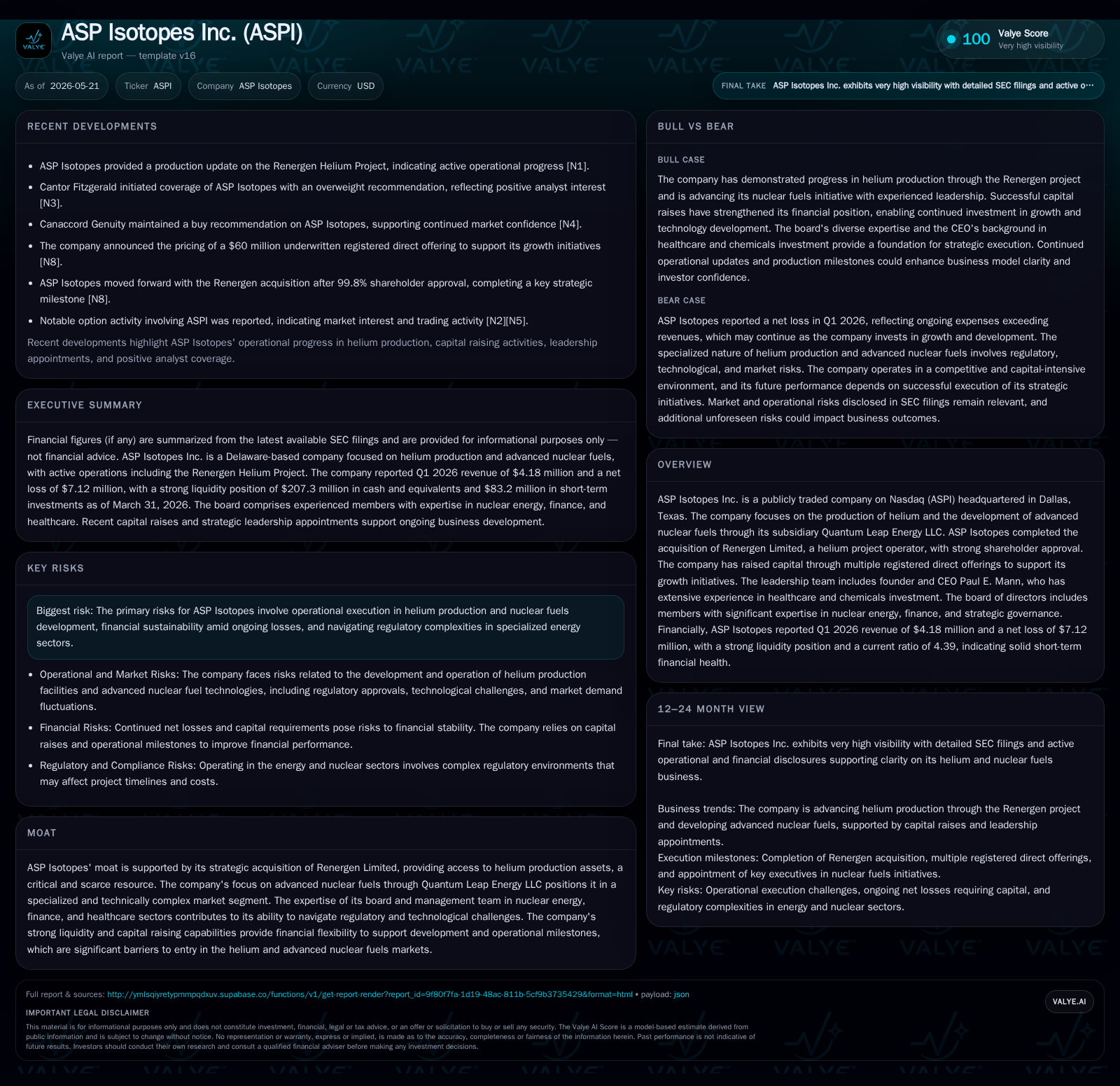
ASP Isotopes reported Q1 2026 revenue of $4.18 million with a net loss of $7.12 million, reflecting ongoing investment in scaling its helium and nuclear fuel businesses. The company’s strategic acquisition of Renergen Limited has bolstered its helium asset base amid global scarcity, while its subsidiary Quantum Leap Energy LLC drives innovation in advanced nuclear fuels. A strong liquidity position with approximately $207 million in cash supports capital-intensive growth initiatives, positioning ASP to leverage critical raw materials demand and technological barriers within the energy sector.
Latest Quarterly Operating Update Confirms Momentum
ASP Isotopes’ Q1 2026 filing on May 20 reported $4.18 million in revenue alongside a net loss of $7.12 million, signaling continuity in its investment-heavy growth phase focused on executing its dual strategy [S2][F1]. No significant new risk factors were identified relative to prior disclosures, suggesting stable operational outlook within recognized sector challenges [S2]. Concurrently, the release of an updated investor presentation emphasizes management's sustained focus on deploying the Renergen helium assets effectively and advancing Quantum Leap Energy’s proprietary nuclear fuel projects [S3].
ASP Isotopes’ Dual-Focused Business Model: Helium Production and Nuclear Fuel Development
ASP Isotopes pursues a bifurcated business approach anchored on (1) helium extraction operations sourced through its acquisition of Renergen Limited—a supplier of one of the world's scarcest industrial gases—and (2) advanced nuclear fuels innovation via Quantum Leap Energy LLC [S1][F1]. Helium is indispensable across multiple sectors including medical imaging, semiconductor manufacturing, aerospace cooling systems, and scientific research; its intrinsic scarcity fosters durable pricing power despite cyclical end-market variables. ASP’s helium assets offer potential volume scaling to seize this supply-constrained niche.
On the other side, Quantum Leap Energy develops oxide dispersion strengthened (ODS) alloys integral to next-generation nuclear reactor fuel assemblies. This segment demands intensive materials science capabilities addressing extreme environment performance while progressing through lengthy regulatory licensing paths. This specialized expertise not only differentiates ASP’s offering but also entails substantial switching costs for utility customers reliant on advanced fuel reliability.
Together these verticals create a composite platform delivering critical raw materials supply chain security coupled with cutting-edge nuclear technology innovation—a rare convergence within the broader energy materials industry.
Industry Positioning and Competitive Dynamics
In the helium market landscape characterized by acute global demand-supply imbalances, ASP benefits from ownership of producing assets obtained through Renergen which place it among a limited set of upstream operators capable of materially influencing regional supply dynamics [S1]. The market's high capital intensity—requiring extensive investment in well drilling, gas separation facilities, and storage infrastructure—alongside stringent environmental permits erects high entry barriers protecting incumbents from rapid competition.
Similarly, the advanced nuclear fuel space is constrained by protracted development cycles involving prototype testing, regulatory certification under bodies like the U.S. Nuclear Regulatory Commission (NRC), plus stringent safety compliance procedures. These factors naturally confine competition primarily to firms with substantial technical depth and established industry alliances. ASP's board with seasoned veterans in nuclear energy enhances governance over these competitive complexities.
Thus ASP’s combined position across these two tightly regulated and capital-intensive arenas generates a strategic moat reinforced by asset control and specialized know-how.
Sector Nuances: Critical Raw Materials and Nuclear Technology Challenges
Helium extraction involves balancing finite reservoir capacities against expensive downstream processing technologies that must ensure purity levels meeting exacting customer specifications—a technical bottleneck often limiting daily throughput scalability. Moreover, volatile helium spot prices driven by supply disruptions or geopolitical events can impact margin stability.
For advanced nuclear fuels development using ODS steels designed to withstand high neutron fluxes and thermal stresses, lengthy innovation cycles span material synthesis, irradiation experiments, structural characterization, all integrated within a regulatory framework emphasizing safety demonstration before commercial rollout can initiate. Customer procurement is conservative given lifecycle risks, amplifying demand predictability challenges but simultaneously imposing substantial switching costs once proven solutions gain approval.
This nuanced interplay mandates multidisciplinary expertise embedded deeply within ASP’s business model.
Growth Drivers: Asset Integration, Market Demand, and Innovation Pipeline
Key growth vectors include expanding production capacity at Renergen helium fields where recent completion of Phase 1 well drilling facilitates volume uplifts [S23], enabling revenue growth through higher output coupled with price improvement amid helium scarcity dynamics [S2]. Concurrently, Quantum Leap Energy progresses in maturing proprietary fuel alloys towards commercial-stage testing verified by external strategic partners—recently formalized collaborations with U.S. and European entities underscore pipeline advancement efforts [S19][S22].
Capital raised via registered direct offerings fortifies financial flexibility underpinning continued capex requirements for both front-end extraction facilities and midstream R&D activities [S3][S1]. Monitoring KPIs such as produced gas volumes per quarter, alloy performance benchmarks under irradiation testing cycles, regulatory submission milestones for licensing approvals will provide transparent indicators of trajectory towards commercialization.
Integrating acquired assets while advancing innovation represents the cornerstone growth thesis for ASP.
Risks and Execution Challenges to Monitor
Persistent challenges encompass achieving cost-effective scale-up in helium extraction without oversized operational expenditures or schedule slippages that could compress margins [S2]. The intricate regulatory landscape governing nuclear fuel manufacturing introduces uncertainties around timing for certifications that may delay revenue generation from Quantum Leap Energy innovations [S1]. Financially sustaining these capital-intensive endeavors requires ongoing access to liquidity as net losses continue during pre-commercial stages.
Commodity price volatility inherent in helium markets adds another layer of risk affecting topline consistency. While no new material risks surfaced this quarter [S2], these structural headwinds necessitate vigilant execution discipline plus effective capital stewardship.
Key Milestones and What Investors Should Watch Next
Critical upcoming checkpoints reside in quarterly reporting of helium production volumes against targeted ramp-up goals set forth post-Renergen acquisition [S3]. Progress updates on licensing or pilot program approvals for advanced fuels by Quantum Leap Energy will signal proximity to market entry. Additional intelligence points include outcomes from recent international strategic collaboration MOUs aimed at expanding advanced fuels deployment footprint beyond U.S. borders [S22]. Close observation of quarterly cash burn rates relative to liquidity sources will further illuminate sustainability profiles during intensive development phases.
These metrics collectively serve as bellwethers validating ASP’s execution path forward.
Current Financial Profile and Capital Positioning
ASP maintains a robust balance sheet foundation characterized by cash reserves approximating $207 million juxtaposed against total debt near $58 million as of Q1 end, reflecting a net cash position exceeding $149 million buffer enhancing operational runway potential amidst ongoing investment expenditures [F1]. Reported quarterly revenue at $4.18 million aligns with initial commercialization stages while net losses reflect strategic spending on capacity buildout and R&D programs consistent with stated growth objectives [S2][F1].
This financial posture supports confidence in ASP’s ability to pursue its twin-platform expansion without immediate funding pressures.
This analysis synthesizes reported financial disclosures with industry contextualization to evaluate ASP Isotopes Inc.’s current business dynamics without providing investment advice.
Disclaimer: This is research-only, informational analysis and not investment advice. It may include AI-generated interpretation and general industry context. Always verify important details using primary sources.

Comments