
Aterian’s Strategic Outlook Following the Marquee Brands Divestiture
Aterian, Inc.’s sale of its core brands has left the company with a fundamentally altered operating model, a legacy product portfolio, and acute questions around its ability to fund and execute a viable strategic pivot as it faces going concern uncertainty.
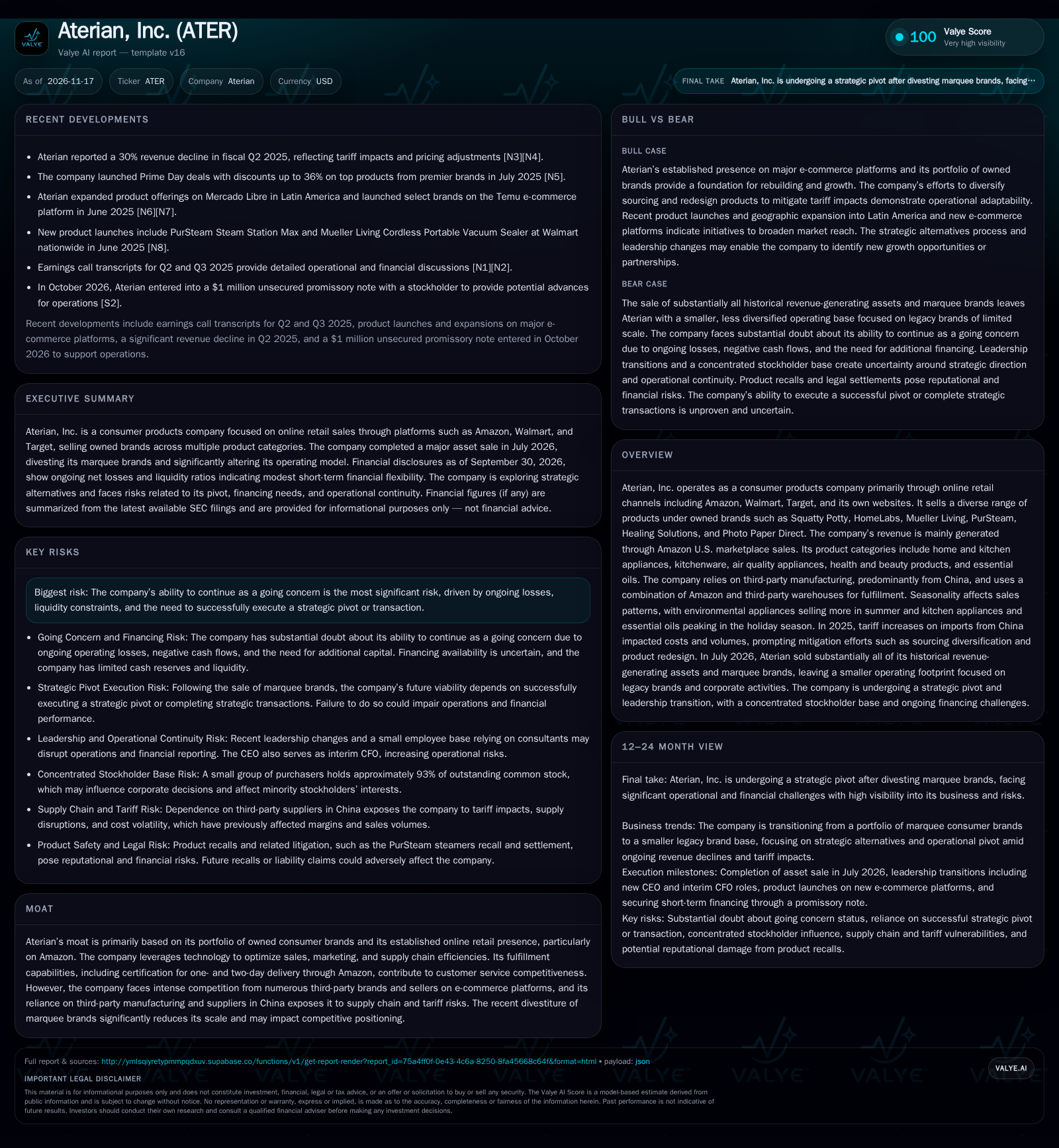
Aterian sold its main revenue-generating brands and assets in July 2026, leaving a smaller business with legacy brands, a new CEO, and a highly concentrated shareholder base. The company’s future now hinges on securing new financing, executing a successful strategic pivot, or completing a transaction amid ongoing losses and a reported liquidity position cushion. The asset sale and strategic alternatives process mark a critical inflection, but execution risk and uncertainty around operational viability remain high. [S2]
Aterian’s transformation in 2026—marked by the divestiture of its major brands and the sale of nearly all its revenue-generating assets—has fundamentally altered the company’s identity and prospects. The business now consists of smaller legacy brands, operates with a skeletal workforce, and faces the immediate challenge of redefining its strategy under new leadership and substantial financial strain. The company’s ability to survive and reposition itself depends on its capacity to raise new capital, execute a credible pivot, or attract a strategic acquirer, all while managing the constraints imposed by contingent value rights and ongoing losses. This analysis examines how Aterian’s business model, economics, and competitive context have been reshaped—and what would need to happen for the company to chart a viable path forward.
Aterian’s Operating Model After the Asset Sale
The most consequential fact shaping Aterian’s current outlook is the July 2026 sale of substantially all of its historical revenue-generating assets and marquee brands to Trademark Global, LLC. This transaction left Aterian with only smaller legacy brands (Vremi and Xtava) and residual corporate activities, fundamentally altering its operating model and revenue base. [S2]
Following this transition, Aterian’s financial position is precarious: as of September 30, 2026, it reported $1.497 million in cash and equivalents, current assets of $17.923 million, current liabilities of $15.469 million, and a net loss of $2.751 million for the quarter. The company reported cash and liquidity metrics for the period; these figures do not by themselves establish operating runway, investment capacity, financial flexibility, or financing capacity. [S2]
The company faces ‘substantial doubt’ about its ability to continue as a going concern due to ongoing operating losses, negative cash flows, and the need for additional financing. In October 2026, Aterian entered into a $1 million unsecured promissory note with a stockholder to provide potential operational advances, but this stopgap does not resolve its longer-term funding needs. [S2]
Aterian is now led by CEO David E. Lazar (appointed July 2026), who also serves as interim CFO, and the company relies on a small number of employees and consultants. The strategic alternatives process—exploring options such as a sale or merger—remains underway, but the company’s future viability is uncertain and contingent on successful execution of a new strategy or transaction. [S2]
Revenue Dynamics and Cost Management in a Leaner Business
Aterian’s pre-divestiture economics were built on a portfolio of owned consumer brands, third-party manufacturing (primarily in China), and a sales mix dominated by Amazon’s U.S. marketplace, which accounted for roughly 86% of 2025 revenue. The company’s model relied on online sales, rapid fulfillment via Amazon and third-party warehouses, and heavy digital marketing spend. [S1]
The asset sale has dramatically reduced both the company’s scale and its brand portfolio. With only legacy brands and limited product lines, revenue potential and fixed-cost absorption are both sharply constrained. The company continues to rely on third-party manufacturers and does not have long-term supply contracts, which can provide flexibility but also exposes it to supply chain shocks and sudden cost changes. [S2]
Gross margins in this model are sensitive to tariff changes, shipping costs, and the company’s ability to pass along price increases. Past tariff increases on Chinese imports led to higher cost of goods sold, price hikes, and subsequent declines in unit volumes. [S1]
Operating leverage is now severely diminished: the smaller revenue base cannot support historical corporate overhead or marketing intensity, and the company has downsized to a skeletal staff. Any new product introductions or platform expansions would likely require external funding, given current liquidity constraints and the capital tied up by contingent value rights (CVRs) from the asset sale. [S2]
Evaluating Brand Strength and Platform Reliance Post-Divestiture
Aterian’s historical edge lay in its portfolio of recognizable consumer brands and its strong presence on major e-commerce platforms, especially Amazon. These advantages have been sharply reduced post-divestiture, as the marquee brands that drove most of the company’s revenue and consumer recognition are no longer part of the business. [S2]
What remains are legacy brands with narrower market appeal and reduced scale. Aterian continues to face intense competition from both established consumer products companies and an ever-growing array of third-party sellers on Amazon, Walmart, and other platforms. The barriers to entry in these categories are low, and differentiation is largely driven by marketing, reviews, and price—areas where scale and investment matter.
Additionally, Aterian remains dependent on third-party platforms for distribution and fulfillment, limiting its ability to control customer relationships or pricing power. The company’s ability to generate recurring revenue, build switching costs, or could create network effects is minimal in the absence of proprietary technology, unique product IP, or locked-in customer ecosystems.
Recent product launches and efforts to expand onto platforms like Mercado Libre and Temu may provide incremental opportunities but are unlikely to offset the loss of core brands and scale. The company’s competitive position is now more vulnerable, with limited resources to invest in differentiation or defend against aggressive competitors. [N5] [N6] [N7] [N8]
Potential Value Creation Through Strategic Shifts or Transactions
The most optimistic scenario for Aterian involves successfully executing a strategic alternative: either completing a sale or merger with a better-capitalized entity, or pivoting into a new business model that leverages the company’s residual assets and public listing. A transaction could bring in new management, capital, and a growth platform—potentially transforming the business far beyond its current scope.
For a pivot to succeed organically, Aterian would need to identify a niche where its remaining brands or operational infrastructure provide a unique advantage, or where its public company status is valuable to a partner. This could involve entering new product categories, licensing its brands, or serving as a platform for roll-up acquisitions if capital can be raised.
Confirmation of this upside would likely come from announcements of completed strategic transactions, significant new capital raises, or the onboarding of experienced operators with a credible turnaround plan. Revenue stabilization, positive cash flow, and new product launches with meaningful traction would further validate the scenario.
Falsification would be evident if the strategic alternatives process fails to yield a transaction, the company cannot raise capital, or operational losses persist without a clear pivot strategy.
Outlook Under Continued Uncertainty and Limited Asset Sales
The most plausible near-term outcome is an extended period of operational uncertainty, with Aterian continuing to explore options while operating on a minimal scale. The company may pursue incremental monetization of its legacy brands and assets, but with limited resources, revenue and cash flow are likely to remain weak.
Survival may depend on further bridge financing from major shareholders or outside investors, with the company reducing costs to the absolute minimum. The strategic alternatives process may stretch on, with the risk of value erosion as cash is consumed and the remaining asset base diminishes.
This scenario would be confirmed by ongoing negative cash flow, continued reliance on promissory notes or shareholder advances, and lack of major new product or business development announcements. Falsification could occur if the company announces a transformative transaction or return to growth through a credible pivot.
Risks of Liquidity Depletion and Possible Business Wind-Down
The most adverse scenario involves Aterian exhausting its reported liquidity position before securing a transaction, new financing, or a viable operating model. [S2]
If additional capital cannot be raised and ongoing losses persist, the company may be forced to pursue bankruptcy protection or a formal wind-down. The presence of contingent value rights (CVRs) complicates capital allocation, as proceeds from asset monetization are earmarked for shareholders, limiting flexibility to reinvest in the business.
Confirmation of this scenario would include default on obligations, the absence of further financing, or announcements of asset liquidation and wind-down procedures. Falsification would require clear evidence of new funding, a completed strategic transaction, or sustainable positive cash flow.
Key Developments Influencing Aterian’s Future Trajectory
The announcement of a completed strategic transaction (sale, merger, or significant partnership) would be the most definitive signal of a viable path forward.
Updates on the use and status of the $1 million unsecured promissory note and any additional financing agreements will reveal the company’s short-term funding capacity.
Any further asset sales, product line divestitures, or licensing deals would show the pace and scale of asset monetization or business model transformation.
Changes in leadership composition, especially the appointment of a permanent CFO or addition of turnaround specialists, would signal operational focus and strategic intent.
Announcements regarding the fate, payout, or renegotiation of contingent value rights (CVRs) will affect capital available for operations and investor expectations.
Disclosure of new product launches, platform expansions, or entry into new business lines—if material—would help test the viability of an organic pivot.
Legal or regulatory developments, especially related to past product recalls or settlements, could impact both reputation and potential financial flexibility.
Disclaimer: This is research-only, informational analysis and not investment advice. It may include AI-generated interpretation and general industry context. Always verify important details using primary sources.

Comments