
Agape ATP: Network-Driven Wellness Meets Diversification Ambitions Amid Persistent Profitability Hurdles
Agape ATP Corporation continues to operate a large distributor-led wellness business in Malaysia while seeking new growth in renewable energy and digital health.
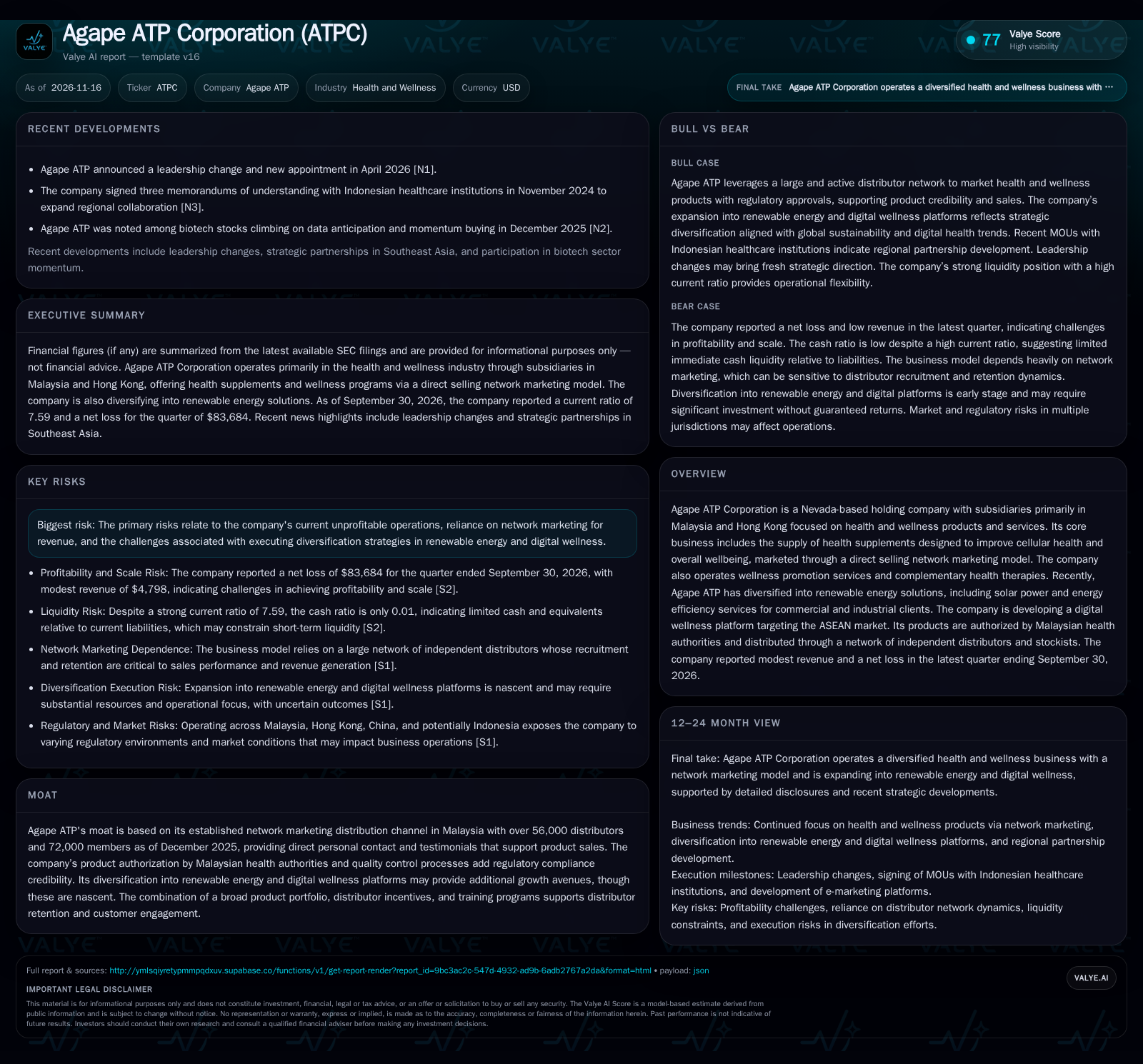
Agape ATP is a Nevada-incorporated holding company with core health and wellness operations in Malaysia and Hong Kong, distributed via a network marketing model. While the company is expanding into renewable energy and digital wellness, its most recent quarter saw low revenue and a net loss, raising questions about the scalability of its business and the execution risks of diversification. Recent leadership changes and regional MOUs signal strategic intent, but execution remains the central challenge [S1] [S2] [N1] [N3].
Agape ATP Corporation faces a pivotal moment as it attempts to balance its established network-marketing-driven health and wellness business with ambitions in renewable energy and digital wellness. While its distributor network and regulatory credentials provide a foundation in Malaysia, recent financials reveal persistent losses and minimal revenue, underscoring the uphill battle to achieve meaningful scale or profitability. The company’s diversification initiatives and regional partnerships signal strategic evolution, but sustainability will depend on both execution and the ability to convert broad ambitions into operational results.
Recent Financials and Strategic Moves Define the Near-Term Challenge
Agape ATP reported a net loss of $83,684 and revenue of just $4,798 for the quarter ended September 30, 2026, reflecting the company’s ongoing struggle to achieve scale and profitability [S2]. The company reported cash and liquidity metrics for the period; these figures do not by themselves establish operating runway, investment capacity, financial flexibility, or financing capacity. [S2]
Operationally, the company remains rooted in its network marketing model for wellness products in Malaysia and Hong Kong, but is also making early moves into renewable energy and digital wellness. Strategic actions include the signing of three MOUs with Indonesian healthcare institutions in late 2024, aiming to build regional collaboration, and a leadership change in April 2026, which could influence future direction [N1] [N3]. These facts frame a business at a crossroads: legacy business under profit pressure and new initiatives yet to deliver material results.
Direct Selling Economics: Fixed Incentives, Variable Results, and New Capital Needs
At its core, Agape ATP monetizes health and wellness supplements and programs through a direct selling network. Distributors earn profits on product sales and may receive bonuses tied to network expansion and performance. This model typically allows for low fixed overhead relative to traditional retail, as the cost of sales and marketing is largely variable and linked to distributor activity. However, such structures often face high churn, dependency on continual recruitment, and limited pricing power—especially if product differentiation is modest or regulatory scrutiny increases.
The company’s foray into renewable energy (solar power and energy efficiency) and digital wellness platforms introduces new capital and operational requirements. Renewable energy projects, especially those targeting commercial clients, generally involve longer payback periods, higher upfront investment, and more complex regulatory and technical demands than supplement sales. The digital wellness initiative, while potentially asset-light, will require sustained investment in platform development, user acquisition, and technology integration to compete with established players. The business thus faces a bifurcation: legacy network-driven cash flows (currently modest) and capital-absorbing, uncertain new ventures.
Given the low revenue base and persistent losses, Agape ATP’s ability to internally fund expansion is limited, potentially necessitating external capital or partnerships if diversification is to progress meaningfully.
Distributor Depth, Regulatory Credentials, and the Realities of Market Entry
The company’s competitive position in Malaysia is anchored by its large distributor and member base—over 56,000 distributors and 72,000 members as of December 2025, according to prior disclosures [S1]. This network provides direct access to consumers and supports word-of-mouth-driven sales, which can be powerful in wellness categories where trust and testimonials matter. Regulatory approval by the Malaysian Ministry of Health and batch-level quality controls enhance product credibility and provide some insulation from lower-quality competitors.
However, network marketing models are inherently vulnerable to shifts in distributor motivation, changes in incentive structures, and regulatory tightening—especially in jurisdictions wary of pyramid-like schemes. The company’s expansion into renewable energy pits it against established engineering, procurement, and construction (EPC) firms and energy service companies with deeper technical expertise and project finance capabilities. In digital wellness, the competitive set spans global health apps, local telemedicine platforms, and fitness tech providers, many of which benefit from scale economies, brand recognition, and more robust digital ecosystems.
Agape ATP’s ability to defend and grow its position will depend on maintaining distributor engagement, differentiating its wellness offering, and finding credible entry points in its new verticals.
Leveraging the Network to Drive Wellness Sales and Seed New Growth Engines
A favorable outcome would see Agape ATP reinvigorate its core wellness business, using its significant distributor network to drive higher product throughput and member engagement. If the recent leadership change results in improved training, incentives, or digital tools that boost distributor productivity or retention, topline growth could accelerate. Enhanced e-marketing and trading platforms—if successfully deployed—may lower acquisition costs and extend reach into adjacent ASEAN markets.
In parallel, successful execution of renewable energy and digital wellness initiatives could begin to generate incremental revenue streams. Signing and converting institutional MOUs in Indonesia into real commercial contracts would demonstrate traction outside the core market. Early wins in solar or energy efficiency projects could validate the diversification strategy and attract new partners or capital.
Confirmation of this scenario would require evidence of sustained revenue growth, improving gross margins, and disclosures of contract wins or user adoption in the new business lines. Conversely, continued flat or declining sales, distributor attrition, or lack of progress in new ventures would falsify it.
Incremental Progress in Core Business While Diversification Remains Nascent
The most plausible trajectory is for Agape ATP to see modest improvement in its core Malaysian wellness business, with incremental gains from distributor activity but no step-change in scale or profitability. The direct selling model may continue to support a stable but limited revenue base, with profitability challenged by distributor incentives and the cost of ongoing engagement programs.
Diversification efforts in renewable energy and digital wellness are likely to remain in the developmental phase over the next several quarters, consuming management attention and resources without delivering material revenue or margin contribution.
Evidence supporting this scenario would include stable or slowly rising revenues, persistent but manageable losses, and periodic announcements of new pilot projects or partnerships that are not yet transformative. Falsification would come from either a sharp deterioration in core business metrics or, conversely, a sudden breakthrough in new segment performance.
Distributor Attrition, Liquidity Strain, and Failed Diversification Undermine the Model
A negative chain of events could be triggered if Agape ATP’s distributor network contracts—due to waning incentives, increased competition, or regulatory intervention—leading to declining sales and higher per-unit costs.
Should diversification efforts in renewable energy and digital wellness stall or require larger-than-anticipated investment, the company could face capital shortfalls, forcing dilutionary fundraising or retrenchment. Regulatory changes in Malaysia or other target markets could further constrain both the network marketing approach and expansion ambitions.
This scenario would be confirmed by declining distributor/member counts (if disclosed), worsening revenue and loss trends, delays or withdrawals from announced initiatives, or urgent fundraising under distressed terms.
Benchmarks for Testing Agape ATP’s Strategic Execution and Business Viability
Quarterly revenue growth and gross margin improvement as a sign of distributor productivity and product demand.
Trends in active distributor and member counts—if disclosed—which would indicate the health and motivation of the network.
Progress milestones in digital wellness platform development and evidence of user acquisition or engagement.
Conversion of MOUs or pilot projects in Indonesia and elsewhere into binding commercial contracts.
Any external capital raises, debt issuance, or strategic partnerships that could bolster the balance sheet or accelerate diversification.
Regulatory developments in Malaysia and key ASEAN markets that affect network marketing, supplement approvals, or renewable energy incentives.
Disclosure of distributor churn rates, recruitment trends, or changes in incentive structures, which would clarify the sustainability of the core model.
Disclaimer: This is research-only, informational analysis and not investment advice. It may include AI-generated interpretation and general industry context. Always verify important details using primary sources.

Comments