
Golden Minerals Co Shifts to Focused Exploration Following Asset Divestitures
Golden Minerals pivots from mining operations to prioritize exploration projects in Argentina and Nevada amid tightening liquidity.
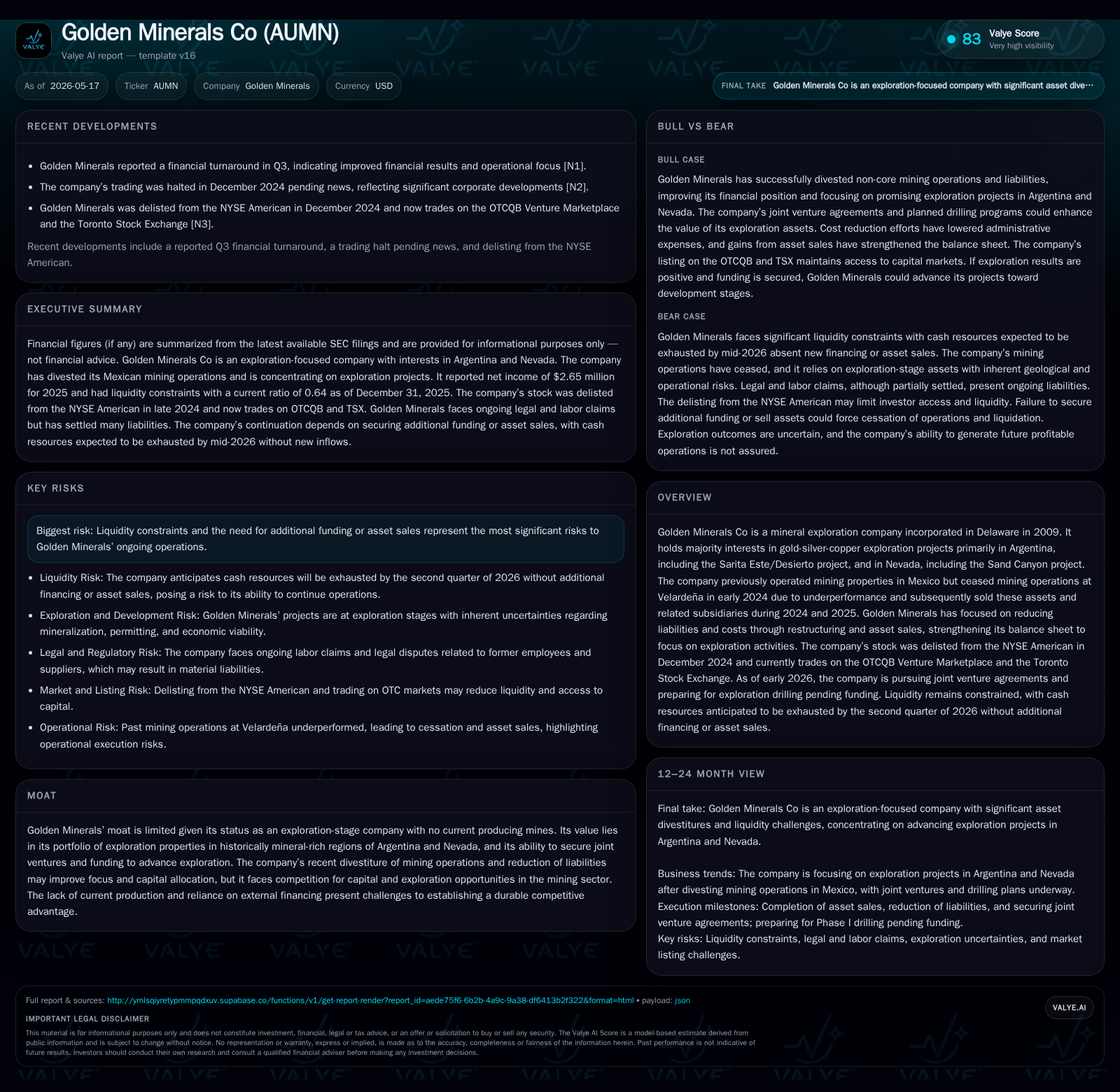
Golden Minerals Company’s latest quarterly filing reveals a decisive transition away from active mining toward exploration-focused growth, particularly at its Sarita Este/Desierto and Sand Canyon projects. Having divested its underperforming Mexican mining assets in 2024 and 2025, the company now concentrates on joint ventures to advance these exploration-stage properties. Despite progress in restructuring and cost reductions, the company faces significant liquidity challenges, with cash resources forecasted to be depleted by mid-2026 absent new financing or asset sales.
Latest Quarterly Update: Operational Pivot and Cash Position
Golden Minerals’ May 15, 2026 quarterly report ([S2]) confirms a strategic exit from active mining operations, highlighted by the completion of Velardeña asset dispositions in late 2025 ([S24]). This follows operational losses tied to underperformance after restarting sulfide mining at Velardeña in late 2023 through early 2024 ([S18]). Proceeds from asset sales have been critical to preserving capital amid this transition.
As of December 31, 2025, Golden Minerals held approximately $1.3 million in cash and cash equivalents with total current assets around $1.9 million against current liabilities near $1.4 million. The resulting current ratio of about 0.64 ([F1]) illustrates a constrained liquidity position. Management acknowledges that sustaining operations beyond the second quarter of 2026 will require new financing or proceeds from further asset sales ([S5][S18]).
With mining activities ceased, no meaningful revenue is generated currently; operating focus centers on carefully managed exploration expenditures and corporate overhead ([S2]).
Business Model Overview: Transition to Exploration Stage
Golden Minerals has shifted from a producer to an exploration-stage company under SEC S-K Regulation 1300 guidelines ([S1][S22]). It holds majority interests primarily in gold-silver-copper exploration concessions without recognized "proven and probable" mineral reserves; accordingly, all property-related expenditures are expensed as incurred rather than capitalized ([S1]).
Historically reliant on mining outputs for revenue generation, the company ceased Velardeña mining operations early in 2024 and completed related asset sales by year-end 2025 ([S18][S24]). Value creation now depends largely on advancing exploration projects located in Argentina’s Puna geological region (Sarita Este/Desierto) and Nevada’s historical precious metals district (Sand Canyon) ([S5][S22]).
Operating as an explorer means funding primarily comes from investors and joint venture partners rather than direct metal sales; successful partnerships help mitigate capital risk while validating geological potential ([S1]).
Exploration Assets: Sarita Este/Desierto and Sand Canyon Projects
Golden Minerals’ core portfolio comprises two adjoining Argentine concessions — Sarita Este (51% owned) and Desierto (67% owned) — where surface exploration has delineated alteration zones indicative of precious metal systems typical for epithermal deposits ([S5]). In late 2025, joint venture agreements were finalized with Cascadero at Sarita Este while negotiations continue for Desierto. These agreements aim to enable Phase I drill programs testing extensions of gold mineralization, contingent upon securing additional funding ([S5]).
In Nevada, Golden Minerals earned a 60% interest in the Sand Canyon project through an option exercise completed early in 2025. Sand Canyon remains fully at the exploration stage without resource delineation or production assets ([S5]).
These assets represent Golden Minerals’ primary growth focus following divestitures elsewhere.
Industry Environment and Competitive Dynamics
Operating within the junior mining sector exposes Golden Minerals to intense competition for scarce capital among explorers without producing mines or proven reserves ([S1]). Exploration demands significant upfront investment for drilling campaigns required to demonstrate economic viability.
Regulatory environments differ: Argentina offers rich mineral belts but presents permitting challenges; Nevada provides clearer regulatory frameworks but increased competition for drilling resources elevates costs during active cycles ().
The absence of producing mines removes steady cash flow streams that could subsidize exploration spending, increasing reliance on equity markets or joint venture funding which can fluctuate significantly with market sentiment ().
Growth Drivers: Joint Ventures and Strategic Partnerships
Joint ventures form the cornerstone of Golden Minerals’ growth strategy, enabling advancement of technical programs while mitigating capital constraints ([S5]). The Cascadero partnership at Sarita Este is pivotal; successful drilling will refine geological models and potentially increase project valuations.
Such partnerships dilute operational risk inherent in early-stage exploration. Key performance indicators include drill program milestones and progress toward defining SEC-compliant mineral reserves necessary for transitioning beyond speculative status ().
Additional partner arrangements or asset sales may further support scaling exploration without overextending financial resources.
Risks and Watchpoints: Liquidity Challenges and Legal Exposure
Liquidity remains critical; with just over $1 million cash at end-2025 amid ongoing exploration spend plus corporate overheads, management forecasts exhaustion by Q2 2026 absent equity raises or asset monetizations ([F1][S5][S18]). The going concern qualification underscores this vulnerability ([S6][S10]).
Legal risks stem mainly from legacy Mexican operations including settled labor claims post-divestiture but outstanding Argentine labor claims accruing approximately $250,000 which management plans to contest vigorously ([S9][S20]). Additionally, disputed fees related to a cancelled Mexican mining concession (~$403,000 claim) could pose financial obligations if enforcement proceeds; however, the company disputes liability based on procedural grounds ([S9][S20][S23]).
No current production or asset retirement obligations exist since mining ceased; this limits fixed cost burdens but also eliminates any operational revenue cushion ([S17]).
Looking Ahead: Key Milestones and Financial Watchpoints
Near-term priorities include finalizing joint venture agreements—especially for Desierto—initiating Phase I drilling programs subject to funding availability, refining geological models with drilling data, updating stakeholders on litigation developments, and managing liquidity through capital raises or strategic disposals ([S2][S3][S5]).
Monitoring future quarterly filings will be essential to assess changes in cash burn rates or shifts in financing strategies that impact operational continuity beyond mid-2026.
Brief Financial Context: Restructuring Gains Amid Liquidity Pressure
Recent disclosures show constrained working capital—approximately $1.9 million current assets versus $1.4 million current liabilities—resulting in a tight liquidity cushion (current ratio 0.64) as of June 30, 2025 per [F1]. Cash declined year-over-year due primarily to discontinued operations expenses ($1.0 million) alongside general & administrative plus exploration costs totaling about $2.7 million partially offset by approximately $1.8 million proceeds from asset sales including Velardeña disposals ([S10][S14]).
Net income reflected gains mainly from these asset sales though underlying operating losses persist without active production revenues ([F1][S21]).
Disclaimer: This analysis is based solely on publicly filed SEC documents and does not constitute investment advice or research views.
Disclaimer: This is research-only, informational analysis and not investment advice. It may include AI-generated interpretation and general industry context. Always verify important details using primary sources.

Comments