
Mission Produce’s Vertical Integration Fuels Steady Margins and Strategic Expansion
Mission Produce leverages full supply chain control and strategic acquisitions to maintain profitability despite tariff and market challenges.
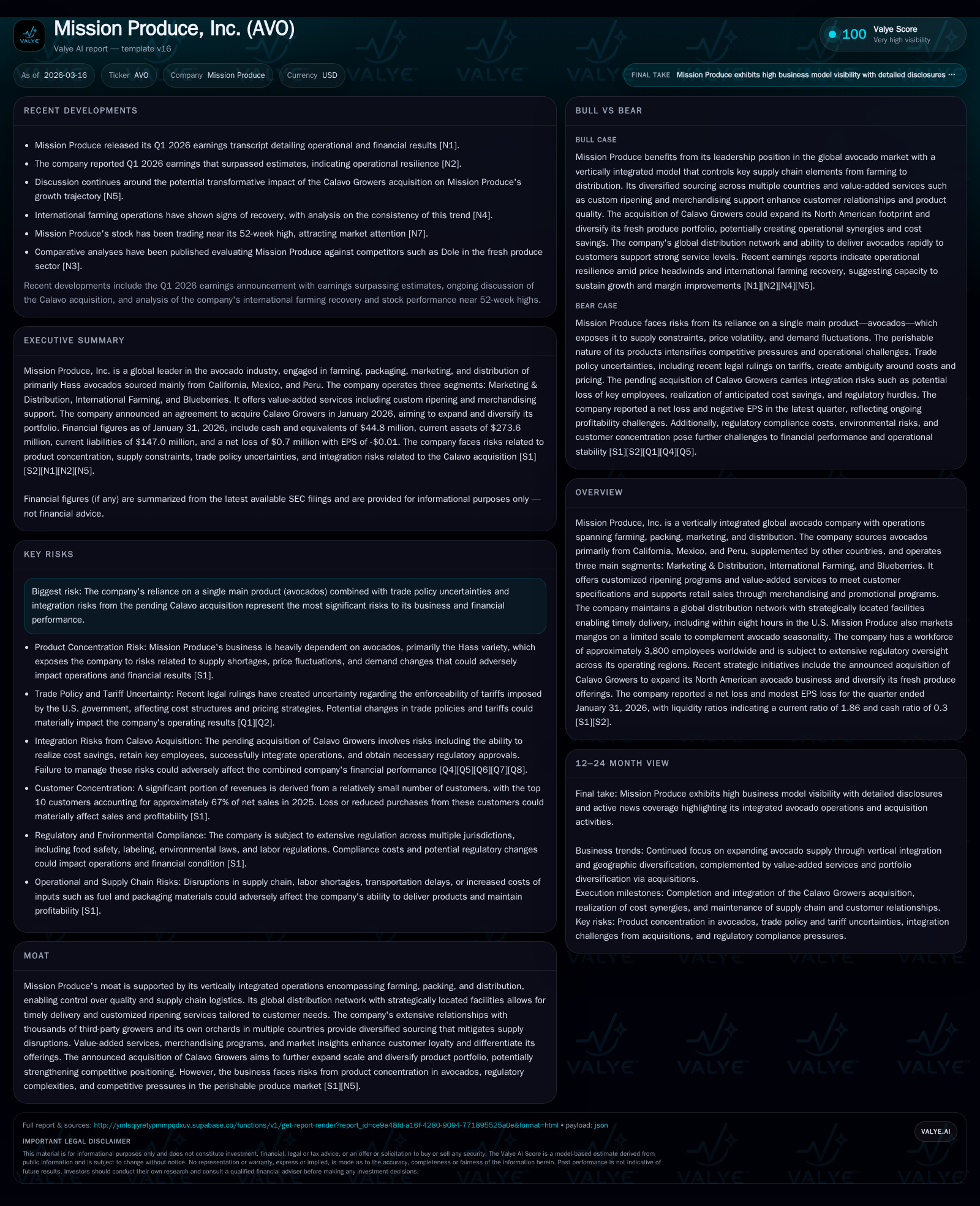
Mission Produce, a global avocado leader, has transformed its financial profile from a multi-year loss in FY2022 into steady profitability by capitalizing on vertical integration across farming, packing, and distribution. The company's comprehensive ripening programs and value-added services support strong customer loyalty amid an uncertain regulatory environment marked by evolving U.S. trade policies and Supreme Court tariff rulings. The pending acquisition of Calavo Growers is positioned to enhance scale and diversify the product portfolio, though integration risks persist. Financial discipline is evident in robust operating cash flows and measured capital expenditures, with modest buybacks but no dividends so far.
From Turnaround to Stability: Mission Produce’s Historical Growth Drivers
Mission Produce’s financial trajectory over the past four fiscal years highlights a shift from significant losses to consistent profitability anchored by operational improvements within its vertically integrated business model. The company reported an operating loss of $37.2 million in FY2022 but recovered to an operating income of approximately $65.2 million by FY2025 [F1]. Net income similarly improved from a $34.6 million loss in FY2022 to a $37.7 million profit in FY2025.
The company controls multiple stages of the avocado value chain—from cultivation on owned orchards primarily in Peru and Guatemala through sorting and packing at strategically located facilities near sourcing regions (California, Mexico, Peru), to distribution via a global network enabling delivery within U.S. metro areas typically under eight hours [S1][S4]. This vertical integration reduces reliance on external growers for critical activities, helping stabilize margins amid market fluctuations.
Operating cash flow increased from $35.2 million in FY2022 to $88.6 million in FY2025 reflecting improved working capital management alongside profitability gains [F1]. Capital expenditures rose notably in FY2025 ($51.4 million), suggesting ongoing investments likely related to capacity expansion or infrastructure upgrades.
Historical performance (annual)
| FY | Net ($mm) | CFO ($mm) | OpInc ($mm) | Capex ($mm) | Net YoY |
|---|---|---|---|---|---|
| 2025 | 38 | 89 | 65 | 51 | +2.7% |
| 2024 | 37 | 93 | 66 | 32 | +1410.7% |
| 2023 | -3 | 29 | 7 | 50 | +91.9% |
| 2022 | -35 | 35 | -37 | 61 |
Source: SEC companyfacts cache [F1].
Capital returns and efficiency (annual)
| FY | Buybacks ($mm) | FCF ($mm) | ROE% |
|---|---|---|---|
| 2025 | 6 | 37 | 6.4 |
| 2024 | 0 | 61 | 6.7 |
| 2023 | 1 | -21 | -0.6 |
| 2022 | 0 | -26 | -6.9 |
Source: SEC companyfacts cache [F1].
Table Note: Growth rates are year-over-year changes where calculable; FY2023 showed initial recovery from losses.
Navigating U.S. Tariff Volatility and Operational Impact
A significant challenge for Mission Produce arises from the volatile U.S. trade policy landscape affecting import tariffs on avocados sourced mainly from Mexico—the company’s largest grower base [S7][S15]. On February 20, 2026, the U.S. Supreme Court ruled that the International Emergency Economic Powers Act does not authorize tariff imposition powers for the Executive Branch, rendering recent tariffs illegal [S15]. This ruling introduces uncertainty about future tariff enforcement timelines and potential alternative trade restrictions.
This legal ambiguity complicates cost forecasting and margin management as tariffs previously increased costs for imported fruit while customers’ sensitivity limits passing these costs downstream effectively [S7][S15]. Uncertainty also surrounds potential refunds of tariffs already paid; growers or customers may seek credits before government refunds materialize.
Operationally, such tariff volatility requires agile logistics management across truck, ocean, and air freight modes to minimize holding costs while meeting customized ripening schedules demanded by retail clients seeking precise ripeness at shelf arrival [S4]. The company’s ability to tailor ripening stages—ranging from hard to fully ripe—remains a competitive advantage mitigating some margin pressure amid broader macroeconomic uncertainties.
The Calavo Acquisition: Scale Expansion with Integration Risks
The announced acquisition of Calavo Growers represents a strategic move aimed at expanding scale within the fresh produce segment while diversifying beyond avocados into related fruit categories [N4][S1]. Calavo’s complementary product lines could reduce single-crop dependency risk by broadening Mission’s product basket—a potential benefit for customers preferring consolidated procurement.
However, this expansion entails integration risks including blending corporate cultures, consolidating supply chains without disruption, retaining key talent during change management, and harmonizing customer service platforms [N4][S7]. Both companies operate substantial farming acreage plus packing/promotion networks globally—across countries with distinct regulatory frameworks—adding complexity flagged by the company itself [S7].
If successful, the acquisition may solidify Mission Produce as a leading vertically integrated provider with enhanced negotiating power among major retail chains worldwide.
Segment Overview: Marketing & Distribution vs. International Farming
Mission Produce reports results primarily through three segments: Marketing & Distribution (M&D), International Farming (IF), and Blueberries farming—which complements seasonal variability in avocado production [S1][S4]. M&D drives revenue by sourcing fruit from both third-party growers and internal farms while offering ripening customization programs, packaging innovations like "Minis" or "Emeralds in the Rough," along with merchandising support including category management that fosters customer loyalty through value-added services [S4].
International Farming provides supply stability owning orchards mainly in Peru and Guatemala with planted acreage exceeding 11,000 acres spanning various maturity levels that typically require five to seven years for peak production [S27]. Service revenues from packing/processing blueberries for exclusive distributors plus select third-party fruits enhance infrastructure utilization [S11].
Synergies arise as M&D sources most internally produced fruit complemented by dominant third-party inputs ensuring year-round availability while global logistics hubs near consumer markets reduce lead times—a key differentiator versus more fragmented competitors lacking integrated networks [S4][N6].
Capital Allocation: Cash Flow Trends, Capex Patterns, and Shareholder Returns
Financial discipline is evident with free cash flow sustained after accounting for increasing capital expenditures—capex rose nearly 60% year-over-year between FY2024 ($32.2 million) and FY2025 ($51.4 million), reflecting possible orchard expansion or facility upgrades [F1].
Operating cash flows have consistently exceeded net income levels due to non-cash charges balanced against working capital effects [F1]. As of January 31, 2026, the current ratio stood at about 1.86 confirming solid liquidity coverage [F1][S5]. Despite positive cash flow generation there have been no dividends issued historically; however, share repurchases increased modestly totaling $6.1 million in FY2025 indicating a cautious capital return approach focused on growth investment and debt compliance [F1][N1].
Leverage ratios aligned with credit facility covenants constrain financial flexibility but reinforce prudent capital management necessary for acquisitions like Calavo without undue risk exposure [S5][S9].
Risk Factors: Product Concentration, Trade Policy Uncertainty, Integration Challenges
The company acknowledges several material risks that could affect future performance [S7][N4]:
- Heavy reliance on avocados concentrates exposure to crop-specific risks such as disease or demand volatility,
- Ongoing instability in U.S.-Mexico trade relations including tariffs creates cost unpredictability,
- The pending Calavo acquisition introduces execution risk inherent in integrating geographically dispersed operations under varying regulatory regimes,
- Political volatility in key sourcing countries like Mexico poses logistical threats,
- Regulatory compliance demands related to environmental laws governing agrichemical use increase costs while potentially constraining farming practices [S22][S27],
- Labor shortages or unrest impacting planting/packing cycles could disrupt supply chains exacerbating margin pressures.
Mitigating these risks requires continued investment in infrastructure resilience alongside proactive regulatory engagement plus diversified grower relationships emphasizing breadth over exclusivity to maintain supply flexibility despite concentration challenges [S7][N12][S16].
Watcher's Guide: Key Metrics Signaling Future Direction
Beyond recent earnings beats reported [N1][N2], important indicators include:
- Combined entity revenue growth post-Calavo reflecting cross-selling success versus integration cost drag;
- Gross margin trends amid tariff uncertainties revealing pricing power elasticity;
- Capex-to-revenue efficiency showing whether investments translate into capacity or productivity gains;
- Operating cash flow sustaining free cash flow generation critical for debt service without curtailing growth;
- Customer retention rates among top clients driving ~67% of sales [S4] amid increasing competition;
- Progress toward diversification goals including incremental contribution from new fruit lines complementing avocado seasonality;
- Regulatory compliance records especially food safety audits affecting import permits. Monitoring quarterly disclosures for shifts in these metrics alongside management commentary on tariff outlooks will be essential to assess trajectory of this vertically integrated avocado leader amid evolving external conditions.[N3][N10][N14]
Analysis based on SEC filings ([F1],[S#]) combined with recent news insights ([N#]) up to March 16th, 2026 without extrapolation beyond disclosed facts or providing investment advice.
Disclaimer: This is research-only, informational analysis and not investment advice. It may include AI-generated interpretation and general industry context. Always verify important details using primary sources.

Comments