
Avantor, Inc. (AVTR) Company Analysis: Navigating Life Sciences with Operational Discipline Amid Competitive and Cybersecurity Risks
Avantor’s solid presence in life sciences and advanced materials is underpinned by operational execution and rigorous governance, yet margin pressures, liquidity constraints, and sector competition present key challenges. This analysis dissects the company’s business model dynamics, competitive moat, and plausible future scenarios to inform strategic investor perspectives.
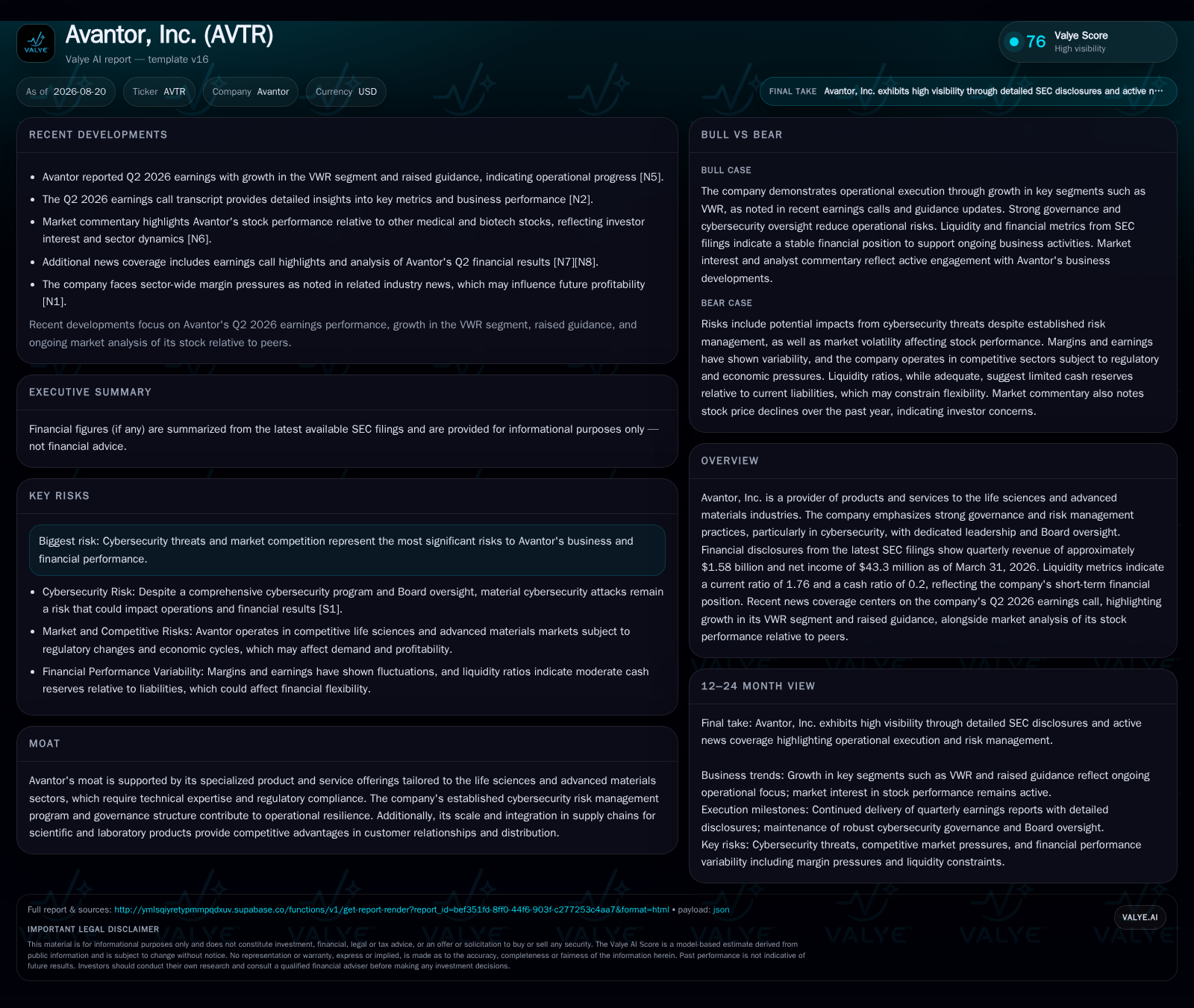
Avantor delivers steady revenue growth driven by its VWR segment and robust cybersecurity oversight, supported by a strong balance sheet. However, margin variability, competitive pressures in life sciences, and limited cash reserves relative to liabilities temper upside. The company’s moat hinges on specialized products, integrated supply chains, and governance structures, but sustaining operating leverage and navigating cybersecurity risks remain critical. Monitoring segment performance, margin trends, and risk management effectiveness will be pivotal in assessing Avantor’s trajectory.
Avantor, Inc. operates within the high-complexity life sciences and advanced materials sectors, leveraging specialized products and integrated supply chains to serve scientific and laboratory customers. Recent Q2 2026 results underscore operational momentum, especially in the VWR segment, driving revenue growth and prompting upward guidance revisions [S2][N5]. The company’s disciplined approach to cybersecurity, led by a Chief Information Security Officer with deep experience and strong Board oversight, aims to shield operations from escalating digital threats [S1]. Yet, Avantor navigates a challenging environment marked by margin pressures across the industry and competitive dynamics that constrain pricing power. Balancing growth and risk management within these parameters will shape Avantor’s medium-term trajectory.
Latest Operating Snapshot
Avantor reported second-quarter 2026 revenue of $1.581 billion, generating net income of $43.3 million and earnings per share of $0.06, highlighting continued operational progress [S2]. The company’s VWR segment notably drove top-line growth, prompting management to raise guidance for future quarters, signaling confidence in execution and market demand [N5].
From a liquidity perspective, Avantor’s current ratio stood at 1.76, reflecting the ability to cover short-term liabilities with current assets, while the cash ratio of 0.2 indicates limited immediate cash reserves relative to liabilities [S2]. Governance emphasis remains strong, with cybersecurity risk management led by a Chief Information Security Officer with over 25 years of experience and regular reporting to the Board’s Audit and Finance Committee, underscoring the priority assigned to operational resilience [S1].
Business Model and Unit Economics
Avantor’s business model centers on supplying products and services tailored to life sciences and advanced materials customers, sectors that demand regulatory compliance, technical specialization, and reliable supply chains. Revenue drivers typically combine volume growth in scientific consumables and materials with pricing influenced by mix – specialized products command premium pricing but face competitive pressures [S1]. The company’s VWR segment exemplifies this, contributing substantially to revenues through broad laboratory supplies and services.
Operating economics reflect moderate fixed costs embedded in supply chain infrastructure, distribution networks, and compliance functions. Although scale affords some operating leverage, sector-wide margin pressures limit margin expansion potential. Capital intensity arises primarily from inventory management and distribution capabilities, which are necessary to meet customer expectations for availability and service. The cash ratio signals that liquidity management is tight, potentially restricting discretionary investment or rapid scaling, which could blunt operating leverage effects if volumes slow or margin pressures intensify [S2].
Moat, Competition and Counterforces
Avantor’s moat is anchored in its technical specialization and integration across life sciences supply chains, enabling it to serve complex customer needs that generalist distributors cannot easily replicate. This specialization fosters some customer switching friction, particularly where regulatory and documentation requirements are stringent. Additionally, the company’s cybersecurity governance adds operational resilience, reducing potential disruptions and protecting intellectual property [S1].
However, Avantor faces significant counterforces from competitive dynamics including other specialized life sciences suppliers, distributors, and integrators, as well as broader macroeconomic and regulatory pressures that can compress margins. These sectors are characterized by moderate product commoditization alongside pockets of differentiation, limiting pricing power. Emerging digital platforms and alternative procurement models could further challenge traditional distribution economics. Thus, sustaining the moat depends on continuous innovation in service delivery, supply chain efficiency, and risk management.
Bull Case
In a favorable scenario, Avantor leverages its VWR segment momentum to drive sustained revenue growth and margin expansion through operational efficiencies and selective pricing power. Effective cybersecurity risk management minimizes operational disruptions, preserving reputation and customer trust. Liquidity management improves modestly, enabling reinvestment in supply chain innovations and expansion of specialized product lines, which deepens customer relationships and could raise switching costs.
Confirming evidence for this pathway would include consistent quarterly revenue growth surpassing industry averages, improving gross and operating margins despite sector pressures, and incremental enhancements in cash flow and liquidity ratios. Enhanced Board and management communication on strategic initiatives and cybersecurity resilience would reinforce investor confidence. Conversely, failure to achieve margin improvement or recurring cybersecurity incidents would falsify this scenario.
Base Case
The base case anticipates continued revenue growth driven by the VWR segment and stable demand in life sciences, offset by persistent margin pressures from competitive pricing and inflationary cost inputs. Avantor maintains its cybersecurity program effectively, preventing material incidents but with ongoing vigilance required. Liquidity remains sufficient to support current operations but constrains large-scale strategic investments or acquisitions.
Under this scenario, revenue and earnings grow modestly, with margins fluctuating within industry norms. Operating leverage is limited but positive, reflecting careful cost control and steady volume growth. Market positioning remains stable, with competition maintaining pressure on pricing and mix. Key falsification points include unexpected margin deterioration beyond industry trends or a significant cybersecurity breach impacting financial results.
Bear Case
A downside scenario materializes if Avantor experiences a material cybersecurity attack causing operational disruption, reputational damage, and financial losses, despite its governance framework. Concurrently, intensified competition and regulatory changes compress margins further, while liquidity constraints limit the company’s ability to adapt or invest in growth initiatives.
This scenario’s confirming signals would include deteriorating financial metrics such as declining revenue or margins, increasing debt or liquidity stress, and documented cybersecurity incidents. Market sentiment would likely turn negative, reflected in stock underperformance relative to peers and downgrades by analysts. Recovery would require substantial remediation efforts and potential strategic pivots. Absence of these developments over successive quarters would falsify the bear case.
What Matters Next
Key performance indicators to monitor include quarterly revenue growth by segment, especially VWR, to gauge demand trends and operational execution. Margin metrics—gross, operating, and EBITDA margins—will reveal how effectively Avantor manages cost pressures and pricing power. Cash flow generation and liquidity ratios such as the cash ratio and current ratio provide insight into potential financial flexibility and investment capacity.
Cybersecurity metrics, while not always publicly disclosed in detail, remain critical; disclosures on incident frequency, remediation actions, and governance updates would be valuable. Market share trends relative to key competitors and customer retention rates would illuminate competitive positioning. Finally, management commentary on regulatory impacts and innovation initiatives will signal Avantor’s strategic responsiveness in a dynamic environment.
Disclaimer: This is research-only, informational analysis and not investment advice. It may include AI-generated interpretation and general industry context. Always verify important details using primary sources.

Comments