
AVAX ONE Expands Sustainable Bitcoin Mining and Avalanche-Focused Digital Treasury Amid Large Q1 Loss
Q1 2026 results underscore AVAX ONE’s strategic pivot to integrated crypto mining and AVAX token stewardship, highlighting growth ambitions amid significant losses and operational risks.
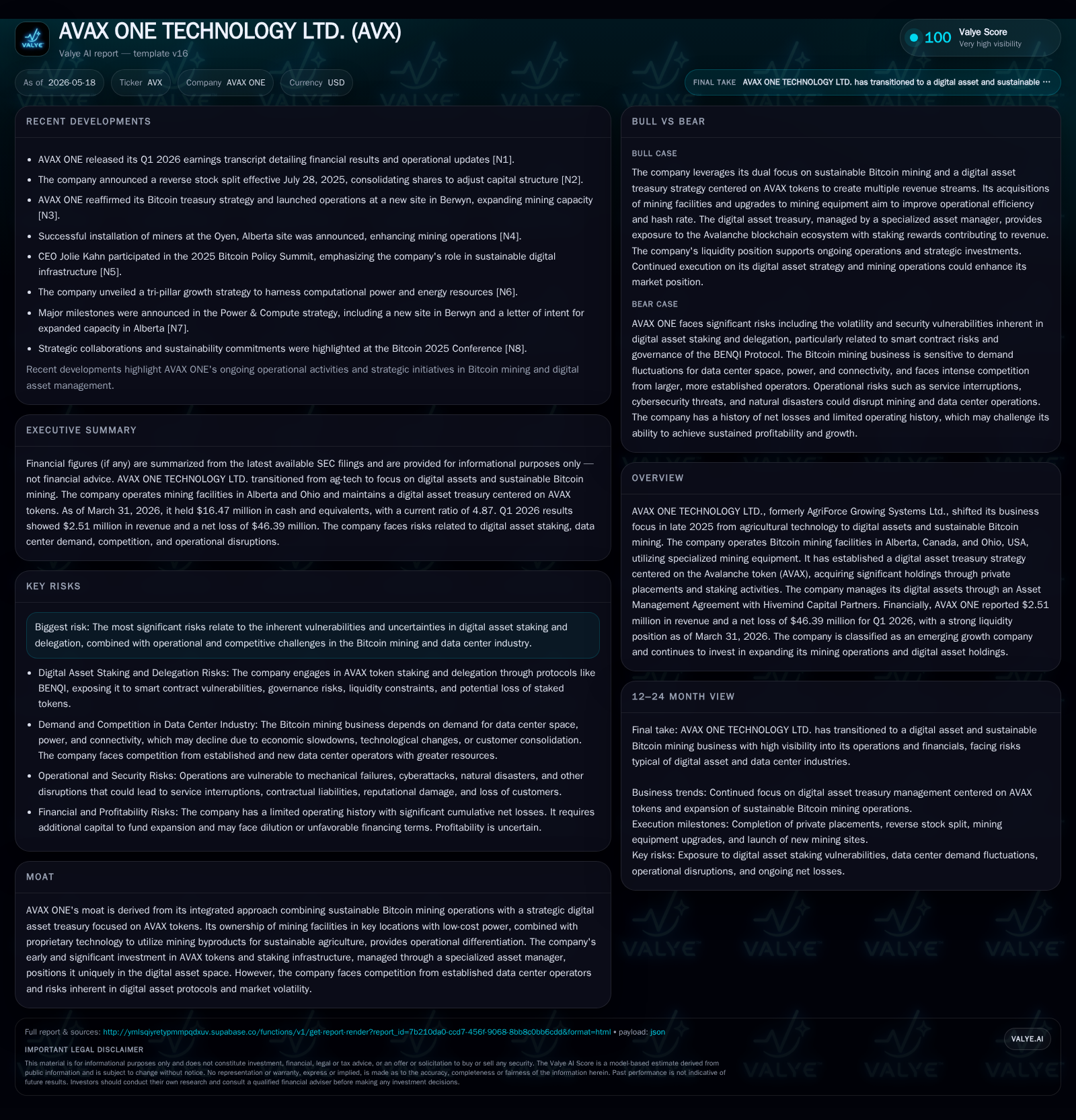
AVAX ONE TECHNOLOGY LTD. has solidified its transition from agricultural technology to a dual focus on sustainable Bitcoin mining and building a digital asset treasury centered on the Avalanche (AVAX) token. The company reported $2.51 million in revenue and a net loss of $46.39 million in Q1 2026, reflecting ongoing investments in mining capacity upgrades and digital asset accumulation. Its competitive moat lies in leveraging low-cost, sustainable energy sources for mining operations in Canada and the U.S., paired with an active AVAX staking strategy managed by Hivemind Capital Partners. Key risks include the volatility and protocol vulnerabilities associated with AVAX staking and execution challenges inherent in capital-intensive crypto mining expansion.
Recent Operating Update
AVAX ONE TECHNOLOGY LTD. released its latest quarterly report on May 15, 2026 [S2], reflecting the ongoing strategic shift from its previous agricultural technology roots toward building an integrated cryptocurrency business focused on sustainable Bitcoin mining and an Avalanche-based digital asset treasury strategy. The company reported first-quarter revenue of roughly $2.51 million alongside a substantial net loss of approximately $46.39 million [F1][S2], consistent with a growth-phase organization investing heavily in operational capacity upgrades, digital asset acquisitions, and expanding its specialized infrastructure.
On the same day, the company held an earnings call reinforcing these themes while discussing near-term milestones including the continued ramp-up of upgraded mining equipment delivered to its Ohio facility [S3][N1]. This quarterly filing confirms that AVAX ONE's primary revenue stems from its Bitcoin mining operations supplemented by staking rewards gathered through its significant holdings of AVAX tokens.
Business Model
AVAX ONE’s revenue model rests principally on two synergistic pillars: (1) operating sustainable Bitcoin mining facilities that generate Bitcoin rewards as tangible outputs of computational work; and (2) managing a strategically curated digital asset treasury heavily weighted toward Avalanche's native token (AVAX).
Bitcoin Mining Operations: The company owns and operates facilities in Alberta, Canada — benefiting from unique access to low-cost natural gas flares that power mining rigs — as well as Ohio, USA [S1]. These sites utilize high-efficiency ASIC miners (notably BITMAIN Antminer models), converting electricity into blockchain hash power that validates transactions for Bitcoin network rewards. Prime cost efficiencies arise from leveraging captured methane flare gas and participating in Alberta’s carbon credit programs, giving AVAX ONE an edge in the highly competitive energy expense component that dominates industry economics.
Digital Asset Treasury Strategy: Coinciding with its November 2025 private placement fundraising (~$219M), AVAX ONE initiated a dedicated treasury reserve focusing on acquiring AVAX tokens both through direct purchases (private placement deals and market buys) and via staking rewards earned by locking tokens within Avalanche’s ecosystem [S1][S13][S23]. Management delegates day-to-day oversight of these assets to Hivemind Capital Partners under an Asset Management Agreement entitling Hivemind to a fixed annual fee of 1.25% on assets under management [S13]. This arrangement signals a professionalized approach embracing decentralized finance mechanics while aiming to capitalize on potential appreciation of Avalanche’s blockchain platform.
Revenue flows primarily from mined Bitcoin sales; however, token staking generates additional non-cash economic value reflected in enhanced crypto holdings rather than immediate cash inflows. Pricing power for mined Bitcoin is cyclical but benefits from operational leverage when electricity costs are minimized via proprietary flare capture techniques.
Industry Structure and Competitive Position
Bitcoin mining is highly capital- and energy-intensive with barriers to entry dependent largely on securing cost-advantaged power and deploying efficient mining hardware. AVAX ONE positions itself uniquely by combining traditional energy markets with low-carbon solutions — capturing methane flares otherwise contributing to greenhouse emissions — thereby aligning sustainability goals with cost competitiveness.
Geographically, Alberta offers regulatory incentives including carbon credits that few other jurisdictions provide at scale. The company’s Ohio operations complement this with upgrades to more-efficient miners targeting improved hashing rates (+20% expected efficiency over prior equipment) [S1]. This technical refresh cycle is standard practice industry-wide given constant advances in ASIC miner performance.
The digital asset treasury niche focused on Avalanche tokens introduces differentiation but also places AVAX ONE amid an increasingly crowded ecosystem catering to staking participants and DeFi yield strategies. While large crypto custodians or institutional holders have scale advantages, the partnership with Hivemind leverages specialized know-how on Avalanche-centric delegation strategies — adding operational rigor uncommon among pure-hardware miners.
Competitors include vertically integrated miners who may or may not engage actively in token staking or broader portfolio diversification strategies. Data-center heavyweights typically operate bigger fleets but have not universally integrated combined agricultural or sustainable resource-utilization approaches as AVAX ONE has attempted historically.
Growth Drivers
Expansion of Sustainable Mining Capacity
A core driver will be successful deployment and operation of upgraded BITMAIN Antminer S19K Pro models at Ohio facilities replacing older generation models—expected efficiency gains directly translate into higher BTC production per unit electricity consumed [S1]. Scaling internal capacity enables revenue growth directly tied to hash rate improvements.
Avalanche Token Accumulation & Staking Rewards
As AVAX One increases holdings via negotiated private placements at favorable prices versus open market buys alongside organic accrual through staking rewards using liquid staking instruments (such as tAVAX/sAVAX tokens managed through BENQI Protocol), it amplifies exposure to potential Avalanche price appreciation plus governance incentives [S13].
Strategic use of Excess Mining Heat & Carbon Byproducts for Agriculture
By recycling heat waste and carbon exhaust from their Alberta facility into agriculture applications—though legacy ag-tech operations were mostly wound down except for units like Manna being liquidated—the company harnesses synergies between crypto mining expenses/assets and sustainable business practices potentially unlocking multiple profit centers beyond cryptographic yields alone [S1][N1]
Professional Asset Management Relationship
Hivemind Capital Partners' management brings institutional process implementation for volatile digital asset custody/staking operations reducing execution risk involved in decentralized finance protocols. Transparent monthly reporting to board also assists investor confidence surrounding fluctuating crypto valuations [S13][N1].
Risks / Watchpoints / Growth Constraints
Digital Asset Staking Vulnerabilities & Liquidity Risks
Engagements in liquid staking products expose AVAX ONE’s treasury assets to smart contract bugs or exploits inherent in DeFi protocols like BENQI [S2]. The governance structure behind these protocols further limits the company's influence despite holding sizable staked amounts; adverse governance votes could change fee structures or redemption rules unfavorably.
Liquid staking tokens trade less liquidly than native AVAX tokens resulting in elevated slippage during market stress conditions; this impacts realized value if rapid liquidation is needed.
Volatile Cryptocurrency Pricing & Market Sentiment Impact
Price fluctuations inherent in AVAX tokens present valuation risk affecting both balance sheet mark-to-market values as well as future revenue streams from staking yields — creating earnings volatility difficult to hedge comprehensively.
Likewise, BTC price swings impact core revenues derived from mined coins making profitability sensitive to spot pricing correlated strongly to global macro-financial environments.
Capital Intensity & Need for Additional Financing
While cash on hand (~$16.47 million) provides runway for near-term investments, ongoing expansion initiatives require external financing which may dilute existing shareholders or involve onerous covenants limiting operational flexibility [F1][S7]. Raising capital during bearish crypto markets or illiquid equity windows poses execution risks impacting growth continuity.
Competition & Technological Obsolescence Risk
Industry demands continual hardware refresh cycles (e.g., transitioning miners every two years) at considerable expense posing pressure on margins if technological shifts outpace the company’s ability to upgrade efficiently.
More established players benefit from larger economies of scale across electricity procurement, IP development around protocol participation, or diversified crypto portfolios beyond single-chain exposure affecting competitive positioning.
Legal Proceedings & Regulatory Environment Uncertainty
Ongoing litigation exposures exist though management currently assesses no material adverse effect is likely; nonetheless legal costs can divert resources unexpectedly while regulatory shifts related to crypto-mining energy consumption policies may impact operational licenses or incentive programs [S10].
What To Watch Next
- Delivery completion and performance benchmarking for the new BITMAIN Antminer S19K Pro fleet at Ohio operations by end Q2/Q3 2026 outlined in prior filings; hashing rate improvements will be key utilization/efficiency metrics to track [S1][N1].
- Monthly reports from Hivemind Capital Partners detailing digital asset performance including token mix changes or shifts between liquid staking providers remain leading indicators for treasury health and risk appetite adjustments [S13].
- Updates on any further capital raises or amendments to existing convertible debenture agreements that affect liquidity runway or shareholder dilution dynamics should be monitored closely given funding dependence highlighted by management.[S7]
- Market price trends for BTC and especially AVAX tokens will significantly influence future earnings prospects as well as fair value disclosures prompting re-assessment of long-term viability for this dual-strategy business model.
- Progress updates regarding legacy agricultural IP business wind-down including final disposition plans for Manna technology could clarify capital allocation focus.[S1]
- News related to regulatory changes impacting carbon credit valuations or Quebec/Alberta flare gas policies affecting cost structure could alter mining facility economics significantly.[N1]
- Observations regarding smart contract audits outcomes if disclosed or any security incidents involving liquid staking platforms could materially adjust perceived protocol risk profiles.[S2]
- Retention and hiring trends as company plans workforce expansion beyond seven employees seen at Q1 scale could signal readiness for operational scaling.[F1]
Financial Profile Summary
As of March 31, 2026, AVAX ONE held roughly $16.47 million in cash equivalents supported by $38.88 million total current assets against current liabilities last reported at nearly $8 million yielding a healthy current ratio around 4.87 — indicating sound near-term liquidity sufficient for working capital needs amid expansion efforts [F1]. The total reported debt figure available stems from older periods showing about $14 million outstanding but does not reflect newer financing rounds explicitly disclosed post-2022 suggesting potential changes [F1].
The first quarter’s top-line revenue was modest ($2.51M) consistent with nascent production phases coupled with ongoing investments translating into significant operating losses predominately driven by asset acquisition costs (including miner purchases) and administrative overheads related to digital treasury management resulting in an aggregate net loss close to $46.39 million [F1][S2]
While losses weigh heavily on near-term profitability metrics typical of emerging growth companies engaged in capital-intensive infrastructure deployments alongside volatile asset holdings exposure — cash reserves combined with investor-backed PIPE financing suggest manageable solvency risk contingent upon successful execution of growth initiatives within planned funding frameworks [S7]
Disclaimer
Financial position in context
As of 2026-03-31, companyfacts shows $16.47 million in cash and equivalents [F1]. Current assets of $38.88 million and current liabilities of $7.99 million imply a current ratio near 4.87x for 2026-03-31 [F1].
This analysis is intended solely for informational purposes based on publicly available SEC filings and does not constitute investment advice or research views regarding securities mentioned herein.
Disclaimer: This is research-only, informational analysis and not investment advice. It may include AI-generated interpretation and general industry context. Always verify important details using primary sources.

Comments