
Aspira Women's Health: AI Diagnostics Promise Meets the Realities of Capital Scarcity and Adoption Hurdles
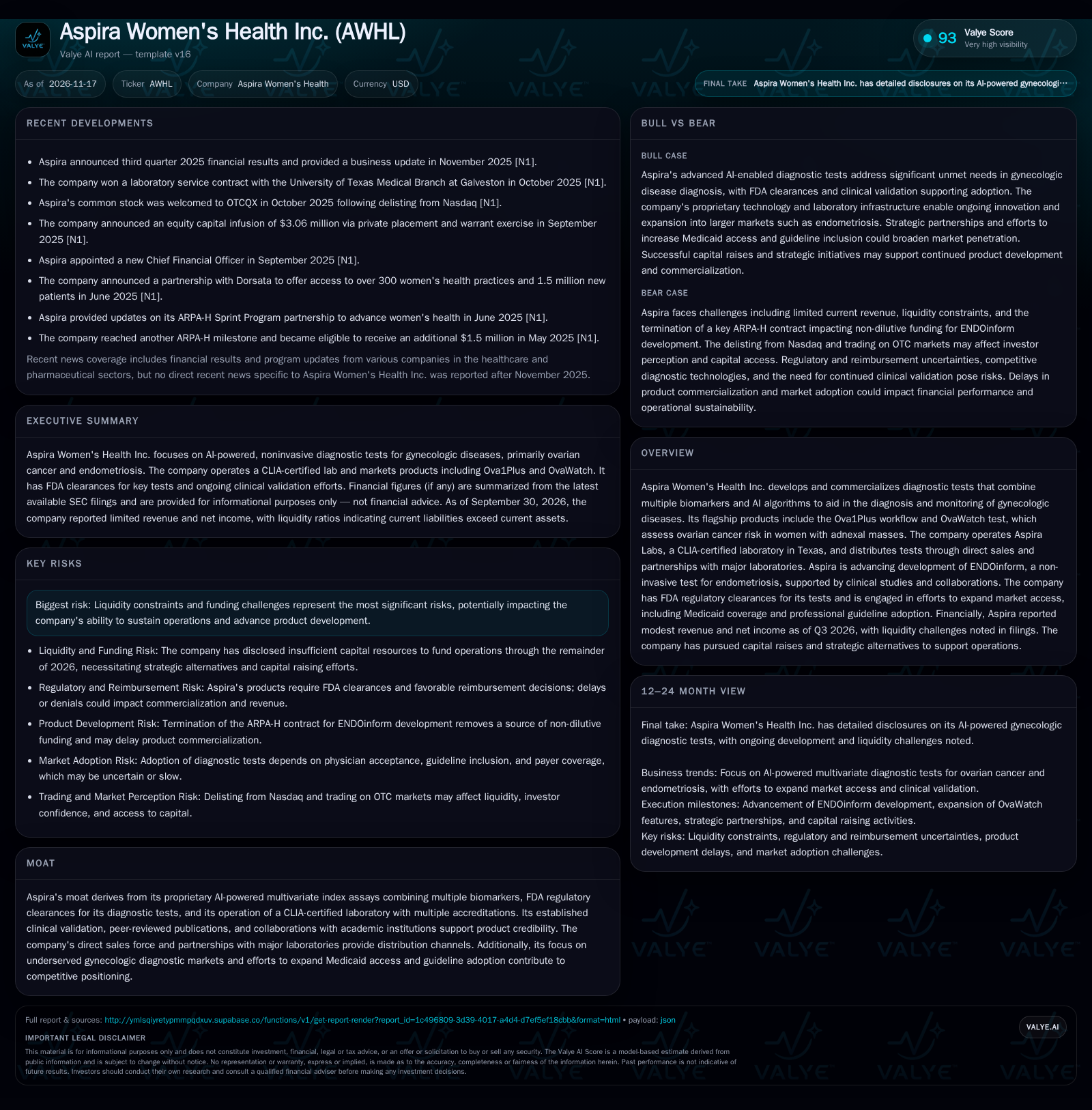
Aspira Women's Health has established a portfolio of FDA-cleared, AI-powered diagnostic tests for gynecologic diseases and operates a CLIA-certified clinical lab, but faces existential funding and commercialization challenges following the loss of non-dilutive support and a Nasdaq delisting. The company’s future now hinges on its ability to secure new capital, accelerate market penetration, and validate its next-generation endometriosis test.
Aspira Women's Health commercializes AI-driven diagnostic assays for ovarian cancer and is developing a non-invasive endometriosis test, supported by clinical validation and regulatory clearances. The company’s prospects depend on raising capital, achieving broader reimbursement, and driving adoption in a cautious diagnostics market. [S2]
With its flagship products FDA-cleared and commercially available, and its laboratory infrastructure in place, Aspira must now overcome a daunting capital gap, regain momentum in product development after the termination of a key ARPA-H contract, and prove that its technology can achieve meaningful adoption in risk-averse clinical markets. The next phase will test not only the merits of its diagnostic innovation but also its resilience in navigating financial and regulatory headwinds. [S2]
Recent Funding Constraints and Product Development Setbacks Define the Landscape
Aspira Women's Health enters late 2026 with several intersecting challenges: as of September 30, 2026, the company reported only $12,000 in cash and cash equivalents, against current liabilities of $6.09 million, resulting in a current ratio of 0.3. Total revenue for the period was $11,000, with net income of $339,000. Most critically, Aspira has acknowledged that its capital resources are insufficient to fund ongoing operations through the remainder of 2026, prompting pursuit of strategic alternatives and new fundraising initiatives. Compounding the financial strain, the company lost a key ARPA-H contract—removing non-dilutive funding for the development of ENDOinform, its promising non-invasive endometriosis diagnostic. This not only delays commercialization but also raises uncertainty about Aspira’s ability to maintain its innovation pipeline. The company’s delisting from Nasdaq in April 2025, with shares now trading on the OTC QX Best Market, further restricts access to capital and may impair investor confidence and institutional participation. [S2]
Diagnostic Test Commercialization: Economics, Leverage, and Capital Needs
Aspira’s business model revolves around developing proprietary, multivariate index assays—such as Ova1Plus and OvaWatch—that leverage AI algorithms and biomarker panels for early detection and risk stratification of gynecologic diseases. These tests are processed in Aspira Labs, a CLIA-certified facility, and distributed through both a direct sales force and partnerships with major national reference labs. The economics of diagnostics are inherently sensitive to pricing, test volume, reimbursement rates, and payer mix. While fixed costs are high due to R&D, regulatory, and lab infrastructure, variable costs per test (materials, labor, logistics) are relatively modest, creating the potential for substantial operating leverage if test volumes scale. However, with very low reported revenue and a high current-liabilities burden, the company’s fixed costs are not being offset by sufficient volume, resulting in acute funding needs. The capital intensity of ongoing clinical validation, regulatory submissions, and guideline advocacy remains significant, especially as ENDOinform’s development now requires alternative funding sources following the ARPA-H contract loss. Without a step-change in market adoption or successful capital raises, Aspira risks an inability to cover basic operating expenses, let alone fund further innovation.
AI-Driven Differentiation Versus Entrenched Diagnostics and Market Frictions
Aspira's core competitive proposition lies in its proprietary, AI-powered multivariate diagnostics—offering non-invasive, blood-based alternatives to traditional diagnostic pathways for ovarian cancer and, prospectively, endometriosis. FDA clearances and CLIA certification provide regulatory credibility, while partnerships with major labs expand distribution reach. However, the competitive landscape is crowded: established diagnostic companies, academic medical centers, and emerging startups all pursue improved detection of gynecologic diseases. Many competitors benefit from scale, diversified product portfolios, and entrenched relationships with payers and providers. Switching frictions are high—physician adoption depends on compelling clinical evidence, integration into professional guidelines, and payer reimbursement. The promise of AI-driven risk stratification is counterbalanced by skepticism toward new algorithms and a conservative clinical culture. Aspira’s focus on underserved diagnostic niches is a potential moat, but only if it can rapidly achieve clinical consensus and payer support before better-funded rivals replicate or outcompete its offerings.
Unlocking Adoption Through Validation, Coverage, and Strategic Partnerships
In a favorable scenario, Aspira secures sufficient bridge financing or a strategic transaction to stabilize operations and continue product development. Ova1Plus and OvaWatch gain traction through expanded Medicaid access, inclusion in clinical guidelines, and successful advocacy with payers—driving higher test volumes and reimbursement rates. The company successfully completes clinical studies for ENDOinform, restoring momentum after the ARPA-H setback, and launches the test with strong peer-reviewed validation. Channel partnerships with reference labs yield broader distribution, while direct sales efforts penetrate new provider segments. If hospital systems and OB-GYNs adopt Aspira’s assays for routine risk assessment, operating leverage improves markedly as fixed costs are spread over a larger revenue base. Evidence that would confirm this scenario includes: meaningful increases in test volumes, new or renewed commercial partnerships, positive reimbursement decisions, and successful capital raises or M&A activity.
Survival Mode: Incremental Progress Amid Cash Constraints and Cautious Adoption
The most plausible near-term outcome is a period of survival-driven incrementalism. Aspira may secure limited bridge capital—likely at dilutive terms—allowing for continued operations but not transformative growth. Ova1Plus and OvaWatch see modest uptake, constrained by slow-moving payer coverage decisions and gradual clinical adoption. ENDOinform’s development proceeds at a slower pace, dependent on the company’s ability to find new non-dilutive funding or partnerships. The company may explore asset sales, licensing deals, or joint ventures as a means of generating liquidity and maintaining its innovation pipeline. Delisting and OTC trading continue to weigh on investor sentiment, making large-scale capital infusions unlikely absent a major commercial breakthrough. Evidence supporting this scenario would include continued low revenue growth, small-scale capital raises, and incremental clinical or commercial milestones without step-change adoption.
Liquidity Exhaustion and the Risk of Strategic Discontinuity
Should Aspira fail to secure new capital or strategic partners, the company faces the prospect of exhausting its liquidity before meaningful commercial traction or product launches can be achieved. Under this scenario, ongoing operations become unsustainable, potentially leading to workforce reductions, R&D program suspensions, or even bankruptcy proceedings. The development of ENDOinform stalls indefinitely, and existing products lose momentum as marketing and sales efforts are curtailed. Competitors may acquire assets or intellectual property at distressed prices, and the company’s proprietary assays risk being eclipsed by rival technologies. Evidence that would confirm this scenario includes: failure to announce new funding, material workforce reductions, cessation of clinical programs, or public disclosure of going-concern uncertainties.
Milestones and Metrics That Will Shape Aspira’s Strategic Fate
Announcement of new capital raises, bridge loans, or strategic transactions to extend operational runway.
Quarterly test volume growth for Ova1Plus and OvaWatch; a useful metric would be the number of tests processed and revenue per test, if disclosed.
Progress updates on ENDOinform development, including completion of clinical studies, regulatory submissions, or restoration of non-dilutive funding.
New or expanded commercial partnerships with major reference labs, payers, or provider networks.
Milestones related to the inclusion of Aspira’s assays in professional guidelines or payer coverage decisions.
Any reported workforce reductions, restructuring actions, or R&D program suspensions.
Public disclosures regarding going-concern status, bankruptcy risk, or asset sales.
Peer-reviewed publications or abstracts demonstrating improved clinical utility or cost-effectiveness of Aspira’s assays.
Disclaimer: This is research-only, informational analysis and not investment advice. It may include AI-generated interpretation and general industry context. Always verify important details using primary sources.

Comments