
American Express Advances Premium Card Growth and Commercial Payments Amid Regulatory Pressure
Q1 2026 results highlight robust card member spending, AI investments, and strategic commercial expansion under intensifying competition and regulatory scrutiny.
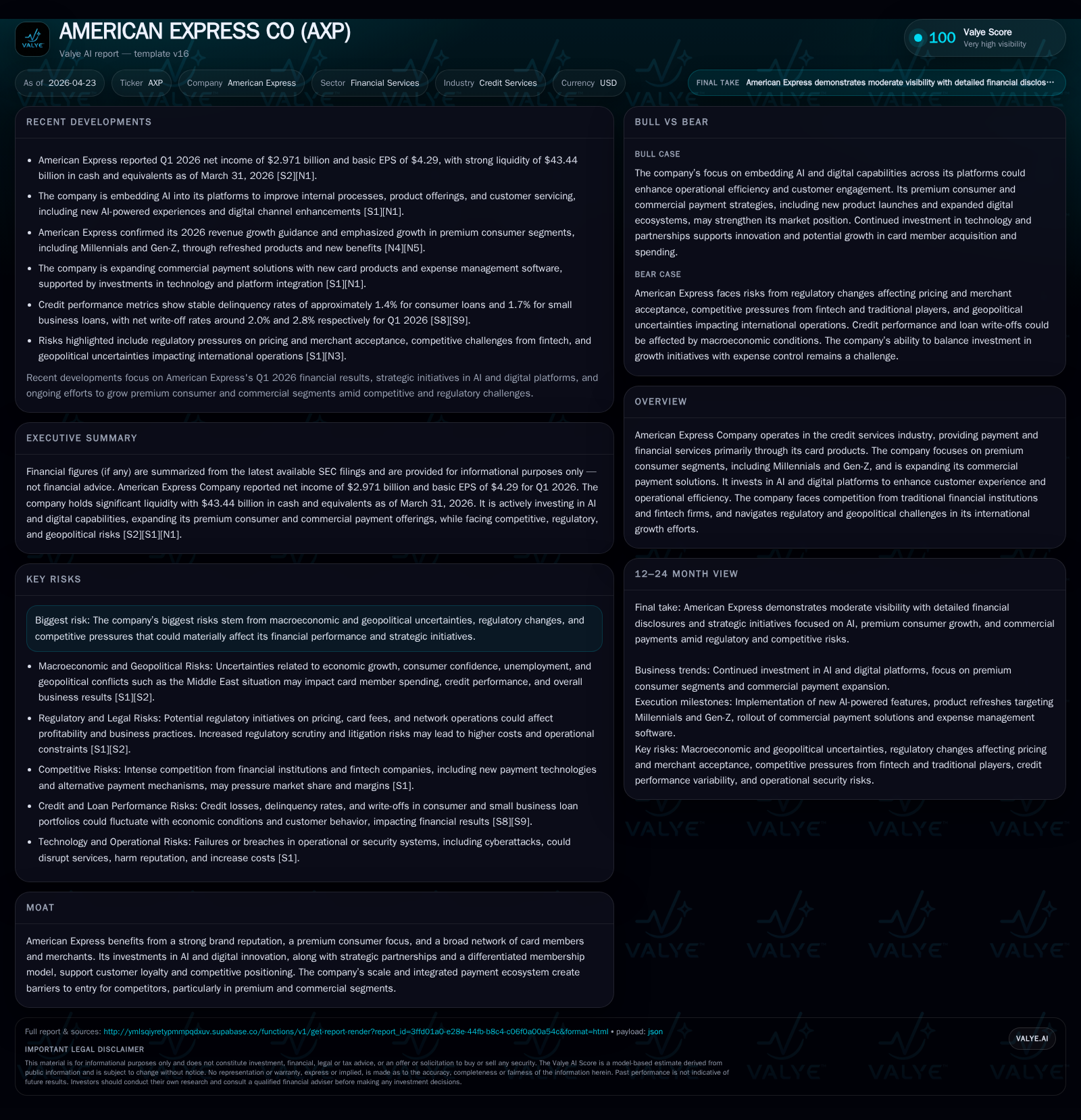
American Express reported strong first-quarter performance in 2026 with notable card member spending growth, particularly in premium segments and among Millennials and Gen-Z cohorts. The company is accelerating its investment in AI and digital platforms to enhance customer experience and operational efficiency, while expanding commercial payment solutions including new product launches. Regulatory challenges, competitive pressures from fintechs and traditional banks, and geopolitical uncertainties represent headwinds that could impact future growth trajectories. Continued focus on premium membership value propositions and international market adaptations will be critical milestones to monitor.
Recent Operating Update
American Express's Q1 2026 filing [S2] revealed continued momentum in core business metrics that reinforce its premium positioning. The company reported its highest card member spending growth rate in three years [N10], driven by sustained demand from both consumer and commercial segments. This acceleration is supported by the rollout of new commercial products such as the Graphite Business Cash Unlimited Card and plans for a Corporate Cash Back Card [S12]. These innovations align with expanding the company’s addressable market beyond traditional consumer credit cards into comprehensive business payment ecosystems.
Concurrently, Amex is deepening investments in artificial intelligence technologies to personalize offers, automate internal workflows, and embed payments into emerging agentic commerce platforms like its Agentic Commerce Experiences™ developer kit [S12,S9]. This emphasis on digital transformation aims to differentiate the brand experience during a fiercely competitive landscape.
The recent 8-K [S3] cautioned about potential volatility in the effective tax rate influenced by global minimum tax implementations and geographic income mix changes. There are also ongoing regulatory pressures related to merchant fees, acceptance policies, surcharging practices, and network rules that could materially affect profitability [S4,S5]. Brand perception issues tied to these dynamics and intensified competition were noted as key reputational risks affecting market standing [S8,S7].
Business Model Analysis
American Express operates primarily as a global payments company focused on credit card issuance, network services, travel-related offerings, and business-to-business payments. It generates revenue through multiple streams: merchant discount fees collected from network transactions; interest income from revolving cardholder balances; annual fees from premium card memberships; and fees for ancillary services like travel bookings and expense management tools [S1,S12].
Distinctively, Amex targets a premium consumer demographic characterized by affluent Millennials and Gen-Z customers with higher spending capacity and loyalty propensity. Its Membership Model creates switching-cost dynamics through rewards programs, exclusive access benefits (lounges, dining experiences), and co-brand partnerships that cultivate long-term engagement [S1,S7].
The company also operates an integrated payment ecosystem that combines issuer-issued cards with proprietary network infrastructure. This structure facilitates tighter control over transaction economics than open-loop networks that solely rely on interchange fees paid by merchants.
In the commercial segment, Amex is strategically expanding offerings beyond traditional corporate cards into broader payment solutions incorporating cash flow management, expense tracking software scheduled for release in 2026, and multi-product digital integration [S12]. This broadening product suite aims to capture more touchpoints within client organizations thereby increasing wallet share.
However, growth execution requires balancing hefty investments in AI capabilities alongside managing credit risk exposure amid varying macro conditions. The firm’s approach integrates underwriting innovation to sustain lending quality while growing net interest income [S13].
Industry Structure and Competitive Position
The credit services industry sits at the intersection of financial services technology innovation, regulatory oversight, and shifting consumer behaviors. American Express occupies a unique niche with its vertically integrated model focused on premium users rather than competing primarily on volume via mass-market cards typical of Visa or Mastercard issuers.
Competitive dynamics are complex: large banks maintain scale economies in lending operations while fintech firms introduce disruptive digital wallets, alternative payment schemes (cryptocurrencies), and seamless API integrations appealing particularly to younger consumers who prioritize convenience. Moreover, regulatory initiatives targeting merchant fees (interchange caps), pricing transparency, surcharging bans or steering rules threaten traditional revenue levers [S5,S7].
Amex’s moat derives from its brand strength recognized globally for premium service quality combined with a curated rewards ecosystem difficult for new entrants to replicate quickly. Strategic partnerships enhance merchant acceptance breadth despite some resistance linked to higher transaction costs embedded in Amex’s pricing model.
Technological agility is now a salient competitive factor — American Express appears ahead in integrating generative AI tools leveraging proprietary data sets for personalized marketing offers and fraud detection frameworks. However, sustaining leadership mandates continuous reinvention given rapid fintech innovation cycles.
Internationally, Amex faces sizeable barriers including local regulator mandates impacting fee structures or network access alongside competitors with entrenched domestic relationships [S12,S14]. Geopolitical instability further complicates cross-border acceptance expansion strategies [N11].
Growth Drivers and Constraints
Growth Drivers:
- Premium Consumer Spend: Elevated card member spend from Millennials & Gen-Z groups fueled by tailored value propositions drives top-line revenue growth.
- Commercial Payments Expansion: Launching versatile corporate products plus B2B expense management solutions opens higher-margin revenue streams.
- Technology Investment: Deploying AI-powered personalization enhances member engagement resulting in greater wallet share capture.
- Brand & Partnership Strength: Exclusive benefits tied to dining/lifestyle experiences strengthen loyalty amidst competitive alternatives.
- Global Network Scale: Leveraging scale advantages helps negotiate favorable merchant contracts reinforcing product desirability.
Constraints:
- Regulatory Pressure: Heightened scrutiny over interchange fees, card interest rate caps or surcharging limitations may compress margins.
- Competitive Intensity: Fintech disruptors erode market share through innovative payment options challenging conventional card usage.
- Macroeconomic Volatility: Economic slowdowns or geopolitical conflicts risk reduced consumer/business spending impacting volume-linked revenues.
- Cost Inflation: Rising expenses related to technology deployments (cloud infrastructure), compliance requirements & talent acquisition temper operating leverage potentials.
- International Complexity: Diverse regional regulations require product localization adding operational complexity slowing scalable rollout.
What to Watch Next
Several key milestones will serve as indicators of American Express's ability to navigate its multifaceted environment:
- Execution progress on newly introduced commercial cards including adoption rates among SMBs versus larger enterprises.
- Development velocity of AI enhancements impacting both client-facing experiences (personalized offers) and backend efficiencies (fraud prevention).
- Responses to evolving regulatory guidance particularly around interchange fee structures across core markets like U.S., Europe and Asia-Pacific.
- International market penetration pace against localized competition especially amid geopolitical tensions influencing cross-border trade & travel flows.
- Credit portfolio performance metrics including delinquency trends amidst changing economic forecasts extending into late 2026.
- Cost discipline versus investment balance reflected in quarterly operating margins providing insight into scaling sustainability.
Financial Profile Summary
American Express demonstrated solid financial results across recent years evidencing strong profitability supported by high incremental margins on growing transaction volumes:
Historical performance (annual)
| FY | Net ($bn) | CFO ($bn) | Capex ($bn) | Net YoY |
|---|---|---|---|---|
| 2025 | 10.8 | 18.4 | 2.4 | +7.0% |
| 2024 | 10.1 | 14.1 | 1.9 | +21.0% |
| 2023 | 8.4 | 18.6 | 1.6 | +11.4% |
| 2022 | 7.5 | 21.1 | 1.9 |
Source: SEC companyfacts cache [F1].
Capital returns and efficiency (annual)
| FY | Div ($bn) | Buybacks ($bn) | FCF ($bn) |
|---|---|---|---|
| 2025 | 2.3 | 5.8 | 16.0 |
| 2024 | 2.0 | 6.0 | 12.1 |
| 2023 | 1.8 | 3.6 | 17.0 |
| 2022 | 1.6 | 3.5 | 19.2 |
Source: SEC companyfacts cache [F1].
Free cash flow recovered nicely after navigating past cyclical pressures (approx $16bn FY25) enabling consistent capital returns policy encompassing dividend hikes alongside share repurchases supporting shareholder value [F1]. Credit losses remain well managed with low annualized default rates (~1.2%) maintained through conservative underwriting amid macro uncertainties [S16,S20].
Conclusion
American Express continues leveraging its differentiated Membership Model supplemented by intensified innovation investments particularly in AI-driven personalization to defend leadership within premium consumer credit services while expanding its reach into commercial payment domains. The company’s vertically integrated approach creates resilient network effects that are not easily replicated even as the competitive environment tightens through fintech disruption and regulatory reforms impose new constraints on traditional revenue pools.
Yet headwinds persist from geopolitical instability affecting international operations along with evolving compliance demands requiring nimble strategic adjustments. Monitoring early indicators from Q2 onward — including product adoption metrics for new commercial offerings coupled with response effectiveness to regulatory developments — will be critical barometers of sustained execution success going forward.
Disclaimer: This analysis is for informational purposes only and does not constitute investment advice or recommendations.
Disclaimer: This is research-only, informational analysis and not investment advice. It may include AI-generated interpretation and general industry context. Always verify important details using primary sources.

Comments