
AMREP CORP.’s Turnaround in Profitability and Capital Discipline
AMREP CORP. demonstrates significant profitability gains despite steep revenue declines through operational integration and prudent capital management.
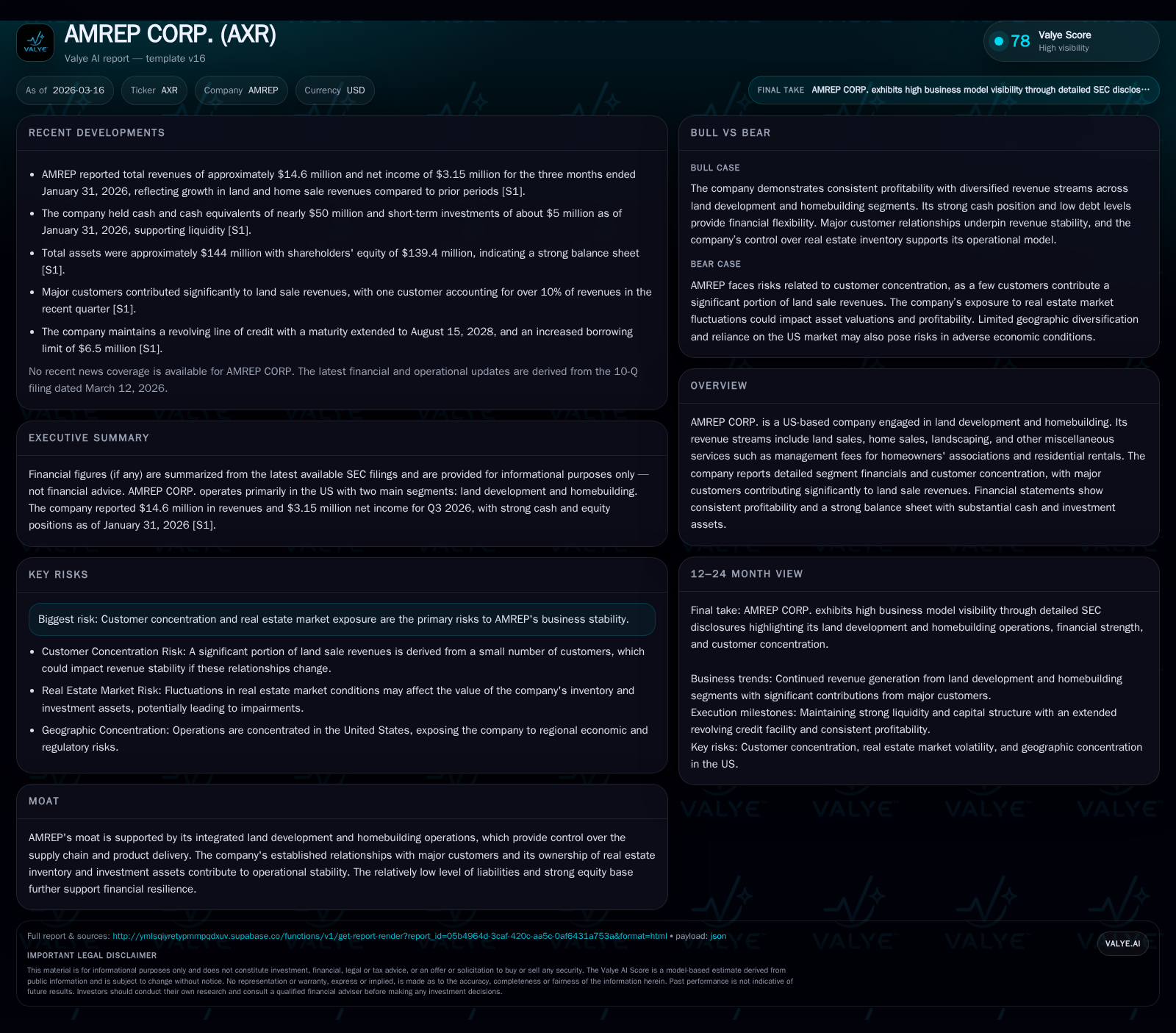
AMREP CORP. experienced a sharp contraction in revenue from over $42 million in FY2018 to just $12.8 million in FY2019, yet has remarkably increased operating income to $12.1 million by FY2025. This turnaround reflects tight cost controls, margin improvements across land development and homebuilding segments, and a strategic focus on integrated operations managing land inventory and homebuilding supply chains. While major customer concentration poses risks, the company’s conservative debt profile, robust cash reserves, and disciplined capital expenditures underpin financial resilience. Future growth will hinge on market conditions affecting land absorption rates and diversification of its revenue base.
From Revenue Volatility to Income Recovery: Tracing AMREP’s Historical Performance
AMREP CORP.’s financial trajectory over recent years presents a compelling study in operational leverage amid industry cyclicality. The company’s reported revenue crashed from $42.4 million in fiscal 2017 to approximately $12.8 million by fiscal 2019 [F1]. This precipitous decline—about 68%—might typically threaten sustainable profitability; however, AMREP’s subsequent years reveal an inverse trend with operating income rising steadily to $12.1 million by fiscal 2025 despite subdued revenues (latest revenue data post-2019 not explicitly reported) [F1].
This reversal can be primarily attributed to rigorous cost control measures, efficient absorption of fixed costs across its integrated segments, and margin improvements linked to optimizing land development sales mix and homebuilding operations [F1]. Net income’s nearly 90% increase to $12.7 million in FY2025 exemplifies how AMREP extracted greater profitability from leaner top-line figures—underscoring operational leverage potential within real estate development economics.
Historical performance (annual)
| FY | Net ($mm) | CFO ($mm) | OpInc ($mm) | Capex ($) | Net YoY |
|---|---|---|---|---|---|
| 2025 | 13 | 10 | 12 | 583000 | +90.1% |
| 2024 | 7 | 11 | 8 | 457000 | -69.3% |
| 2023 | 22 | 6 | 6 | 131000 | +37.4% |
| 2022 | 16 | 15 | 21 | 1287000 |
Source: SEC companyfacts cache [F1].
Capital returns and efficiency (annual)
| FY | Buybacks ($mm) | FCF ($mm) | ROE% |
|---|---|---|---|
| 2025 | 10 | 9.8 | |
| 2024 | 10 | 5.7 | |
| 2023 | 0 | 6 | 19.6 |
| 2022 | 22 | 14 | 19.1 |
Source: SEC companyfacts cache [F1].
Note: Revenue figures after FY2019 are not provided explicitly; operating income and net income are annual totals from [F1].
Integrated Operations Fueling Stability: Land Development Meets Homebuilding
AMREP’s dual-segment structure encompassing both land development and homebuilding provides intrinsic synergy that mitigates market volatility risks characteristic of each standalone business line [S5],[S7]. By internally controlling substantial portions of the supply chain—from raw land acquisition through landscaping services to finished homes—the company manages absorption rates effectively across inventory channels such as undeveloped lots and homes under construction or completed [S14],[S16].
This vertical integration ensures smoother pull-through between segmented demand swings: slower lot sales may be partially offset by steady homebuilding backlog execution or vice versa [S20],[S21]. AMREP also diversifies into ancillary revenues including homeowners' association management fees and residential rentals reported under miscellaneous services, further stabilizing cash flow streams [S5],[S7].
Inventory segmentation highlights include substantial land inventory ($56 million mid-2025) complemented by homebuilding model and construction inventory ($12 million), providing significant working capital coverage for ongoing sales cycles [S17],[S26],[S27]. Operational synergies reduce transaction costs and enable better timing on sales recognition reflective of the sector's typical long-cycle development timeline.
Customer Concentration: Strategic Relationships as Both Moat and Risk
A defining trait of AMREP is reliance on a limited number of major customers who comprise a majority share of land sale revenues [S5],[S7],[S16]. Recent reports indicate one customer contributing over $6 million in revenue within a three-month period—reflecting trusted buyer relationships but also high dependency levels.
This concentration offers benefits such as predictable payment streams fostering efficient working capital management typical in development deals with escrowed deposits and contract extensions [S14],[S16]. However, it heightens vulnerability to demand fluctuations among these buyers or changes in their strategic intentions—risks exacerbated by regional housing market dynamics or regulatory shifts impacting residential absorption rates.
Limited receivables exposure suggests effective credit controls but does not eliminate the inherent risk linked to buyer portfolio concentration—a common challenge in microcap real estate markets.
Future Prospects and Market Constraints: Indicators to Monitor
Forward-looking commentary within recent SEC filings emphasizes cautious optimism centered on ongoing contract negotiations for lot sales alongside steady but competitive homebuilding market conditions [N1],[S2],[S3],[S5]. Growth prospects are tied to geographic expansion abilities—currently domestic-only—and product mix enhancements leveraging existing HOA management platforms.
Potential headwinds include macroeconomic factors constraining homebuyer affordability (interest rate trends impacting mortgage costs), incremental costs from skilled labor or materials inflating homebuilding expenses, and variability in land absorption rates [S20],[S21]. Pipeline risks inherent in long lead times for subdivision completions remain relevant for meeting recognized backlog targets.
Key indicators include new contract volume announcements per quarter, changes in pipeline inventory turnover velocity adjacent to local home price appreciation trends, capex spend shifts signaling expansion intent or conservatism, and broadening service revenues beyond core segments.
Capital Allocation and Financial Returns: Conservative Debt, Robust Cash, and Payouts
AMREP exhibits conservative financial stewardship evidenced by cash & liquid investments exceeding $49 million as of early 2026 against modest secured debt balances around $1.7 million drawn under revolving facilities at favorable interest rates near ~6.8% [S4,S6,S8,S22,F1]. This low leverage profile offers balance sheet flexibility crucial within the cyclical real estate environment.
Annual capital expenditures remain controlled at roughly half a million dollars ($583K FY2025), suggesting priority toward maintenance & selective reinvestments rather than aggressive expansion [F1],[S19],[S21],[S29]. Operating cash flows have remained resilient (~$10 million plus annually), supporting near $9.7 million free cash flow after capex—a healthy cushion enabling dividends restitution while suspending buybacks since FY2023 [F1].
The company’s return on equity approximates a moderate ~9.8%, aligning with its low leverage approach combined with stable net income generation under the current business model [F1]. Capital allocation prioritizes balance preservation alongside shareholder distributions without excessive risk exposure.
What to Watch Next: Catalysts for Growth or Signs of Headwinds
From an analytical perspective, monitoring quarterly shifts in major customer purchase volumes is essential given their outsized influence on revenue spikes or troughs [S16,S23]. New land sales agreements or extensions within the backlog provide actionable insights into medium-term income stability.
Equally important are metrics around landscaping service growth tied closely with HOA fee management expansions; these recurring revenues serve as subtle hedges against construction cycle fluctuations [S5,S7,S14]. Adjustments in capex spending patterns could also signal directional changes reflecting management’s confidence regarding new community developments or homebuilding scale.
Finally, vigilance around evolving regional housing affordability measures is prudent as they directly affect demand elasticity for AMREP’s residential products amid cyclical market pressures.
This analysis is grounded strictly on available financial disclosures ([F1]) and regulatory filings ([S#]) without speculative forecasts or investment recommendations.
Disclaimer: This is research-only, informational analysis and not investment advice. It may include AI-generated interpretation and general industry context. Always verify important details using primary sources.

Comments