
Axalta Coating Systems Faces Margin Pressure Amid Industry Cyclicality and Raw Material Volatility
Recent quarterly results highlight Axalta’s resilience in revenue growth but reveal margin compression attributed to cost inflation and automotive market softness.
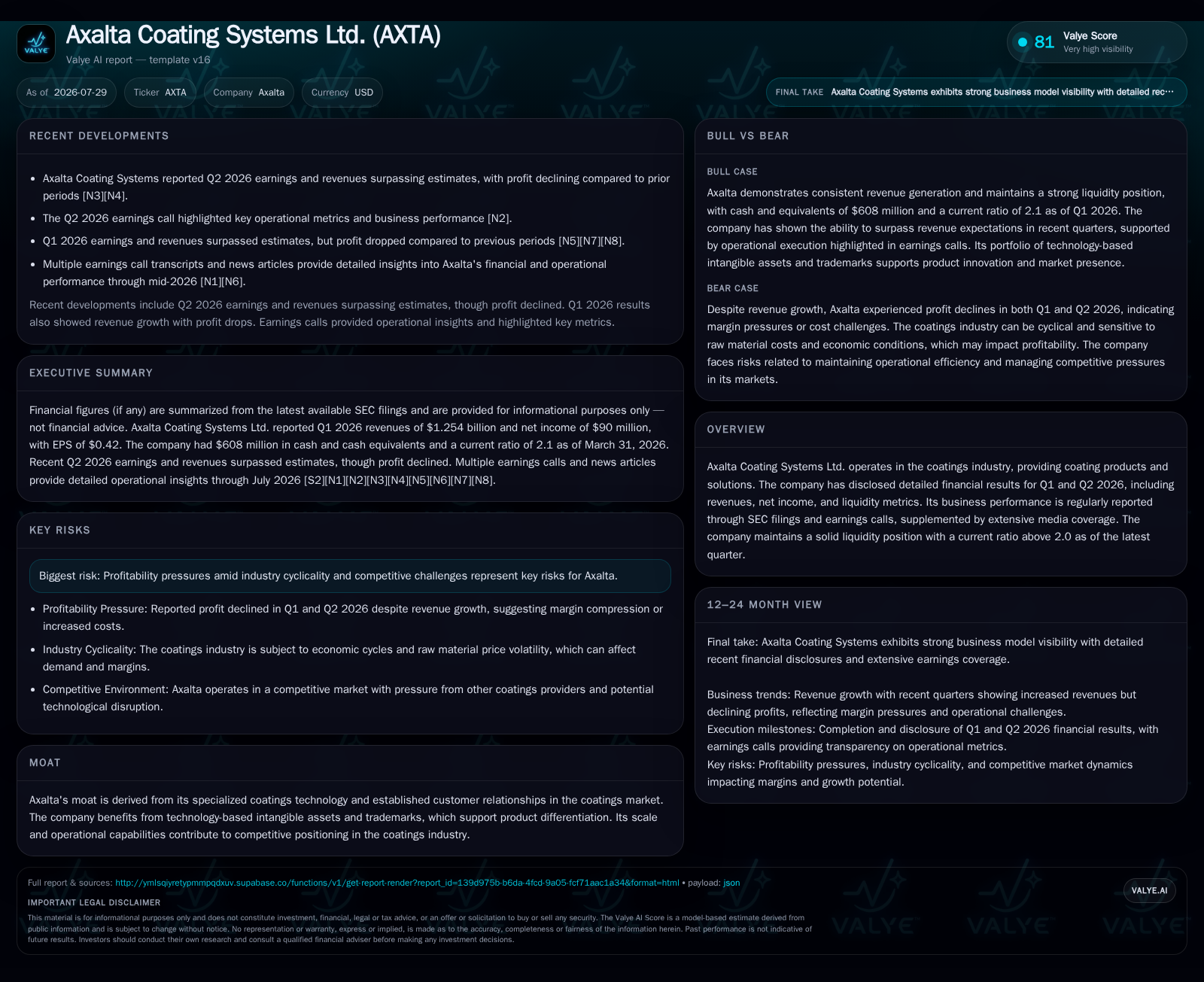
In Q2 2026, Axalta Coating Systems reported revenue growth driven by volume gains and product mix improvements, surpassing analyst estimates. However, profitability showed signs of pressure due to elevated raw material costs and subdued demand in key automotive segments. The company’s business model, centered on specialized liquid and powder coatings for automotive OEMs and industrial customers, benefits from its technology moat and technical service capabilities but remains exposed to cyclicality and input cost volatility. Going forward, Axalta’s ability to manage raw material sourcing, maintain product differentiation through innovation, and navigate environmental compliance will be critical amid industry headwinds. Financially, the company maintains solid liquidity with a current ratio above 2.0 and a manageable leverage profile despite recent debt repayments.
Recent Operating Update: Q2 2026 Results Reflect Revenue Growth Amid Margin Pressure
Axalta Coating Systems Ltd. reported second-quarter 2026 results on July 29, 2026, highlighting continued revenue growth driven by volume increases and favorable product mix shifts, particularly within its automotive refinish and industrial coatings segments [S2][N3]. The company’s revenue outpaced analyst expectations, supported by higher sales volumes of both liquid and powder coatings, reflecting sustained demand in select end markets despite broader cyclicality. However, gross margins contracted due to significant raw material cost inflation—primarily from petrochemical feedstocks—and elevated supply chain and logistics expenses, which partially offset operational efficiencies realized during the quarter [S2][N2]. This margin compression underscores the ongoing challenge of balancing input cost volatility with pricing power in a competitive coatings market.
Demand softness in automotive OEM coatings was notable, driven by production slowdowns at key OEM customers and inventory adjustments at automotive refinish repair shops, which dampened coatings consumption volumes in certain regions [S2]. These dynamics reflect the cyclical nature of Axalta’s core markets, where automotive production rates and aftermarket activity directly influence volume trends. Conversely, growth in industrial coatings, including powder coatings used in infrastructure and manufacturing applications, provided some offset, benefiting from ongoing infrastructure investments and industrial production in select geographies.
Business Model and Revenue Drivers: Specialty Coatings with Technical Service Integration
Axalta operates as a specialty chemicals company focused on the formulation, manufacture, and sale of advanced liquid and powder coatings. Its product portfolio includes automotive OEM coatings, automotive refinish coatings, and industrial coatings, with powder coatings favored for their environmental benefits such as low volatile organic compound (VOC) emissions [S1]. The company generates revenue primarily through product sales to automotive OEMs, commercial refinish shops, industrial manufacturers, and distributors. Pricing is influenced by raw material cost pass-through mechanisms, product mix, and geographic market conditions.
A key competitive advantage lies in Axalta’s proprietary formulation chemistry and curing processes, which deliver coatings with superior durability, gloss retention, and color consistency—attributes highly valued by automotive OEMs and refinish customers [S1]. The company complements its product sales with technical service offerings, including advanced color matching technologies and application process support, which enhance customer retention and provide differentiation in a commoditized market.
Revenue growth is driven by volume sold (measured in liters or tons), average selling price (ASP) adjustments reflecting raw material inflation and pricing strategies, and product mix shifts toward premium, low-VOC, and eco-friendly coatings that meet tightening environmental regulations [S2]. Operating margins depend on raw material sourcing efficiency, manufacturing capacity utilization, and supply chain management effectiveness. Given the global volatility in petrochemical feedstocks, securing stable raw material supply at competitive costs remains a critical operational focus
Industry Landscape and Competitive Positioning
The specialty coatings industry is characterized by intense competition among global players such as PPG Industries, Sherwin-Williams, AkzoNobel, RPM International, and BASF Coatings. Axalta’s competitive positioning is anchored in its strong presence in automotive refinish coatings and industrial powder coatings, leveraging scale and technical expertise to maintain moderate manufacturing leverage. However, like its peers, Axalta faces margin sensitivity to raw material price fluctuations and cyclical demand patterns tied to automotive and industrial production cycles.
Environmental compliance is a significant industry driver, with increasingly stringent VOC regulations necessitating continuous R&D investment to develop low-emission coatings without compromising performance. Axalta’s ongoing commitment to innovation in eco-friendly formulations supports its product differentiation but also entails elevated fixed costs that can pressure near-term profitability [S1].
Customer procurement behavior emphasizes quality differentiation, particularly in color accuracy supported by proprietary software-enabled color matching systems, and reliable just-in-time delivery aligned with OEM assembly schedules. These factors reinforce the importance of technical service capabilities and supply chain reliability in maintaining customer relationships.
Growth Drivers and Strategic Opportunities
Several structural factors underpin Axalta’s medium-term growth prospects:
- Increasing adoption of eco-friendly liquid coatings driven by global emissions standards is prompting upgrades to legacy formulations.
- Expansion in emerging markets, where rising automotive production and industrial infrastructure investments fuel demand for durable powder coatings.
- Growth in the automotive refinish segment, supported by an aging vehicle fleet and steady aftermarket repair activity.
- Technological advancements, including multi-layer coating systems, enable premium product offerings with higher average selling prices.
- Potential strategic acquisitions to broaden product portfolio or geographic reach, although recent disclosures focus primarily on ongoing merger-related activities without immediate operational disruption [S3]
Risks and Operational Challenges
Axalta’s operating environment involves several risks and watchpoints:
- Cyclicality in automotive OEM and industrial end markets can lead to volatile volume and revenue trends.
- Raw material price volatility, especially in petrochemical derivatives, continues to pressure gross margins despite efforts to pass through costs to customers.
- Supply chain disruptions and logistics cost inflation may increase working capital requirements and impact delivery performance.
- Regulatory risks related to VOC emissions and environmental compliance require sustained R&D investment; failure to innovate could erode competitive positioning.
- Ongoing litigation and governance considerations linked to merger activities may divert management focus, though filings indicate proactive management of these issues [S3].
- Foreign exchange fluctuations due to the company’s global footprint can affect reported earnings and cost structures.
Key Performance Indicators and Monitoring Points
Market participants and analysts should monitor several quantitative KPIs to assess Axalta’s operating trajectory:
- Volume shipped by segment (automotive OEM, automotive refinish, industrial coatings) to gauge demand trends.
- Average selling price trends adjusted for geographic and product mix changes, reflecting pricing power and raw material pass-through.
- Order backlog and order intake levels as indicators of near-term demand health.
- R&D expenditure as a percentage of sales to track innovation investment and pipeline vitality.
- On-time delivery rates and inventory turnover metrics to evaluate supply chain efficiency.
- Gross and operating margin trends to assess cost control effectiveness amid raw material inflation.
Upcoming quarterly earnings releases will provide further clarity on macro demand conditions, pricing strategies, and progress on eco-friendly product introductions or capacity expansion initiatives.
Financial Position and Capital Structure
As of March 31, 2026, Axalta reported cash and cash equivalents of $608 million against total debt of approximately $3.17 billion, resulting in net debt of about $2.56 billion [F1][S2]. The company’s current ratio stood at 2.1x, calculated from current assets of approximately $2.83 billion and current liabilities near $1.35 billion, indicating solid liquidity to support working capital needs and operational flexibility [F1].
Capital expenditures are balanced between sustaining manufacturing capacity utilization—critical for meeting volume growth—and funding R&D initiatives essential for regulatory compliance and product differentiation [S1][S2]
This article synthesizes publicly available information as of July 29, 2026, aiming to provide an analytical overview without investment research views or forecasts.
Disclaimer: This is research-only, informational analysis and not investment advice. It may include AI-generated interpretation and general industry context. Always verify important details using primary sources.

Comments