
Vulcan Materials Strengthens Aggregates Leadership with Margin Expansion and Strategic Positioning
Vulcan Materials Company reported robust Q2 2026 results underpinned by strong aggregates demand and disciplined operating execution.
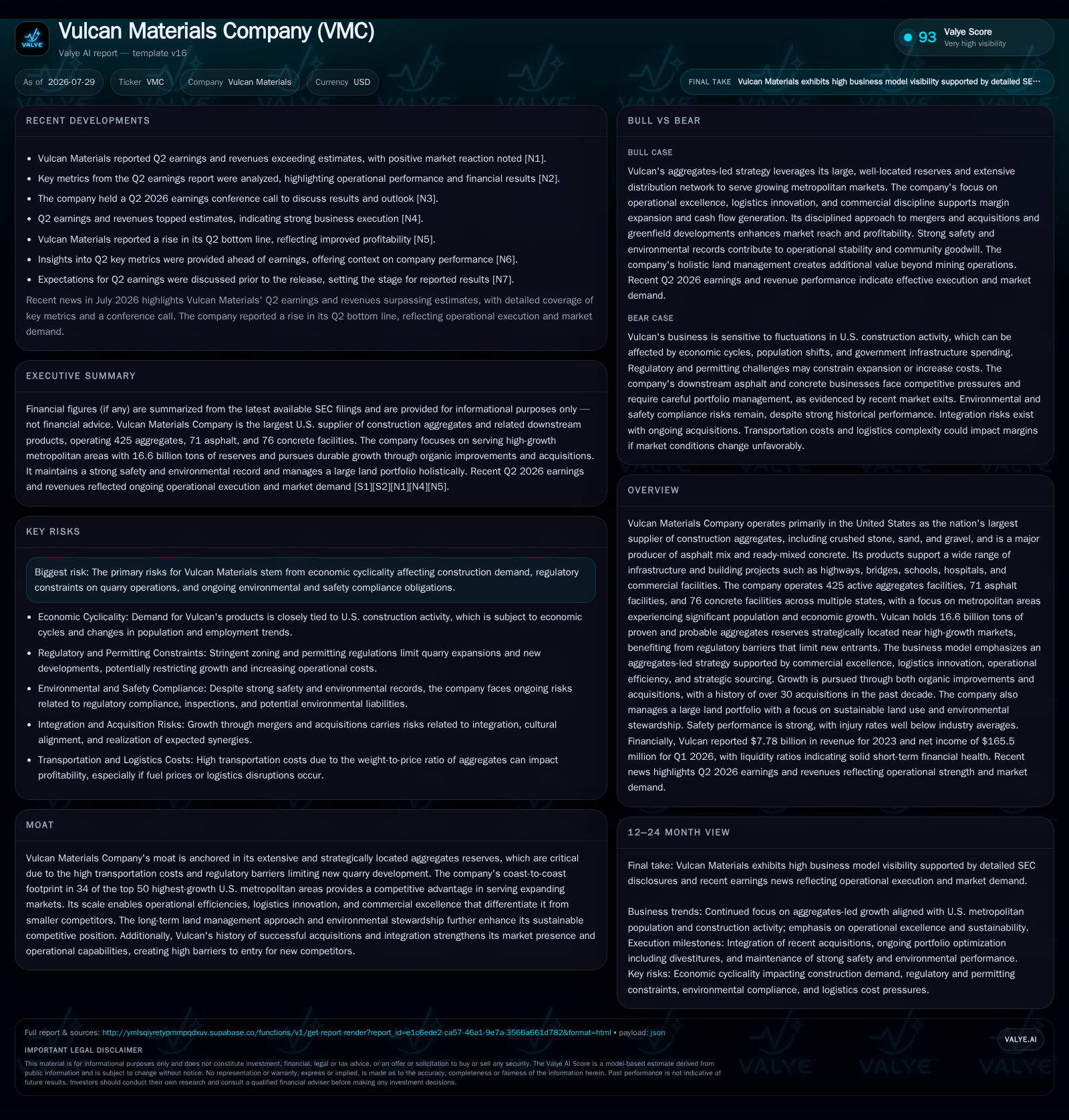
In Q2 2026, Vulcan Materials Company advanced its aggregates-led strategy with rising shipments, improved pricing, and margin expansion despite ongoing macroeconomic uncertainties. The company’s extensive reserves near high-growth metropolitan areas combined with operational and commercial excellence continue to undergird durable earnings growth. While industry cyclicality and regulatory constraints remain risks, Vulcan’s coastal-to-coast footprint and logistics innovation differentiate it in a fragmented market. Vigilant capital deployment towards maintenance, growth projects, and selective acquisitions positions Vulcan well to capitalize on sustained infrastructure spending and urbanization trends.
Recent Operating Update
Vulcan Materials Company reported second-quarter 2026 financial results with revenues and earnings surpassing analyst expectations, driven by sustained strength in aggregates demand and disciplined operational execution [S2][S3][N1]. Total shipments of construction aggregates increased modestly year-over-year, supported by steady public infrastructure spending under federal programs such as the IIJA and improving private nonresidential construction activity [S17]. Management emphasized that freight-adjusted pricing gains effectively offset inflationary pressures on input costs, including labor, enabling expansion of gross margins across both aggregates and downstream asphalt and concrete segments [S2].
The aggregates segment, which remains the core profit engine, benefited from a freight-adjusted sales price per ton increase that helped drive revenue growth despite competitive market dynamics [S2]. This pricing power, combined with operational efficiencies, contributed to margin expansion and improved unit profitability metrics.
Business Model Overview
Vulcan Materials operates as the largest U.S. supplier of construction aggregates—primarily crushed stone, sand, and gravel—alongside vertically integrated downstream operations producing asphalt mix and ready-mixed concrete in select high-growth metropolitan markets [S1][S16]. The company generates revenue principally by selling physical tons of aggregates to construction contractors and public infrastructure agencies engaged in building and maintaining roads, bridges, airports, water systems, and commercial and residential structures.
Revenue is driven by two key operating variables: total aggregate shipments (measured in tons) and freight-adjusted sales price per ton [S1][S16]. The freight adjustment accounts for delivery distance, a critical factor given that transportation costs often match or exceed raw material costs in this sector. This pricing mechanism reflects the importance of proximity to end markets and logistics efficiency in maintaining competitive unit economics
Aggregate shipment volumes are cyclical but supported by structural growth drivers including population expansion, urbanization, and sustained federal infrastructure funding programs [S1][S17]. Vulcan’s downstream asphalt and concrete segments complement the aggregates business by utilizing internally sourced materials at market prices, capturing additional margin layers and offering integrated solutions to customers [S12].
The company’s commercial strategy emphasizes localized customer engagement tailored to each market’s unique characteristics, leveraging its coast-to-coast footprint of over 425 active aggregate facilities and more than 140 asphalt and concrete plants concentrated in states such as California, Texas, Georgia, Tennessee, Virginia, and Florida. These top ten states accounted for approximately 90% of Vulcan’s 2025 revenues, underscoring the strategic focus on high-growth regions [S16]
Operationally, Vulcan capitalizes on its substantial reserve base of 16.6 billion tons of proven and probable aggregates positioned near rapidly expanding urban centers [S16]. This reserve positioning creates significant barriers to entry due to stringent zoning and permitting restrictions that limit new quarry development, thereby supporting premium freight-adjusted pricing and protecting long-term supply
Industry Structure and Competitive Position
The U.S. construction aggregates industry is highly fragmented, featuring numerous small independent producers alongside a select group of large integrated companies such as Vulcan Materials, Martin Marietta Materials, CRH plc, LafargeHolcim, and Granite Construction [S7]. Vulcan’s specialization in aggregates, complemented by selective downstream asphalt and concrete operations, differentiates it from peers with broader cement or international focuses.
Vulcan is estimated to hold approximately a 10% share of total U.S. aggregates production, making it the largest single player in a fragmented market [S7][S23]. This fragmentation presents ongoing opportunities for consolidation through acquisitions or greenfield developments. However, expansion is tempered by regulatory and environmental constraints, particularly land use permitting challenges that restrict quarry openings and preserve the value of existing reserves.
The company’s coast-to-coast geographic footprint covers 34 of the top 50 highest-growth metropolitan statistical areas projected over the next decade, positioning Vulcan to capture demographic-driven demand where infrastructure investments are concentrated [S16]. This strategic reach, combined with industry-leading unit profitability metrics—gross profit per ton of $8.66 and cash gross profit per ton of $11.33 in fiscal 2025—reflects operational excellence and pricing power [S1][S6].
Growth Drivers
Vulcan’s growth is underpinned by several key vectors:
- Public Infrastructure Spending: Multi-year federal programs like the IIJA provide sustained demand for aggregates and asphalt mix in highway, bridge, and public transportation projects.
- Private Nonresidential Construction: Economic expansion supports industrial, commercial, and institutional building activity, driving downstream product consumption.
- Urbanization and Population Growth: Rising housing formation rates and urban development fuel aggregate shipments indirectly through increased construction.
- Strategic Acquisitions and Greenfield Development: Targeted acquisitions in high-growth metropolitan markets and proactive greenfield quarry development address permit scarcity and support long-term supply.
- Logistics Innovation: Advanced logistics systems enhance delivery efficiency, reduce costs, and improve customer service, strengthening pricing power.
- Land Management and Environmental Stewardship: Effective land use planning, including pre-mining agricultural uses and post-mining reclamation, supports regulatory compliance and community relations.
Management’s 2026 outlook anticipates shipment volume growth between 1% and 3%, freight-adjusted price increases of 4% to 6%, and low-single-digit inflation in freight-adjusted unit cash costs, collectively driving further margin expansion [S17]. Capital expenditures are planned between $750 million and $800 million, balancing maintenance with selective growth investments to capitalize on demand durability.
Risks and Watchpoints
Several risks could materially impact Vulcan’s operating performance:
- Cyclicality: Aggregate demand closely follows construction cycles, making Vulcan vulnerable to economic downturns or abrupt changes in government infrastructure appropriations.
- Regulatory Constraints: Environmental regulations and land use permitting impose capital requirements and limit access to new reserves, increasing reliance on existing quarries.
- Labor Market Tightness: Shortages of skilled operators or labor disputes could disrupt production schedules and increase costs.
- Substitution Risk: Growing use of recycled concrete and asphalt substitutes may reduce demand in certain markets, particularly where local producers promote alternatives.
- Geopolitical and International Exposure: Operations in Mexico and Honduras face risks from regulatory actions and political developments, including recent shutdowns affecting quarrying activities [S8].
- Commodity Price Volatility: Fluctuations in fuel prices significantly affect haulage costs; inability to fully pass through these costs could compress margins [S11].
Monitoring federal and state infrastructure budget approvals, regional permitting developments, and unit profitability metrics such as gross profit per ton will be critical to assessing near-term volume and margin trends.
What to Watch Next
Key indicators to monitor include:
- Quarterly aggregate shipment volumes relative to prior periods, signaling demand momentum.
- Progress in freight-adjusted pricing reflecting commercial discipline amid inflationary pressures.
- Capital expenditure effectiveness measured by returns on invested capital (recently 15.7%), indicating growth investment quality.
- Regulatory permitting outcomes influencing capacity expansions and quarry life.
- Execution of portfolio optimization initiatives, such as divestitures of non-core assets.
- Updates on international legal proceedings, particularly regarding Mexican quarry operations.
- Operational metrics like capacity utilization rates at quarries and plants, revealing efficiency gains or bottlenecks.
Financial Profile Discussion
Operational cash flow generation aligns with reported increases in adjusted EBITDA, which grew 13% in fiscal 2025, driven by volume and price gains alongside disciplined cost control and strategic sourcing initiatives that have reduced procurement expenses [S6][S5]
Disclaimer: This analysis is based solely on publicly available information including recent SEC filings and industry context. It does not constitute investment advice or research views.
Disclaimer: This is research-only, informational analysis and not investment advice. It may include AI-generated interpretation and general industry context. Always verify important details using primary sources.

Comments