
V.F. Corp Struggles with Active Segment Declines Despite Outdoor Growth and Margin Gains
VF Corporation's latest quarter reveals mixed performance as its Outdoor brands advance while Active segment faces revenue pressures amid strategic shifts.
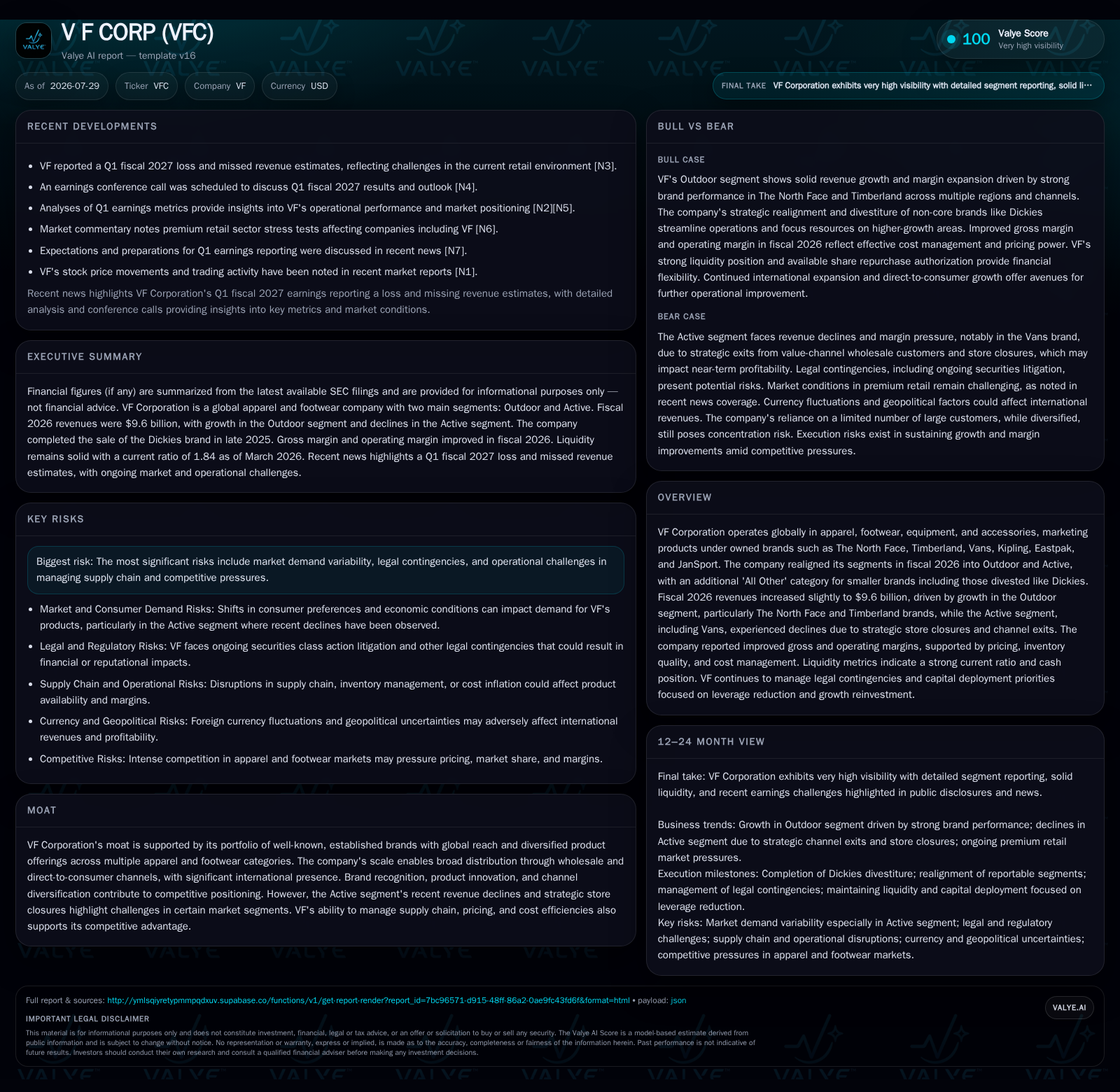
VF Corporation posted a challenging start to Fiscal 2027 with first-quarter revenue declines driven primarily by its Active segment, including Vans, offset partially by growth in the Outdoor division led by The North Face and Timberland. The company’s strategic realignment toward Outdoor-focused brands is reflected in segment performance and operating efficiency gains, but ongoing store closures and channel exits in Active signal structural headwinds. Gross margin improvements from pricing and inventory mix helped stabilize profitability amidst foreign currency benefits. Capital allocation priorities emphasize deleveraging and reinvestment to support sustainable growth, while legal contingencies and supply chain risks remain watchpoints.
Recent Operating Update: First Quarter Fiscal 2027 Performance Highlights
VF Corporation reported a mixed start to Fiscal 2027, with consolidated revenues pressured primarily by declines in its Active segment, while the Outdoor segment sustained positive momentum. The Active segment, which includes Vans and other activewear brands, experienced revenue declines driven by strategic store closures and channel exits aimed at rationalizing the portfolio and improving long-term profitability [S2][S3]. In contrast, the Outdoor segment, anchored by The North Face and Timberland, continued to generate revenue growth, benefiting from strong brand equity and premium pricing strategies [S1][S2].
Gross margin expanded in the quarter, supported by a combination of improved inventory quality that reduced markdown risks, effective pricing strategies that preserved consumer demand, and favorable foreign currency exchange impacts across VF’s global markets [S1][S2]. These factors contributed to a gross margin increase that helped offset restructuring charges related to the Active segment’s ongoing rationalization efforts, resulting in modest operating margin improvement despite top-line pressures [S1].
Direct-to-consumer (DTC) sales, including e-commerce and owned retail stores, delivered modest growth and contributed a higher-margin revenue stream compared to wholesale distribution, which faced softness amid broader retail headwinds [S1]. This channel diversification remains a strategic priority for VF, aiming to enhance customer engagement and improve overall margin profile
VF suspended share repurchases during the quarter to prioritize deleveraging and reinvestment in growth initiatives, reflecting a cautious capital allocation approach amid ongoing restructuring and market uncertainties [S2]. Management continues to evaluate repurchase programs in the context of maintaining financial flexibility and supporting sustainable growth.
Business Model Analysis: Brand Portfolio, Revenue Streams, and Channel Structure
VF Corporation operates a multi-brand portfolio segmented into Outdoor and Active divisions, with an additional 'All Other' category for smaller or divested brands. The Outdoor segment comprises heritage brands such as The North Face and Timberland, which target premium outdoor enthusiasts seeking durable, functional, and stylish apparel and footwear. These brands benefit from strong pricing power and consumer loyalty, enabling VF to command higher average selling prices and maintain gross margin resilience [S1]
The Active segment includes Vans and other activewear labels that cater to younger, trend-conscious consumers. This segment is more susceptible to fashion cycle volatility and competitive pressures from fast fashion and digital-native brands, contributing to the recent revenue declines and store rationalizations [S1][S2]
Revenue generation relies on a hybrid distribution model combining wholesale partnerships with global retailers and direct-to-consumer channels, including VF’s owned stores and e-commerce platforms. While wholesale remains the dominant volume driver, DTC sales provide higher margins and valuable customer data, supporting targeted marketing and product innovation efforts [S1]. Channel mix shifts toward DTC are critical KPIs to monitor, as they impact margin expansion and brand control.
VF outsources most manufacturing to third-party suppliers, focusing internally on brand management, product design, supply chain oversight, and inventory control. Inventory turnover rates and markdown cadence are key operational metrics, as apparel and footwear categories are prone to obsolescence and discounting. VF’s improved inventory quality and supply chain management have helped mitigate markdown risks despite inflationary pressures in raw materials and logistics [S1].
Industry Structure and Competitive Positioning
The global apparel, footwear, and accessories industry is highly competitive and brand-driven, with consumer loyalty influenced by innovation, authenticity, and multi-channel accessibility. VF competes against global peers such as Nike and Adidas, which have strong footwear and apparel portfolios with significant direct-to-consumer penetration. Outdoor-focused competitors include Columbia Sportswear and Patagonia, while the Active segment faces competition from Under Armour and Lululemon Athletica, the latter noted for premium activewear and robust DTC models. Deckers Outdoor Corporation, owner of brands like UGG, also operates in overlapping footwear and apparel categories.
VF’s diversified brand portfolio across Outdoor and Active segments offers some risk mitigation but requires careful portfolio and channel management. The Outdoor segment’s alignment with premium outdoor brands positions it well against peers emphasizing technical innovation and sustainability. Conversely, the Active segment contends with greater fashion trend volatility and competitive disruption, similar to challenges faced by Under Armour in recent years.
Channel diversification is a critical industry trend amid evolving consumer behaviors and retail disruptions. VF’s progress in expanding its DTC footprint, including e-commerce penetration, supports margin enhancement but requires ongoing investment in brand experience and digital capabilities [S1][S2]. The company’s strategic store closures aim to optimize retail footprint productivity, balancing short-term revenue impacts against long-term efficiency gains
Growth Drivers: Brand Repositioning and Channel Expansion
VF’s growth prospects hinge on several key drivers:
- Expansion of Direct-to-Consumer Sales: Increasing e-commerce and owned retail sales to capture higher-margin revenue and deepen customer relationships.
- Product Innovation and Premiumization: Developing differentiated product lines within Outdoor brands to command higher average selling prices and meet evolving consumer preferences.
- Geographic Expansion: Targeting emerging markets with growing outdoor leisure participation and rising disposable incomes.
- Strategic Portfolio Management: Divesting non-core or underperforming brands to focus capital and management attention on high-potential segments.
- Supply Chain and Inventory Efficiency: Enhancing inventory turnover rates and reducing markdown exposure through improved forecasting and supplier collaboration.
- Sustainability Initiatives: Leveraging environmental and social responsibility efforts to strengthen brand equity and appeal to conscious consumers.
Monitoring same-store sales growth, channel mix shifts (wholesale vs DTC), inventory turnover rates, and average selling price trends will provide actionable insights into VF’s execution effectiveness and market responsiveness.
Risks and Operational Watchpoints
VF faces several operational risks that could impact near-term performance:
- Consumer Demand Volatility: Particularly in the Active segment, where fashion trends and competitive fast fashion/digital-native brands can rapidly shift market share.
- Supply Chain Disruptions and Cost Inflation: Raw material and logistics cost pressures may compress margins if not offset by pricing or operational efficiencies.
- Foreign Currency Fluctuations: VF’s international revenue and profitability are exposed to exchange rate volatility, which can introduce earnings unpredictability.
- Legal Contingencies: Ongoing or potential intellectual property disputes and other legal matters may affect operational flexibility.
- Retail Store Closures: While intended to improve long-term productivity, phased store closures carry transitional revenue risks and require disciplined execution.
- Wholesale Channel Dynamics: Wholesale remains the primary volume channel but typically yields lower margins than DTC, necessitating balanced channel management.
Close attention to these factors, alongside KPIs such as same-store sales, channel mix, and inventory metrics, will be essential to assess the sustainability of VF’s strategic repositioning.
Financial Profile Discussion
The suspension of share repurchases during Q1 FY27 reflects a capital allocation strategy focused on reducing leverage and reinvesting in growth initiatives, including brand-building and e-commerce infrastructure enhancements [S2]. Maintaining strong free cash flow generation will be critical to balancing these priorities without constraining operational investments.
Gross margin improvements in the quarter, driven by pricing power, inventory quality, and favorable foreign currency effects, underpin operating margin expansion despite restructuring charges [S1][S2]. These margin dynamics are central to VF’s ability to sustain profitability amid revenue headwinds and competitive pressures
This analysis synthesizes VF Corporation’s latest quarterly and annual filings, emphasizing operational developments, financial context, and sector-specific competitive dynamics within the apparel and footwear industry. It integrates sector-native KPIs and peer context to illuminate the company’s strategic trajectory and operational challenges without offering investment research views.
Disclaimer: This is research-only, informational analysis and not investment advice. It may include AI-generated interpretation and general industry context. Always verify important details using primary sources.

Comments