
Barrett Business Services’ Integrated Platform Fuels Steady Growth and Capital Returns
BBSI leverages a unique decentralized human capital management platform to sustain growth and deliver disciplined returns amid operational seasonality.
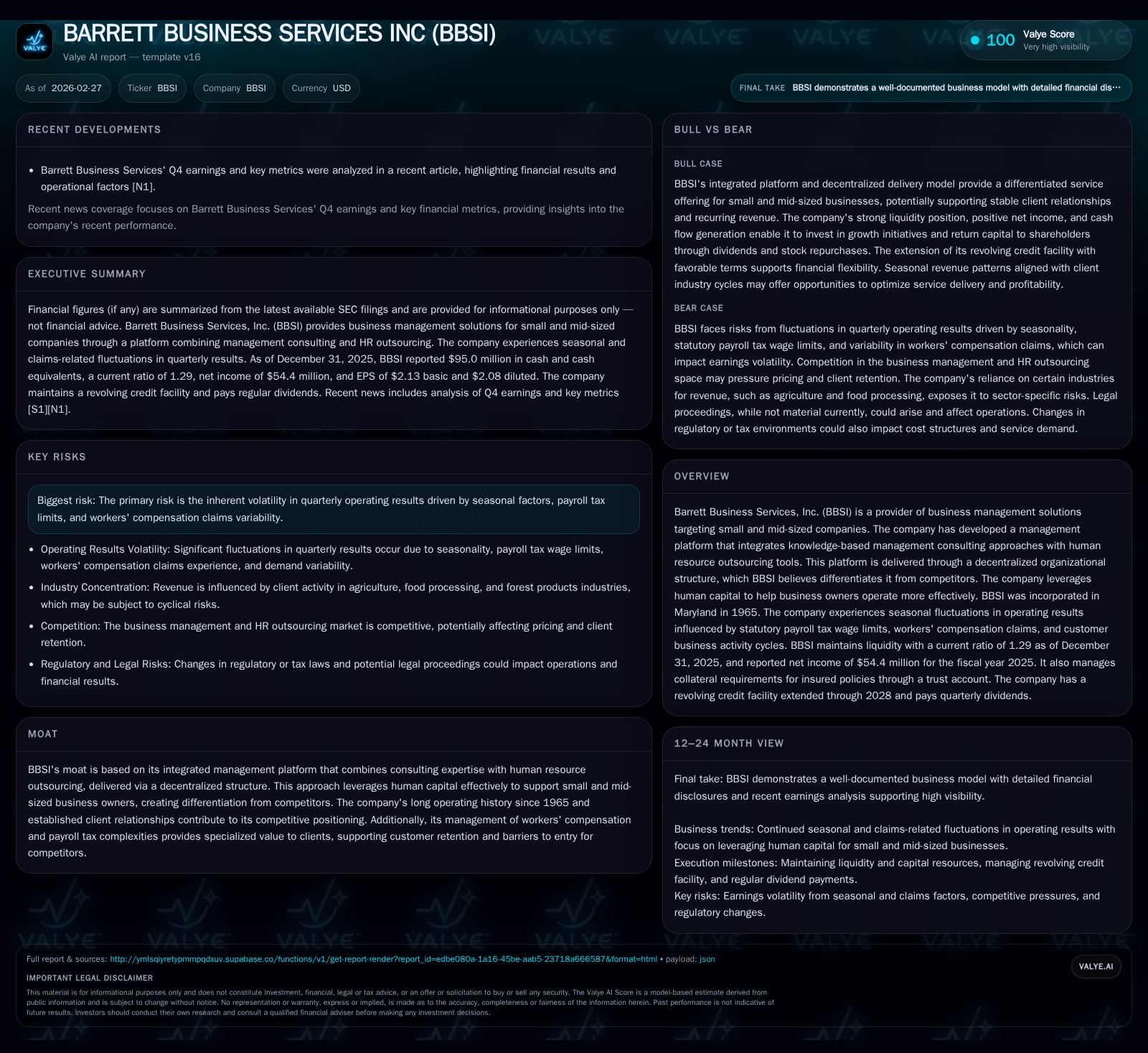
Barrett Business Services, Inc. (BBSI) combines knowledge-based consulting with human resource outsourcing in a decentralized structure serving small and mid-sized companies since 1965. Its integrated platform supports effective business operation while driving steady revenue and income growth despite seasonal volatility due to payroll tax wage limits and workers’ compensation claims. Strong free cash flow enables disciplined capital allocation through dividends and share repurchases, underpinned by solid liquidity and risk management.
Foundation of Decentralized Human Capital Management: Company Background and Moat
Barrett Business Services, Inc., incorporated in Maryland in 1965, has carved out a distinctive niche by combining management consulting's knowledge-based approach with the operational tools from human resource outsourcing. Its decentralized organizational structure is key to this differentiation, enabling localized leveraging of human capital to support small and mid-sized businesses more effectively than centralized competitors [S1][S6]. This integrated platform not only helps clients navigate increasingly complex statutory payroll tax obligations but also controls the variability inherent in workers' compensation administration.
The company's long track record spanning six decades underscores its deep client relationships and entrenched position within its target markets. By managing the complexity of both consulting advisory functions alongside transactional HR outsourcing activities, BBSI fosters high client retention, which creates a meaningful barrier to entry for new entrants lacking this dual expertise.
Historical Financial Performance: Revenue, Operating Income, and the Role of Seasonal Drivers
Over recent years, BBSI has demonstrated consistent financial growth supported by its integrated service offerings. Revenues increased from approximately $175 million in FY2014 to $244.7 million in FY2025, reflecting a compound growth trajectory augmented by rising demand for outsourced business management solutions [F1]. Operating income also saw steady improvement, rising by about 4% year-over-year in FY2025 to reach $62.2 million.
Seasonality significantly influences quarterly earnings as statutory wage base limits on federal and state unemployment taxes reduce payroll tax expenses as the year progresses [S1][S5]. Additionally, higher customer business activity during Q3—particularly relating to agriculture, food processing, and forest products industries—produces top-line variability. Fourth-quarter revenues may face softness due to holiday-shortened calendars across many client operations.
The table below summarizes BBSI’s annual financial performance over six recent years:
Historical performance (annual)
| FY | Net ($mm) | CFO ($mm) | OpInc ($mm) | Net YoY |
|---|---|---|---|---|
| 2025 | 54 | 66 | 62 | +2.7% |
| 2024 | 53 | 10 | 60 | +4.7% |
| 2023 | 51 | 67 | 61 | +7.1% |
| 2022 | 47 | 28 | 59 |
Source: SEC companyfacts cache [F1].
Capital returns and efficiency (annual)
| FY | Div ($mm) | Buybacks ($mm) | ROE% |
|---|---|---|---|
| 2025 | 8 | 42 | 22.6 |
| 2024 | 8 | 29 | 23.9 |
| 2023 | 8 | 34 | 25.4 |
| 2022 | 9 | 47 | 26.6 |
Source: SEC companyfacts cache [F1].
Note: ‘-’ indicates data not available; YoY denotes year-over-year percentage changes where calculable.
Operational Volatility: How Payroll Tax Limits and Workers’ Compensation Impact Quarterly Fluctuations
BBSI explicitly highlights that quarterly operating results fluctuate materially due to several factors primarily related to statutory payroll tax wage base limits and workers’ compensation claims dynamics [S1][S5]. Payroll tax costs decline through the calendar year as employee wages surpass federally defined caps on Social Security and unemployment taxes per employee.
Simultaneously, workers' compensation expense changes arise from both the frequency/severity of injuries reported and the evolving estimates for prior claim liabilities—referred to as loss development—which can substantially swing expense recognition quarter-to-quarter.
Moreover, customer industry seasonality—especially within agriculture-related sectors—inflates Q3 revenue levels due to peak business activity, while Q4 often registers lower working days from holiday schedules reducing demand for BBSI's services.
Strategic Growth Prospects: Navigating Market Demand for Small & Mid-Sized Business Solutions
Looking ahead, demand drivers hinge on the increasing complexity faced by small and mid-sized businesses surrounding payroll tax compliance, regulatory reporting, and workers' compensation risk mitigation [N9][S3][S6]. BBSI's integrated platform which blends consulting insights with outsourcing delivers a streamlined solution addressing these pain points.
This integrated delivery model benefits from recurring revenue streams tied to ongoing administrative support plus consultative engagement fostering stickiness among clientele [S6]. As regulatory requirements evolve, clients lean more heavily on expertise embedded within platforms like BBSI's that can adapt quickly at scale without necessitating internal capability builds.
Capital Deployment Strategy: Share Repurchases, Dividends, and Free Cash Flow Generation
Strong cash generation characterizes BBSI’s financial discipline with operating cash flow reaching nearly $66 million in FY2025 compared to just over $10 million the prior year—a more than fivefold increase driven largely by net income growth and changes in working capital balances [F1][S1]. After investing almost $19 million in capital expenditures primarily relating to property, equipment, and software upgrades during the same period,[F1] BBSI retained robust free cash flow near $60 million.
This ample liquidity supported aggressive shareholder returns including approximately $42 million deployed into common stock repurchases and steady dividend distributions totaling about $8.2 million in FY2025 [F1][S17][S21]. These moves align with the company’s targeted return on equity figure near 22.6%, demonstrating efficient capital utilization while maintaining balance sheet strength.
Liquidity Structure and Risk Management: Managing Collateral Accounts and Revolving Credit Facilities
Liquidity stood sound at year-end with over $95 million held in unrestricted cash plus an additional roughly $175 million of trust account collateral linked directly to workers’ compensation policies administered under insured programs [S1][S5]. These restricted funds provide assurance toward regulatory compliance while underpinning claim obligations.
In September 2025, BBSI extended their revolving credit facility maturity from July 2026 through August 2028 with reduced unused commitment fees signaling enhanced cost efficiency on undrawn bank lines offering operational flexibility should market conditions require additional funding [S10][S11].
The current ratio measured at approximately 1.29 confirms adequate short-term asset coverage versus liabilities supporting ongoing claims payments volatility management intrinsic to their business model.
What To Watch: Key Milestones, Earnings Expectations, and Risk Factors Ahead
Market watchers should closely monitor how BBSI navigates continued quarterly seasonality impacts driven by statutory payroll tax limits shifts or evolving works’ comp claims experience which remain predominant risk vectors affecting earnings stability [N1][N9][S4][S8][S12][S19]. Regulatory changes introducing new reporting or compliance mandates could pose execution challenges or open competitive dynamics altering market share trends.
Earnings releases issued early each quarter provide critical insights into loss development trends on prior periods’ workers’ comp claims alongside client activity cycles that influence revenue trajectories [N1]. In addition, incremental management commentary around capital deployment plans or margin expansion initiatives will shed light on strategic execution effectiveness.
In summary, Barrett Business Services sustains a differentiated value proposition via its integrated consulting-anchored HR outsourcing model deployed through decentralized human capital leveraging that supports consistent growth and strong returns amid notable operational cyclicality inherent in this sector.
Disclaimer: This analysis is for informational purposes only without any investment recommendation or endorsement of any kind.
Disclaimer: This is research-only, informational analysis and not investment advice. It may include AI-generated interpretation and general industry context. Always verify important details using primary sources.

Comments