
BioAtla’s Strategic Crossroads: Platform Promise, Clinical Progress, and the Pressure of Severe Liquidity Constraints
The company’s future now hinges on both scientific and corporate inflection points.
The company’s platform and pipeline offer scientific promise, but execution risk is now dominated by capital scarcity and the outcomes of ongoing strategic review. [S2]
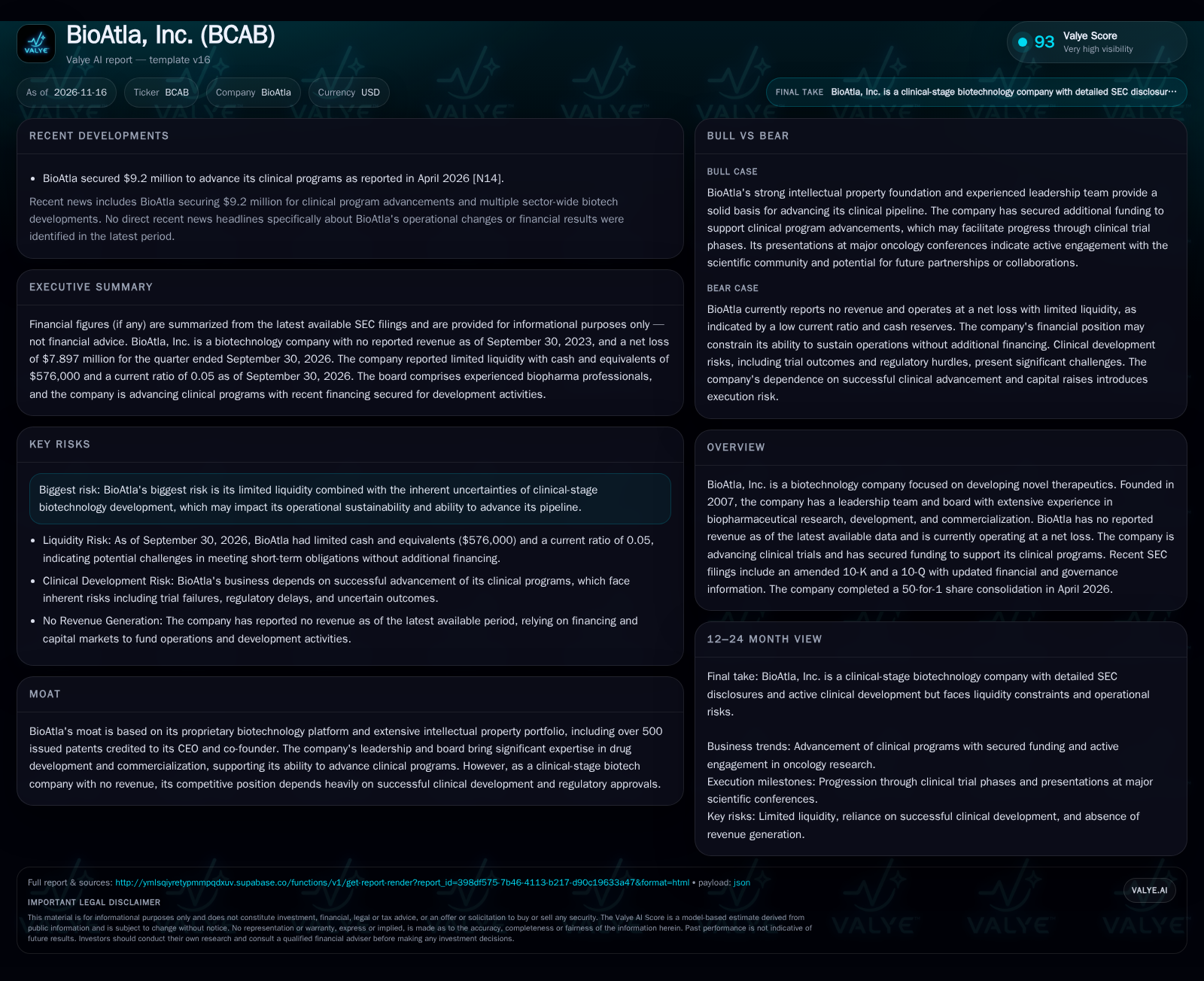
BioAtla, Inc.—once positioned as an innovative oncology biotech with a proprietary antibody platform—now finds its future in jeopardy, not from a lack of scientific ambition, but from an acute lack of capital. Despite a patent-rich platform and ongoing clinical trials, the company’s $576,000 cash balance and 0.05 current ratio as of September 30, 2026, underscore a make-or-break moment. A formal strategic alternatives process is underway, with options ranging from asset sales to partnerships or even a full sale of the company. The next chapter for BioAtla will be defined as much by deal-making and financial engineering as by clinical data.
Severe Liquidity Crunch and Strategic Review Define BioAtla’s Immediate Outlook
The company reported cash and liquidity metrics for the period; these figures do not by themselves establish operating runway, investment capacity, financial flexibility, or financing capacity. The company reported a net loss of $7.897 million for the period, and has not generated revenue, consistent with its status as a clinical-stage biotech. [S2]
In March 2026, the board initiated a formal process to evaluate strategic alternatives, which could include asset sales, licensing, partnerships, or other corporate transactions. There is no assurance that this process will yield any deal, and the company explicitly acknowledges that failure to secure a transaction or new capital could result in cessation of operations or bankruptcy protection. [S2]
To conserve cash, BioAtla has implemented a reduction in force and other cost-containment measures, and is not currently party to legal proceedings expected to materially impact its financials. [S2]
How BioAtla’s Platform Could Create Value—If It Survives to Commercialization
BioAtla’s business model is predicated on the development and eventual commercialization of its proprietary CAB (conditionally active biologic) antibody platform, designed to selectively target tumor cells while minimizing toxicity to healthy tissue. The platform’s unique pH-based targeting mechanism could, if validated in late-stage trials, enable BioAtla to address tumor antigens previously inaccessible to conventional antibodies.
As a pre-commercial biotech, BioAtla currently generates no revenue and funds operations through external capital. The economics of such a platform, if successful, are attractive: high gross margins on marketed biologics, significant licensing or partnership revenue potential, and the possibility of milestone payments or royalties from collaborations. However, fixed R&D and G&A costs are high and largely insensitive to early pipeline attrition, resulting in negative operating leverage until a late-stage asset is partnered, licensed, or commercialized.
Capital needs are substantial and recurring. Without revenue, the company is wholly dependent on capital markets, partnership proceeds, or asset sales to fund clinical activities, regulatory submissions, and eventual commercialization. Delays or failures in clinical advancement can rapidly erode remaining resources and force value-destructive decisions.
Platform Differentiation vs. Sector Realities: Intellectual Property and Execution Risk
BioAtla’s moat is based on its proprietary CAB technology and an extensive patent portfolio, with over 500 issued patents credited to its CEO. This intellectual property, combined with management’s deep experience in oncology drug development, forms the backbone of its competitive positioning.
However, the clinical-stage oncology space is intensely competitive, with numerous companies—both large pharma and venture-backed biotechs—pursuing antibody-based therapeutics for solid tumors. The key differentiator for BioAtla is its pH-dependent binding mechanism, which may reduce off-tumor toxicity and allow targeting of antigens previously deemed unsuitable for antibody therapy.
That said, the practical barrier to competition is conditional on successful clinical validation and sufficient capital to reach pivotal data. In the absence of commercial-stage products, BioAtla’s platform value is vulnerable to fast-followers, larger competitors with deeper resources, and the ever-present risk of clinical or regulatory setbacks. The company’s OTCQB listing and ‘penny stock’ status further limit access to institutional capital and may deter potential partners.
Pathway to Value Creation: Strategic Deal or Clinical Breakthrough as Catalysts
The most favorable scenario for BioAtla would be the successful execution of a strategic transaction—such as a license, partnership, or asset sale—providing enough non-dilutive capital to sustain operations and advance leading candidates through key clinical milestones. A deal with a larger biopharma could validate the platform, bring in upfront cash, and de-risk future development costs.
Alternatively, positive clinical data from ongoing Phase 1/2 programs could catalyze renewed investor interest, enabling a capital raise on more favorable terms or triggering partnership discussions. The company’s presentations at major oncology conferences suggest continued engagement with the scientific community and potential suitors.
Evidence that would confirm the upside scenario includes a disclosed partnership, asset sale, or licensing agreement with material upfront funding; successful closing of a capital raise sufficient to fund at least 12 months of operations; or the announcement of compelling clinical data that draws interest from strategic or financial investors.
Survival Hinges on Near-Term Financing or Asset Monetization
The most plausible middle path is that BioAtla manages to secure a modest capital infusion—via equity, convertible debt, or a small asset transaction—buying limited runway to continue operations and advance its most promising programs. Cost containment, including the recent reduction in force, may slow cash burn but does not eliminate the need for external funding.
This scenario likely entails further dilution for existing shareholders and continued uncertainty, as the company remains dependent on timely execution of clinical milestones to attract larger-scale partners or investors. The risk of operational shutdown is deferred but not eliminated.
Confirmation would come from public disclosure of a financing event, bridge loan, or near-term partnership. Falsification would be evident if the company fails to announce new funding or a strategic deal within the next quarter, or if cash balances fall below operational minimums without clear external support.
Failure to Secure Capital or Partner Forces Operational Shutdown or Bankruptcy
The adverse scenario is that BioAtla’s efforts to secure funding or strategic transactions fail, leaving the company unable to meet payroll, vendor, or clinical trial obligations. Given the reported cash balance and high current liabilities, the window for action is extremely limited.
In this outcome, BioAtla would likely be forced to wind down operations, pursue bankruptcy protection, or liquidate assets at distressed valuations. Clinical programs would be halted, and intellectual property or assets could be sold piecemeal, likely yielding minimal recovery for equity holders.
Indicators confirming the downside would include missed payroll, vendor disputes, SEC filings warning of imminent cessation of operations, or an explicit bankruptcy filing. Lack of any funding or partnership news in the next quarter would increase the probability of this scenario.
Milestones and External Levers That Will Determine BioAtla’s Next Chapter
Disclosure of any strategic transaction (partnership, asset sale, or licensing deal) with meaningful upfront cash or non-dilutive funding.
Completion of a financing round or bridge loan sufficient to fund operations for at least the next two quarters.
Updates on ongoing Phase 1/2 clinical trials, including interim data or conference presentations that could attract partner interest.
Progress or setbacks in cost containment measures and their impact on projected cash burn (if disclosed).
Changes in board or management composition that might signal impending transactions or new strategic directions.
Any SEC filings or public disclosures indicating going-concern warnings, asset impairments, or operational shutdown plans.
A useful metric would be updated cash and current liability figures in the next quarterly filing to gauge remaining runway.
Disclaimer: This is research-only, informational analysis and not investment advice. It may include AI-generated interpretation and general industry context. Always verify important details using primary sources.

Comments