
BioForce Nanosciences' Operational and Financial Struggles Reveal Challenges in Nutritional Supplements Market
Latest quarterly disclosures spotlight BioForce Nanosciences’ severe liquidity constraints and ongoing absence of revenue as it attempts to commercialize natural supplements.
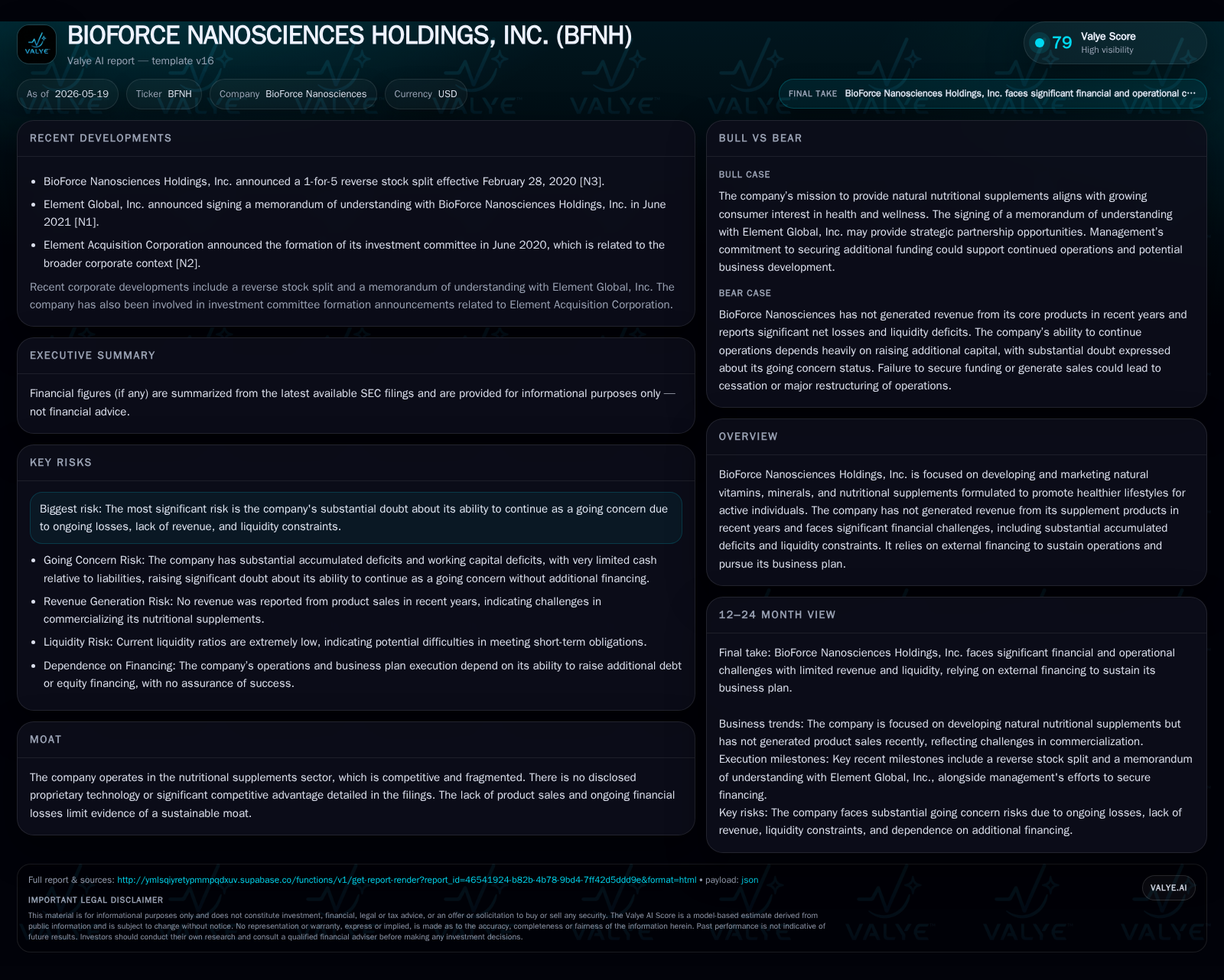
BioForce Nanosciences Holdings, Inc. reported zero revenues and a critically low current ratio of 0.01 as of Q1 2026, reinforcing its precarious liquidity position. Its business model centers on natural vitamins and nutritional supplements aimed at promoting active lifestyles but lacks any recent sales traction or product market penetration. Operating losses and accumulated deficits exceed $162 million, with survival hinging on obtaining new capital amid a highly fragmented and competitive nutritional supplements sector. Key operational risks stem from insufficient working capital, going concern qualifications, and execution uncertainties tied to fundraising success.
Latest Quarterly Filing Underscores Critical Liquidity Crunch
BioForce Nanosciences Holdings' latest SEC Form 10-Q for the quarter ended March 31, 2026 ([S2]) starkly highlights its dire financial footing. The company reported cash and cash equivalents of only $6,347 against current liabilities tallying approximately $727,301, yielding a dangerously low current ratio near 0.01 [F1]. This extreme working capital deficit signals immediate liquidity pressure that threatens ongoing operations without substantial new funding. No revenues were recorded during this quarter or prior reporting periods, confirming that BioForce has yet to begin monetizing its core supplement products [S2], [F1].
The operating backdrop shows persistent cash burn without offsetting inflows, intensifying risk around the company’s ability to continue as a going concern. The magnitude of its liabilities relative to assets serves as a principal financial constraint that overshadows any product or market ambitions currently pursued.
Business Model Focused on Natural Supplements with No Recent Sales
According to the company's latest annual report (Form 10-K filed April 15, 2026 [S1]), BioForce Nanosciences aims to establish itself as a provider of natural vitamins, minerals, and nutritional supplements formulated especially for active individuals across age groups. Its portfolio includes powders and beverages designed to promote healthier lifestyles. The flagship offering is the "BioForce Eclipse" vitamin supplement product; however, there have been zero unit sales reported for both FY2025 and FY2024 [S1]. This complete lack of market traction raises considerable concerns about product-market fit and commercialization execution.
Revenue generation mechanics—critical in understanding the business model—are currently non-functional. The company earns money by selling formulated supplement products directly or via distribution channels but has yet to secure paying customers or generate meaningful volume. Margins remain theoretical given no unit sales occurred during the last two years [S1]. The customer proposition targets health-conscious consumers demanding natural supplement solutions yet remains unproven due to the absence of actual product uptake.
Competitive Environment and Lack of Defensible Moat
BioForce Nanosciences operates within the highly fragmented nutritional supplements industry characterized by intense competition from numerous established brands and new entrants with varied formulations. According to Valye analysis (), there is no indication that BioForce possesses proprietary intellectual property or technology conferring sustainable competitive advantages. Without such differentiation or significant scale economies, pricing power is constrained.
The market context involves relatively low switching costs but high consumer awareness demands rigorous compliance with regulatory standards—a cost burden for smaller players. Supply chains are often diverse and not vertically integrated for many industry participants like BioForce, limiting control over cost structure or quality assurance in contrast with leading brands that command broad retail distribution and marketing budgets.
This environment makes entering and scaling in nutritional supplements daunting without differentiated formulas or robust capital backing to sustain promotional efforts.
Operational and Financial Risks Centered on Going Concern Doubts
Consistent warnings about BioForce’s viability permeate multiple filings indicating "substantial doubt" about its ability to continue as a going concern ([S1], [S5], [S9]). Key risk drivers include:
- An accumulated deficit exceeding $162 million reflecting cumulative operating losses since inception ([S1]).
- Year-over-year net loss growth culminating in nearly $1.3 million loss for FY2025 alone ([S5]).
- Negative operating cash flow exceeding $65k annually despite minimal overheads ([S5]).
- Heavy reliance on debt/equity financing accompanied by professional fees that further strain limited cash resources ([S9]).
Management’s disclosure emphasizes dependence on "additional funds by way of offering our debt or equity securities" as imperative for business continuity ([S1]). Although such financing strategies are standard for pre-revenue biopharmaceutical and nutraceutical start-ups, BioForce's entrenched losses combined with negligible operational momentum magnify execution risk substantially.
Growth Prospects Hinge on Successful Capital Infusions
Given zero recent product revenues or sales traction, business expansion hinges entirely on securing new capital sources sufficient to fund operations and push commercialization efforts forward ([S1], [S5]). There is an "oral commitment" from Chairman Merle Ferguson to provide temporary funding over the coming twelve months as an interim lifeline ([S5]), but this does not address longer-term capital needs.
Absent clear evidence of executed partnerships, marketing initiatives, or supply chain scale-up in filings, growth narratives remain speculative. Effective supplementation market entry typically necessitates considerable marketing expenditure coupled with R&D investment to innovate formulations that pass regulatory muster while delivering consumer value—activities which require tangible resources presently unavailable at scale.
Risks and Execution Watchpoints for Near-Term Viability
The most salient challenges involve achieving financial stability while attempting commercialization in a heavily regulated domain:
- Working capital constraints reflected by current ratio near 0.01 restrict the company's ability to finance day-to-day activities or fulfill operational obligations ([F1]).
- Zero revenues make it impossible to self-fund critical growth initiatives or absorb incremental fixed costs associated with scaling production or distribution ([S2], ).
- No secured contractual revenue streams or distribution partnerships disclosed further exacerbate uncertainty around customer adoption timelines ([S1]).
- Regulatory compliance in dietary supplements demands adherence to FDA labeling guidelines, quality controls under GMP practices, which may require costly certifications demanding time-sensitive investments ([S8], [S10]).
Failure in fundraising coupled with these structural obstacles could force cessation of operations or drastic strategic changes.
Key Upcoming Milestones and Capital Raising Efforts
Investor focus should pivot toward monitoring explicit announcements related to:
- Successful equity or debt financing completed on terms feasible enough to materially extend company runway beyond months.
- Attainment of first unit sales benchmarks signaling initial market acceptance of BioForce’s ‘Eclipse’ supplement line.
- Development progress updates including reformulations or registrations necessary for retail qualification.
- Changes in management strategy indicating shift from survival mode toward commercial execution.
Absent these concrete developments within upcoming reporting cycles or press releases, the company’s trajectory assumes elevated uncertainty.
Brief Current Financial Profile Reflecting Capital Constraints
As of March 31, 2026, BioForce held only $6,347 in cash against current liabilities exceeding $727,000 resulting in a highly unfavorable liquidity posture ([F1], [S2]). Revenues remain nil since at least 2019 with no gross profit benchmarks established due to zero unit sales reported through multiple years ([F1], [S9]). Operating expenses primarily comprise general administrative costs including professional service fees totaling nearly $67k annually—burdensome relative to minimal asset base ([S1], [S5]).
This combination leaves little room for unplanned expenditures or R&D investments without imminent external capital infusion. The pronounced working capital deficit encapsulates the existential challenge facing management.
This analysis underscores how BioForce Nanosciences Holdings confronts a tenuous position typical among nascent supplement companies struggling with capitalization hurdles amid cutthroat competition where proven market presence is paramount. Without material progress on fundraising milestones or genuine commercial validation soon, existential risks will continue dominating its outlook.
Disclaimer: This analysis is based solely on publicly filed SEC documents and company disclosures as of May 19, 2026. It does not constitute investment advice.
Disclaimer: This is research-only, informational analysis and not investment advice. It may include AI-generated interpretation and general industry context. Always verify important details using primary sources.

Comments