
Big Digital Energy Faces Capital and Nasdaq Listing Pressures Amid Strategic Pivot to AI and Energy Management
The company’s latest quarter reveals operational pivots and financial strains amid efforts to diversify beyond Bitcoin mining.
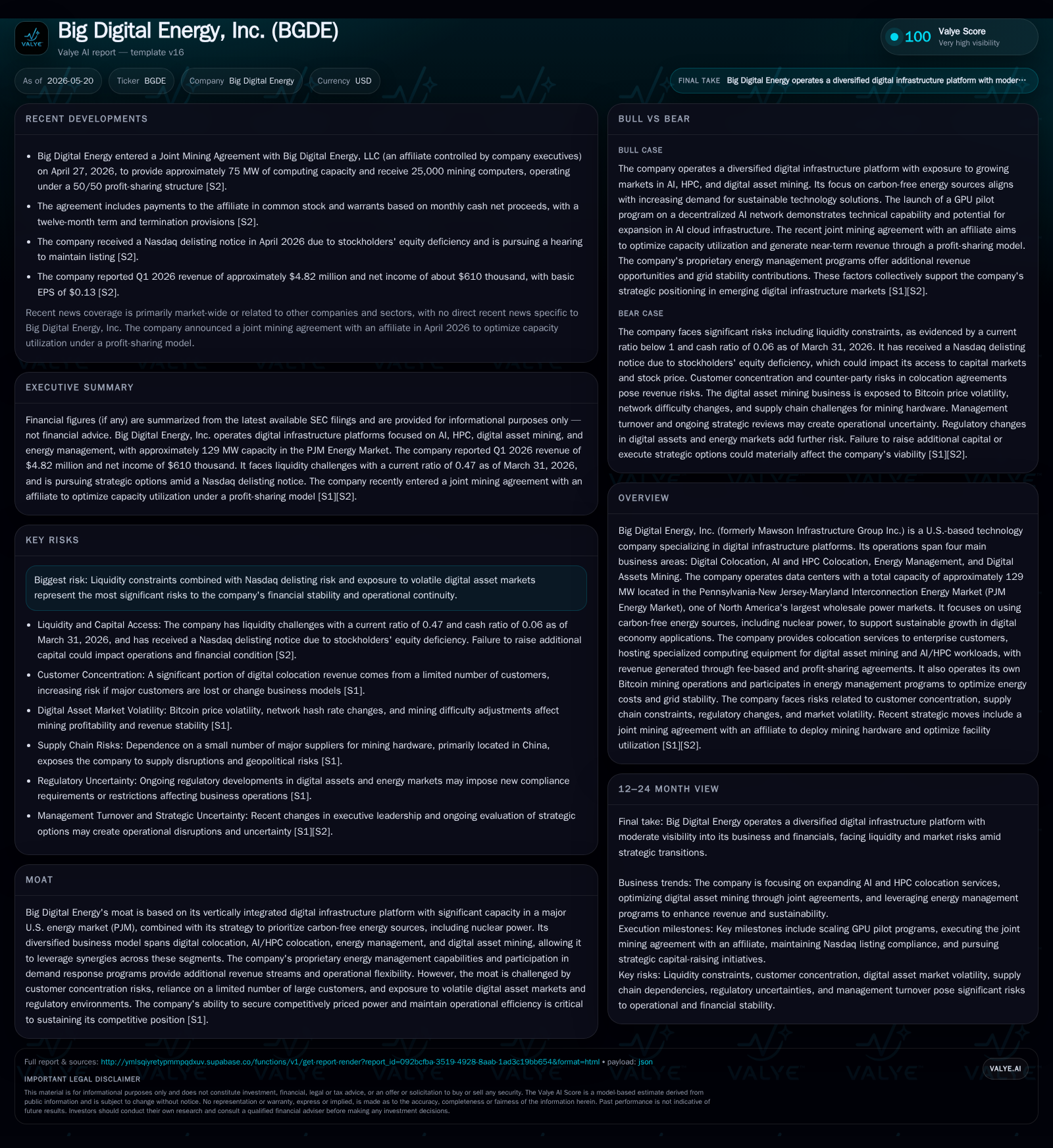
Big Digital Energy, Inc. (BGDE) reported its latest quarterly updates showcasing a strategic shift away from Bitcoin mining toward AI, HPC colocation, and energy management services. The firm entered a new joint mining and colocation agreement aimed at generating near-term revenue while monetizing excess capacity. However, the company faces significant liquidity challenges, highlighted by a low current ratio and ongoing Nasdaq listing compliance issues related to stockholders’ equity. These financial constraints coincide with high customer concentration risk and exposure to volatile digital asset markets, tempering near-term growth prospects.
Recent Operating Update
Big Digital Energy’s latest quarterly filing dated May 14, 2026 [S2] highlights pivotal changes in its operational approach alongside pressing financial headwinds. The company formalized its Joint Mining Agreement with Big Digital Energy, LLC on April 27, 2026 [S3], implementing a profit-sharing model where Big Digital retains all cash net proceeds from mining activities across its facilities while sharing profits equally with BDE through common shares issuance and warrants. This arrangement aims to generate immediate cash flow by capitalizing selectively on excess power capacity where economic conditions favor such mining operations.
The agreement modernizes the company's prior reliance on Bitcoin mining by shifting towards broader colocation services for AI and high-performance computing (HPC) workloads, reflecting the strategic evolution articulated in its March annual disclosure [S1]. The GPU pilot program launched in late 2025 demonstrated superior deep-learning benchmark performance compared to competitors and underpins this transition.
Critically, the company faces immediate Nasdaq compliance pressure. As disclosed in the May quarterly report [S2], on April 17, 2026 Nasdaq issued a delisting determination due to Big Digital's failure to meet minimum stockholders' equity requirements under Nasdaq Listing Rule 5550(b). Although the company requested a hearing which postpones further action temporarily, non-compliance threatens BGDE’s access to capital markets and amplifies investor uncertainty.
Meanwhile, liquidity metrics are weak. At quarter-end March 31, cash and equivalents totaled approximately $2.44 million against current liabilities of roughly $42.7 million [F1], yielding a precariously low current ratio of 0.47. This shortfall underscores pressing working capital deficiencies during ongoing operating losses reported at year-end December 31, 2025 [F1]. The firm must therefore urgently pursue capital raises or asset monetization strategies alongside operational stabilization.
Business Model and Product Relevance
Big Digital Energy operates as a vertically integrated digital infrastructure platform focusing on four core segments: Digital Colocation for specialized computing equipment including cryptocurrency miners; AI and HPC Colocation serving enterprise customers requiring advanced compute capabilities; Energy Management leveraging real-time power grid demand response programs; and self-operated Digital Assets Mining primarily targeting Bitcoin.
Revenue generation derives from two principal mechanisms within its colocation business: fee-based arrangements where customers pay for hosting services separately retaining mined assets; and profit-sharing agreements where the company shares revenues or gains directly from mining outcomes under aligned economic incentives. This dual approach allows modulation of risk profiles depending on market conditions or customer preference.
The company’s strategy explicitly prioritizes deployment in the Pennsylvania-New Jersey-Maryland Interconnection (PJM) wholesale power market — one of North America's largest energy hubs — enabling access to competitively priced carbon-free electricity sources, notably nuclear power [S1]. This environmental positioning aligns with growing corporate sustainability mandates while providing potential cost arbitrage against fossil-dependent peers.
Given the computational intensity of AI/HPC workloads alongside fluctuating profitability in digital assets mining markets, BGDE’s expanded colocation offerings seek to capture demand driven both structurally by AI cloud expansion and cyclically by cryptocurrency price volatilities.
Industry Structure and Competitive Position
The digital infrastructure landscape intersects critical sectors including data center operations, cryptocurrency mining facilities, energy management services, and cutting-edge compute hosting for AI/HPC applications. BGDE distinguishes itself via its substantial installed capacity (~129 MW), vertical integration across energy sourcing and compute hosting, and geographic positioning within PJM — providing advantageous access to wholesale power contracts.
Nonetheless, competitive pressures stem from large-scale hyperscale cloud providers expanding into dedicated AI infrastructure as well as specialized crypto-mining operators with lower-cost or more geographically diversified footprints. Customer concentration risks remain material; recent loss of a significant colocation client following acquisition by a competitor exemplifies vulnerability inherent in relying on few large customers [S1]
Energy procurement costs represent a critical differentiator; BGDE’s emphasis on carbon-free sources aims not only at regulatory alignment but also hedges against energy price volatility that has troubled many peers in higher-emission reliant regions.
Growth Drivers
AI/HPC Market Expansion: The successful scaling of GPU-focused programs positions BGDE to capture growth from enterprises increasingly outsourcing intensive compute workloads requiring specialized hardware setups unavailable or cost-ineffective via generalist cloud providers.
Energy Management Monetization: Participation in demand response programs provides supplementary revenue streams by optimizing consumption patterns responsive to grid needs — an emerging sector aligned with decarbonization initiatives.
Digital Assets Mining Optimization: While deemphasized structurally given volatility concerns, selective monetization of excess capacity via the joint agreement offers opportunistic revenue inflows tied directly to cryptocurrency network economics [S3]
Capacity Expansion: Securing additional development sites meeting stringent criteria (location, community acceptance, low-cost clean energy availability) remains integral for future scalability as demand for edge compute grows [S1]
Operational Efficiency Gains: Efforts ongoing to streamline labor costs relative to revenues alongside process improvements may enhance margins once scale efficiencies materialize [S13].
Risks / Watchpoints / Growth Constraints
Liquidity & Capital Access: The lack of sufficient near-term working capital juxtaposed against high current liabilities poses existential risks absent successful recapitalization or asset sales [F1][S12]. Dilutive equity raises could erode shareholder value further.
Nasdaq Listing Compliance: Delisting risk impairs confidence and restricts capital raising flexibility; outcome of hearing with Nasdaq will be critical near-term milestone [S2].
Customer Concentration: Dependence on limited clientele drives revenue volatility; client churn or contractual disputes have demonstrated materially negative impacts historically [S1]
Market Volatility Exposure: Fluctuations in digital asset prices impact mining profitability directly; regulatory uncertainties exacerbate risk in this segment [S1][S6].
Execution Risks in AI/HPC Transition: Emerging technologies require continued investment and timely development; market adoption rates are uncertain as is competitive response from hyperscale peers [S1].
Legal & Regulatory Matters: Outstanding litigation histories introduce potential financial liabilities and distract management resources [S4][S17]
Energy Costs & Regulation: While leveraging carbon-free power is strategic advantage, shifts in energy market dynamics or regulation could affect operational margins [S1].
What To Watch Next
- Outcome of the Nasdaq hearing regarding continued listing status: impacts stock liquidity and financing ability.
- Realization of revenue contributions from the Joint Mining Agreement with BDE during its initial twelve-month term.
- Progress updates on scaling AI/HPC colocation deployments beyond pilot phases including contract announcements or performance benchmarks.
- Capital raising efforts or asset disposition transactions designed to bolster liquidity metrics.
- Customer acquisition trends within colocation business segments affecting top-line stability.
- Regulatory developments impacting digital assets mining economics or energy market participation rules.
Financial Profile Brief Context
At fiscal year-end December 31, 2025, Big Digital Energy generated $39.8 million in revenue but posted an operating loss north of $19 million with net losses exceeding $23 million [F1]. Cash reserves stood at approximately $2.4 million as of March 31, 2026 against current liabilities over $42 million yielding an acute working capital deficit manifest in a sub-0.5 current ratio [F1]. Total debt is estimated around $28 million netting nearly $26 million after cash adjustments based on earlier data points [F1]. These factors confirm considerable financial strain needing near-term remediation via external funding or operational turnaround.
This analysis synthesizes recent disclosures through May 2026 filings without issuing investment advice. It reflects current operational developments within Big Digital Energy’s evolving business model amidst significant financial challenges characteristic of transitional digital infrastructure firms engaged across energy-sensitive compute sectors.
Disclaimer: This is research-only, informational analysis and not investment advice. It may include AI-generated interpretation and general industry context. Always verify important details using primary sources.

Comments