
Tribeca Strategic Acquisition Corp.: SPAC Economics, Deal Execution Stakes, and the Path to Value Creation
With a recent IPO, reported liquidity position, and no active operations, Tribeca Strategic Acquisition Corp. exemplifies a SPAC at the starting line—where success will hinge not on current financials, but on the quality, timing, and integration of its first business combination.
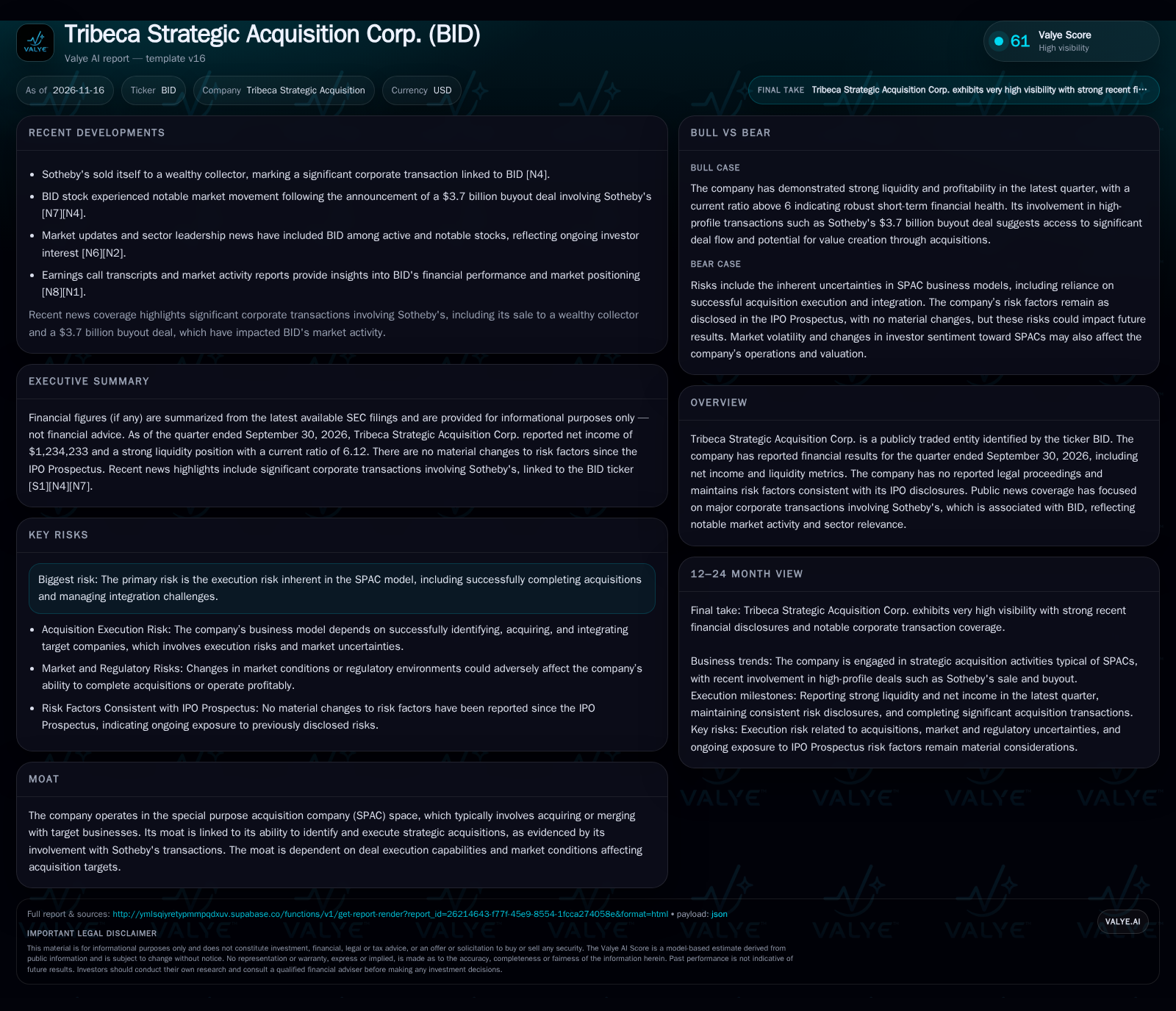
Tribeca Strategic Acquisition Corp. (BID) reported $1.23 million in net income for Q3 2026, driven by interest income on trust assets, and holds a current ratio of 6.12. Having completed its June 2026 IPO, Tribeca remains a pre-acquisition SPAC with no operating business. Its long-term outlook now depends entirely on acquiring and integrating a suitable target, with execution risk and SPAC market sentiment as key swing factors. No legal or regulatory developments have altered its risk profile since inception. The company’s next phase will likely define shareholder value—and expose it to the full risks and opportunities of the SPAC model. [S1]
Tribeca Strategic Acquisition Corp. (NASDAQ: BID) provides a textbook case of a newly public special purpose acquisition company (SPAC): flush with IPO proceeds, reporting reported liquidity position, and yet fundamentally unproven until a business combination is executed. As of September 30, 2026, Tribeca’s financials reflect a pre-deal SPAC—no operating revenues, net income derived from trust interest, and risk factors tied to the uncertainties of acquisition execution. With no legal or regulatory changes since its IPO and no target identified, Tribeca’s next moves—especially the selection and consummation of its first acquisition—will be decisive for shareholders. The company’s story now pivots from financial housekeeping to the high-stakes world of target selection, deal structuring, and integration.
IPO Proceeds, Trust Interest, and a Pre-Deal Status Define the Current Picture
Tribeca Strategic Acquisition Corp. closed its IPO on June 1, 2026, raising $140 million from the sale of 14 million units at $10 each, supplemented by a $4.7 million private placement. As of September 30, 2026, the company reported current assets of $514,173 against current liabilities of $84,000, resulting in a current ratio of 6.12. Net income for the quarter was $1.23 million, almost entirely attributable to interest earned on marketable securities held in trust. No operating revenues were recognized, and the company has not commenced substantive operations or identified a business combination target. All risk factors remain consistent with its IPO disclosure, and there are no reported legal proceedings or regulatory changes. These facts underscore Tribeca’s status as a SPAC in its pre-deal holding pattern, where short-term financial health is less relevant than the looming challenge of finding and executing a value-creating acquisition. [S1]
SPAC Economics: Trust Income, Dilution Mechanics, and the All-or-Nothing Acquisition Bet
Tribeca’s business model is typical of a SPAC: it raises capital via an IPO, places the proceeds in a trust account, and generates modest interest income while searching for an acquisition target. This structure means that pre-combination financials are largely irrelevant to long-term value; virtually all net income to date has been trust interest, not business operations. The company incurs ongoing costs for regulatory compliance, due diligence, and administration, which are offset by trust interest until the combination deadline approaches.
The core economic lever is the eventual acquisition—if a suitable target is identified and the deal is approved, the SPAC redeems public shares, merges with or acquires the target, and transitions into an operating company. The economics post-merger depend on the quality, growth prospects, and integration of the acquired business. However, deal dilution (from sponsor shares and warrants), potential redemptions by public shareholders, and acquisition costs can erode the value delivered to remaining shareholders. If no deal is consummated within the SPAC’s time window, funds are returned to shareholders minus expenses, and sponsors lose their at-risk capital. In this sense, SPACs like Tribeca operate with a high degree of operating leverage: most costs are fixed until a deal occurs, after which the economics shift entirely to the merged entity’s performance.
Deal Sourcing and SPAC Competition: The Challenge of Standing Out in a Crowded Field
Tribeca operates in a highly competitive SPAC landscape, where hundreds of blank-check companies are simultaneously seeking targets—often in overlapping sectors such as software, technology, AI, digital assets, and clean energy. The company’s potential advantage lies in its sponsor network, sector focus, and ability to secure attractive deal terms. However, competition for quality targets is intense, with private equity, established strategics, and other SPACs all vying for the same high-growth businesses.
The market’s recent volatility and evolving sentiment toward SPACs add further complexity. Many targets now demand higher valuations or more favorable deal protections, while PIPE (private investment in public equity) financing has become less certain. Tribeca’s ability to differentiate itself may hinge on sponsor credibility, speed of execution, and willingness to offer creative deal structures. Ultimately, the company’s competitive position is unproven until it announces a target and demonstrates the ability to close and integrate a deal under favorable terms.
How a High-Quality, Accretive Acquisition Could Unlock Shareholder Value
The most favorable scenario for Tribeca shareholders would be the identification and rapid execution of a business combination with a high-growth, well-managed target—ideally in a sector with structural tailwinds such as AI, digital assets, or clean energy. If the company can secure a deal at a reasonable valuation, minimize redemptions, and attract additional capital (e.g., via a PIPE), the merged entity could offer significant upside through operating leverage, public-market access, and strategic expansion.
Confirmation of this scenario would require a timely deal announcement with clear financial and strategic rationale, low public-shareholder redemptions, PIPE participation at or above trust value, and evidence that the target has a differentiated product or defensible market position. Conversely, a lack of credible deal flow, excessive dilution, or an overvalued target would falsify this bullish case.
Most Likely: Extended Search, Heightened Redemptions, and Moderate Deal Terms
The most plausible outcome for Tribeca, given the current SPAC market, is an extended search for a suitable target, followed by a business combination that attracts significant public-shareholder redemptions. In this scenario, the company may ultimately close a deal—likely in a crowded sector such as technology or clean energy—but with a less compelling valuation or capital structure due to market competition and redemption risk.
Evidence supporting this scenario would include incremental news of ongoing target evaluations, a deal announcement after several quarters, and a proxy process marked by elevated redemption rates. If disclosed, the presence of a PIPE at or below trust value, and a target with moderate growth prospects or limited differentiation, would further confirm the base case. A major deviation—such as a failed vote or deal collapse—would falsify it.
Deal Failure, Sponsor Capital Loss, and Potential Liquidation
The primary downside risk is failure to identify or close a business combination within the SPAC’s permitted timeframe, resulting in the return of trust proceeds to public shareholders and the forfeiture of sponsor capital. This outcome is plausible if market conditions deteriorate, quality targets become scarce or overpriced, or regulatory scrutiny increases. Shareholders would receive their pro-rata trust value (less expenses), while sponsors and early investors would lose their at-risk capital and any upside from a completed deal.
Indicators of this scenario include repeated extensions of the business combination deadline, lack of credible deal announcements, or regulatory challenges that delay or derail negotiations. If disclosed, mounting administrative expenses, a shrinking trust balance, or a failed shareholder vote would further corroborate the downside path.
What Will Determine Tribeca’s Trajectory as a SPAC
Announcement of a definitive business combination agreement, including target identity, sector, and deal terms.
Level of public-shareholder redemptions upon deal vote—if disclosed, a redemption rate below industry average would support a more optimistic outlook.
Ability to secure PIPE or other external financing at or above trust value to support the merger and ensure post-combination liquidity.
Quality and differentiation of the target company, as evidenced by disclosed growth metrics, margins, or competitive moat.
Regulatory or legal developments affecting the transaction process, particularly any changes in SPAC rules or shareholder litigation.
Timeline to deal execution and any requests for deadline extensions, which would signal either robust deal flow or difficulty sourcing targets.
Post-merger operating performance, if the business combination closes, including revenue growth, profitability, and integration milestones—if disclosed.
Disclaimer: This is research-only, informational analysis and not investment advice. It may include AI-generated interpretation and general industry context. Always verify important details using primary sources.

Comments