
Allbirds Transitions From Sustainable Footwear to AI Infrastructure: Reinvestment Risks and Opportunities
Following a $39 million asset sale of its core footwear business, Allbirds is repositioning as an AI infrastructure company, a move that redefines its business model but raises significant execution and market risks.
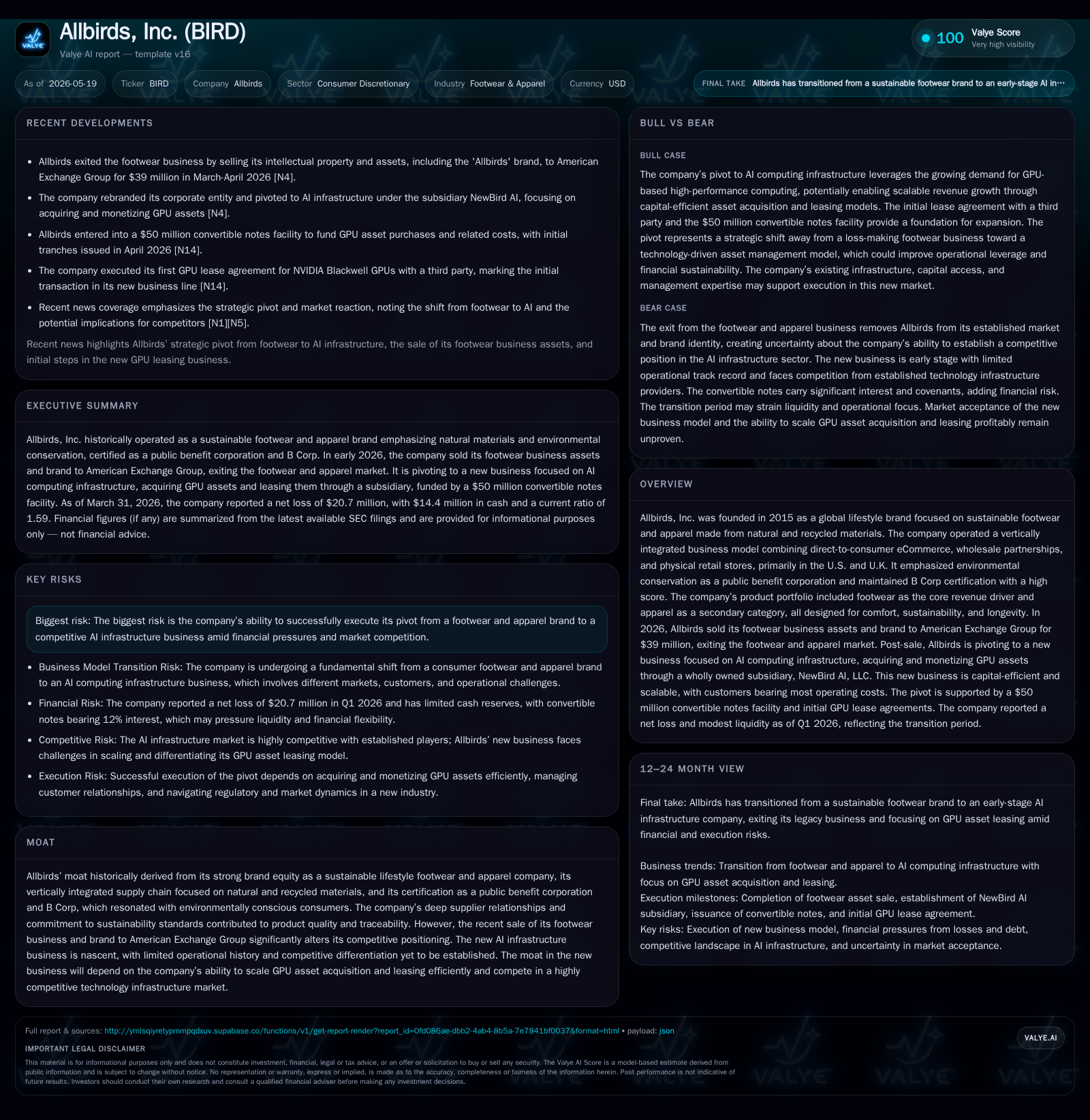
In early 2026, Allbirds executed a dramatic pivot by selling its flagship footwear and apparel business to American Exchange Group for $39 million, effectively exiting the consumer lifestyle market it helped define. The company is now focusing on building a GPU leasing and AI computing infrastructure operation through its NewBird AI subsidiary. This transition replaces its historically strong brand moat in sustainable footwear with a nascent tech infrastructure play, facing capital intensity and fierce competition from established cloud providers. While initial steps include convertible note financings and secured GPU leases, Allbirds must demonstrate rapid operational scalability and client traction to justify the strategic shift amid constrained liquidity and ongoing losses.
Latest Quarterly Operating Update: Asset Sale and Business Pivot Implications
In its Q1 2026 filing dated May 15 [S2], Allbirds disclosed the completion of a transformational asset sale with American Exchange Group for $39 million [S3], divesting substantially all its core footwear business and intellectual property tied to the "Allbirds" brand name. This decisive step marks the company’s exit from its founding consumer product segments after sustained unprofitability.
Post-transaction, Allbirds announced an ambitious pivot focused on AI computing infrastructure through a newly formed subsidiary NewBird AI LLC [S3]. The company is targeting acquisition and monetization of GPUs—highly specialized hardware essential for accelerating artificial intelligence workloads—via capital-efficient leasing arrangements designed to shift substantial operating costs to customers. The pivot represents a radical departure from Allbirds' previous vertically integrated sustainable lifestyle brand model towards a nascent technology infrastructure enterprise [S6].
Simultaneously, Allbirds arranged senior secured convertible notes financing up to $50 million to fund GPU asset purchases for NewBird AI operations, supplemented by an ATM equity offering capability announced April 29 [S23]. Initial traction includes a three-year lease valued at approximately $2.75 million of NVIDIA Blackwell GPUs leased to QumulusAI Inc., signaling early monetization efforts in GPU-as-a-Service (GPUaaS) [S24].
Legacy Business Model and Product Quality in Sustainable Footwear
Before the asset sale, Allbirds operated as a global lifestyle brand with vertically integrated direct-to-consumer (DTC) digital channels complemented by wholesale and physical retail stores concentrated mainly in U.S. and U.K. markets [S1]. Its competitive differentiation stemmed from innovation using natural materials like superfine ZQ-certified merino wool, tree fibers, and sugarcane composites that offered sustainability benefits along with comfort features such as temperature regulation and odor control.
The product portfolio centered on footwear—which accounted for majority revenue—and was supported by complementary apparel items adhering to the same ethos of durability and design simplicity [S1]. Sustainability credentials were institutionalized through Delaware Public Benefit Corporation status and B Corp certification received in early stages of growth, fueling consumer loyalty among environmentally conscious urban demographics willing to pay premium pricing
Marketing campaigns leveraged an organic strategy anchored on brand storytelling around environmental impact balanced against modern aesthetics, maintaining differentiated appeal in the competitive lifestyle footwear segment despite broader retail headwinds.
Industry Context: Competitive Dynamics in Footwear vs. AI Infrastructure Markets
The footwear industry’s barriers largely relied on strong branding equity combined with proprietary materials sourcing and supply chain integration that conferred moderate pricing power amid fragmented competition. Consumer switching costs existed primarily due to brand preference alignment with sustainability values rather than technological lock-in.
By contrast, the emerging AI infrastructure market that Allbirds now targets is intensely capital intensive and dominated by hyperscale cloud providers (e.g., AWS, Google Cloud), alongside specialized GPUaaS entrants who deploy extensive pools of cutting-edge GPU hardware coupled with robust network connectivity and software orchestration platforms. Success depends heavily on asset scale economics, operating efficiency in managing highly depreciable hardware assets subject to rapid obsolescence cycles, plus securing long-term contracts locking customers into leased capacity [N2][N4]
Entering this domain from legacy apparel operations entails ceding ownership of prior competitive moats related to supplier relationships or product uniqueness—instead requiring rapid accumulation of hardware inventory, operational expertise in leasing structures, maintenance commitments, usage optimization technologies, and customer trust within enterprise IT budgets.
Evaluating the Growth Drivers Behind Allbirds’ New GPU Leasing Strategy
Fundamental demand drivers underpinning GPU leasing stem from exponential growth in AI workloads across industries including machine learning training/inference models that demand massive parallel compute power unavailable without specialized GPUs.
Allbirds aims to build scale through purchasing GPUs funded via convertible notes placement and structuring leases designed so lessees absorb most operational costs (e.g., cooling, electricity), allowing scalable expansion without commensurate overhead increase [S6][S24]. Key near-term KPIs include:
- Volume of leased GPUs deployed versus purchase commitments,
- Lease contract terms featuring upfront rental payments or end-of-term purchase options,
- Customer diversification reducing concentration risk from reliance on single lessees,
- Improvement in utilization rates per GPU hardware,
- Margins on leasing activities relative to acquisition costs.
The initial transaction with QumulusAI confirms the model’s early operational stage but achieving meaningful market penetration requires ramping multiple similar deals swiftly amid competitive offerings by established cloud vendors bundling value-added services beyond raw hardware access.
Key Risks and Execution Challenges Amid Corporate Transformation
The abrupt transition exposes several substantial risks:
- Execution risk: Lack of operating history in tech infra leasing raises uncertainty regarding ability to efficiently acquire inventories at scale, maintain uptime/reliability standards critical for enterprise customers.
- Financial risk: Latest available information shows net losses approximately $80 million annually (2025) with cash reserves at $14.4 million against total debt near $17.4 million resulting in modest net debt (~$3 million) just before the pivot completion [F1][S2]. Large capital needs for GPU purchases may strain liquidity absent continued financing success.
- Competitive risk: Entrants must contend with entrenched hyperscalers wielding vast resources able to offer integrated ecosystems unmatchable by newcomers.
- Brand dilution: Abandoning the established sustainable footwear identity removes prior goodwill; building trust under new identity “NewBird AI” takes time.
- Market skepticism: Investor sentiment may impose elevated cost of capital due to perceived speculative nature of strategy change documented via proxy communications alongside amendments allowing significant equity dilution within next two years [S21].
What Investors Should Watch Next: Milestones, Financial Health, and Market Reception
Critical forthcoming events framing Allbirds’ trajectory include:
- Quarterly reports detailing revenues from NewBird AI leasing agreements showing volume uptick or expanded third-party lessee base [S27],
- Updates on additional tranches drawn under $50 million convertible note facility contingent upon Nasdaq stockholder approval,
- Progress report on ATM equity sales impacting liquidity buffer size post-pivot [S23],
- Management commentary on partnership developments or technology platform enhancements,
- Market reaction manifesting through share price action versus broader sector dynamics reflecting investor confidence.
Monitoring these operational markers will clarify whether Allbirds navigates successfully away from its legacy footprint toward credible participation in an entirely different industry.
Financial Overview: Balance Sheet Strength and Cash Burn Post-Pivot
As of March 31, 2026 balance sheet highlights show:
- Cash & equivalents: $14.4 million,
- Total debt: $17.4 million,
- Net debt roughly $3 million,
- Current assets at $64.7 million against current liabilities of $40.8 million yielding a current ratio near 1.59 indicating reasonable short-term liquidity cushions [F1]
Capital allocation decisions will need rigorous oversight given dual pressure points: preserving enough cash runway while aggressively investing in specialized GPU assets essential for establishing position within rapidly evolving AI compute landscape.
Disclaimer: This analysis is based solely on publicly filed documents including SEC disclosures up to May 19, 2026 combined with validated third-party news sources cited herein. It does not constitute investment advice or research views but offers an informed assessment grounded strictly in disclosed operating facts.
Disclaimer: This is research-only, informational analysis and not investment advice. It may include AI-generated interpretation and general industry context. Always verify important details using primary sources.

Comments